Sight · Afghanistan
Tepe Fullol Archaeological Site
Tepe Fullol is a Bronze Age burial site near Fullol in Afghanistan’s Baghlan Province. Its gold and silver vessel hoard established the first archaeological evidence for the Oxus civilization in Afghanistan.
Orientation
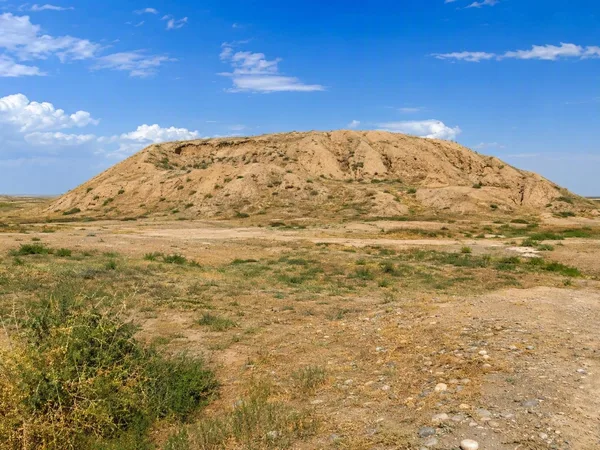
Tepe Fullol, also known as Khush Tepe, is an archaeological burial site in northern Afghanistan’s Baghlan Province. It lies near the village of Fullol, at the meeting of the Khost and Sai valley systems. The mapped point is a representative location, not a museum entrance: archaeological gazetteers place it at roughly 36.183° N, 69.317° E, with an accuracy margin of about two kilometres.
The site is a small mound and former burial context, not a monumental ruin. Its importance lies in what was recovered from it rather than in standing architecture.
The 1966 discovery
In 1966, farmers uncovered gold and silver vessels in a burial cache near Fullol. Local recovery efforts salvaged five gold vessels, seven silver vessels and fragments from further objects; some pieces had already been broken up when the find was divided.
Subsequent work identified a disturbed inhumation burial beneath ash and charcoal. This find gave Afghanistan its first archaeological evidence for the Oxus civilization, the Bronze Age cultural complex also called the Bactria–Margiana Archaeological Complex.
The original mound was modest in scale: about 14 metres long and 8 metres wide, against a rock face above the route toward Khost Ferenj. That contrast is central to Tepe Fullol: a low, easily overlooked place produced objects of exceptional historical weight.
Read the vessels
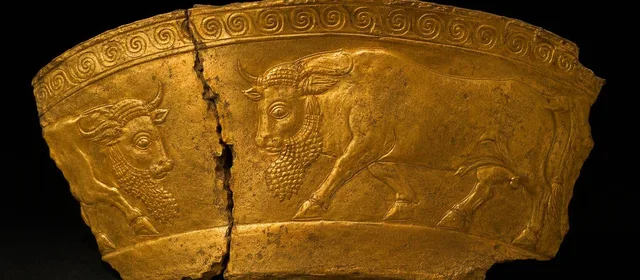
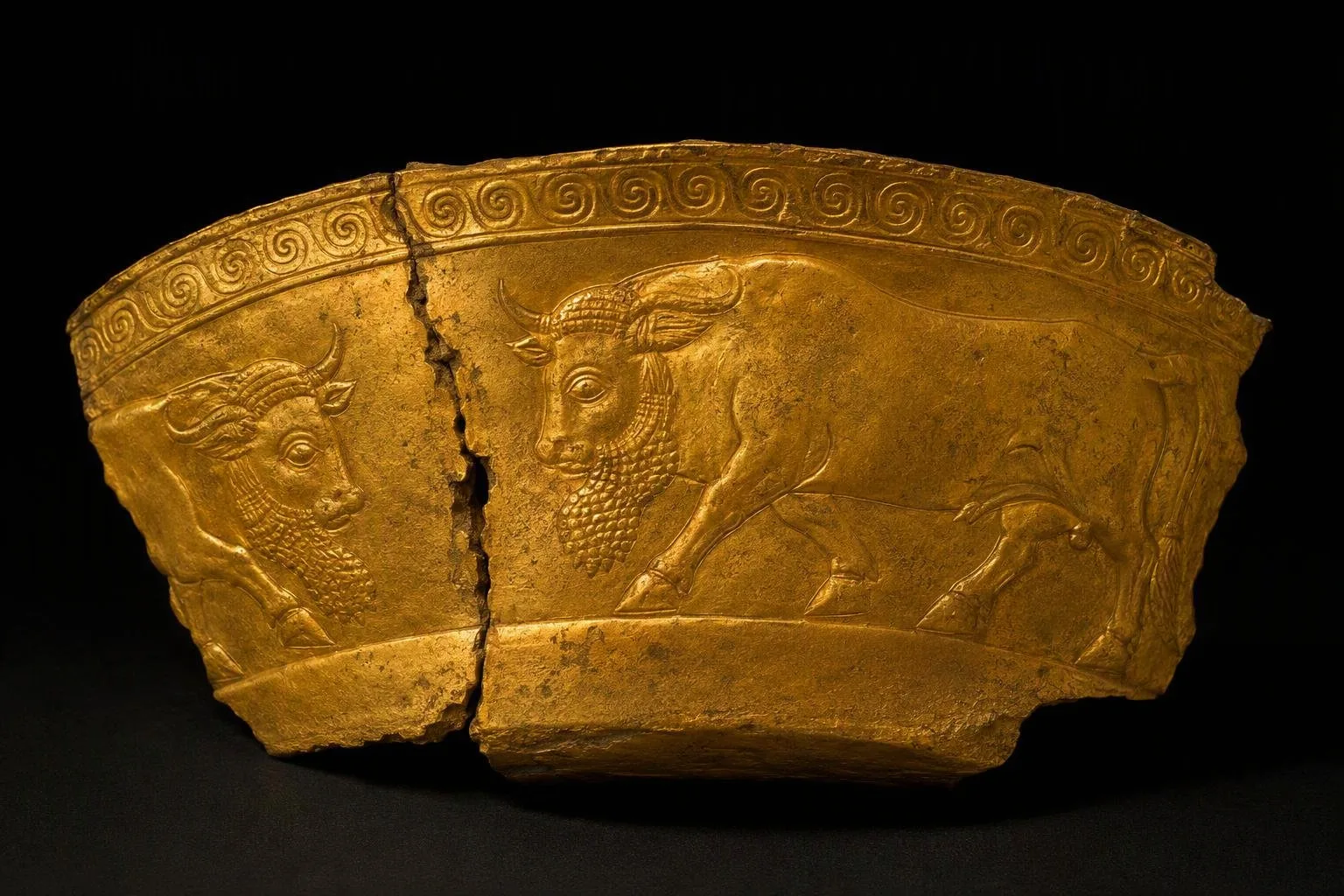
The surviving hoard is generally dated to the late third and early second millennium BCE. Gold and silver bowls carried carefully worked imagery, including a boar and bearded bulls with human faces. The bull imagery has close visual connections with Mesopotamian art.
Look past the precious metal. The vessels register a trade world extending well beyond this valley:
- Gold, silver, copper and carnelian circulated as high-value materials.
- Lapis lazuli from Badakhshan was a major export moving west through long-distance exchange networks.
- The hybrid imagery shows that northern Afghanistan was connected to Mesopotamia, Elam and the Indus world centuries before later Silk Road routes.
A gold bowl fragment with bearded bulls is the clearest single object to seek out in collection photography or exhibitions.
Site and collection
The excavated treasure belongs to the National Museum of Afghanistan in Kabul. Tepe Fullol itself should be understood as the archaeological origin of those museum objects, not as their display location.
Do not confuse it with Tillya Tepe, the separate first-century burial site in Jowzjan Province associated with the later Bactrian gold. Tepe Fullol is much earlier and belongs to the Bronze Age.
Treat the mound and any exposed material as protected archaeology. Do not remove fragments, disturb ground, or assume that the mapped coordinate identifies a marked public entrance.
From the magazine
Stories about Tepe Fullol Archaeological Site
Editorial stories linked directly to Tepe Fullol Archaeological Site.
No stories about Tepe Fullol Archaeological Site have been published yet.
Routes from our editors
Travel through Tepe Fullol Archaeological Site
Editorial routes connecting Tepe Fullol Archaeological Site with other countries, cities and hotspots.
No routes through Tepe Fullol Archaeological Site have been published yet.
More in Afghanistan
Related hotspots
Other cities, nature areas and places within Afghanistan.