Before the Bouquet: Bogotá’s Flower Trade at Paloquemao
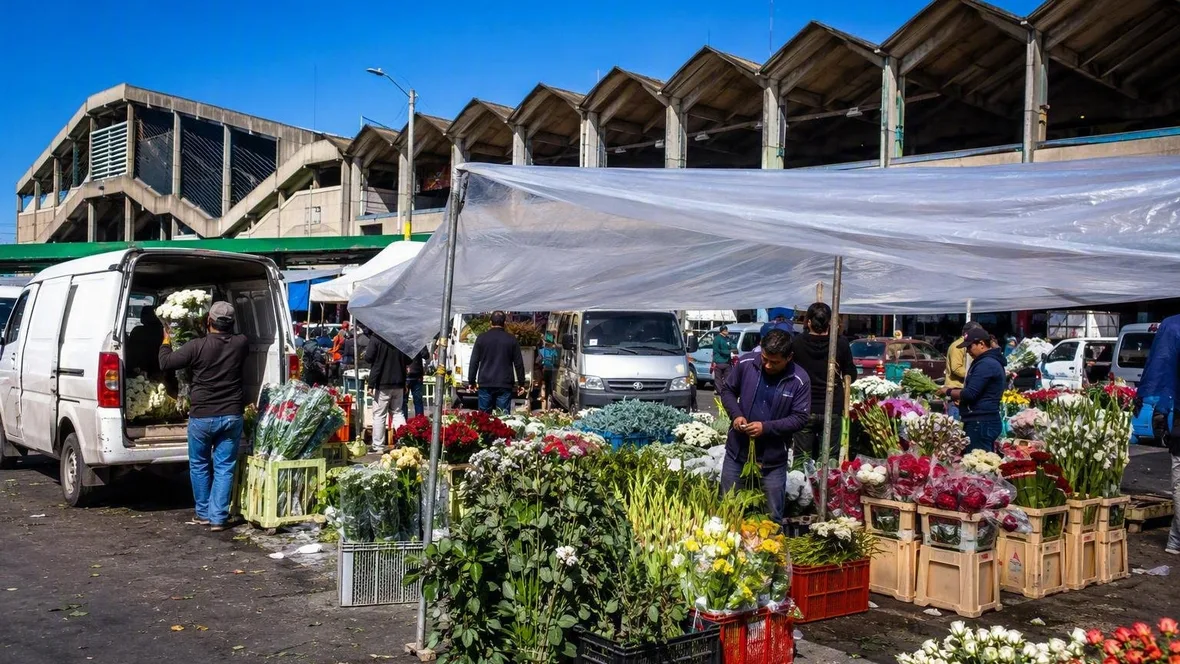
Each morning, flower sellers raise broad plastic covers over a parking area outside Mercado de Paloquemao. They trade there until early afternoon, when the stalls come down and the ground returns to cars.
A flower market that comes down each afternoon
Paloquemao’s flower trade does not sit in a picturesque aisle inside the main market. Sellers set up outdoors near Calle 19 and Carrera 27, in the southern parking area, where flowers share space with vans, small trucks, crates and people carrying goods. Traders put up the large plastic covers each morning and take them down again later in the day.
That daily work distinguishes the flower area from the permanent market beside it. Inside, households and businesses buy fruit, vegetables, meat, fish, dairy products, grains and herbs. Outside, growers, wholesalers, florists and families buy and sell cut flowers and arrangements. Paloquemao links Bogotá with the farms that supply the capital, and flowers form one part of that larger daily exchange.
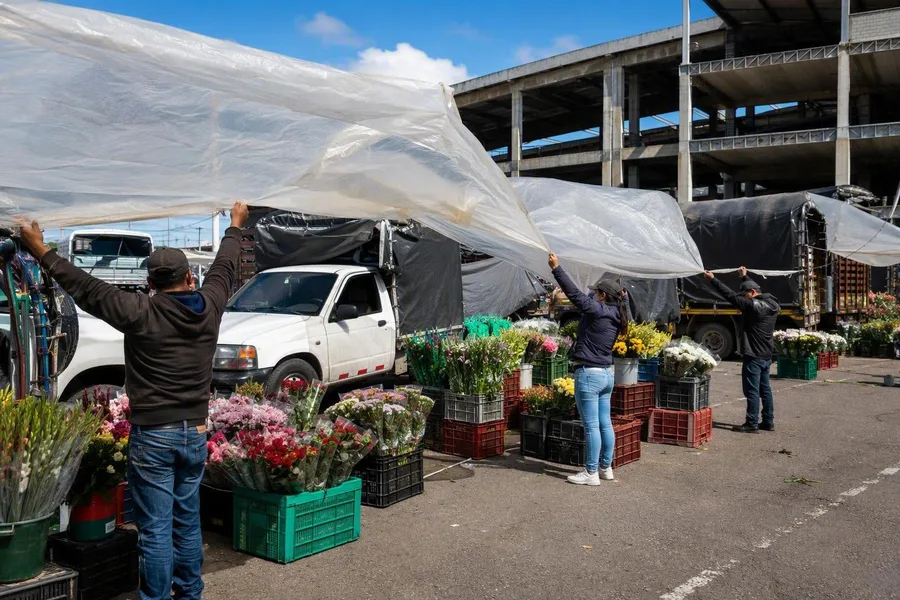 Flower sellers set up plastic-covered stalls beside crates and small trucks at Paloquemao.
The arrangement also cuts through the familiar image of Colombian flowers as polished export goods. At Paloquemao, cut stems arrive as perishable stock. Sellers arrange them for wholesale buyers, florists and people buying a few stems or a finished bouquet.
An unfinished market built for perishable goods
Bogotá developed Paloquemao while trying to bring scattered sales of perishable goods around Plaza España onto a single large site. The city chose land belonging to the national railways. Architects Dicken Castro and Jacques Mosseri began designing the current complex in 1962.
Construction stopped in 1967, before much of the plan had been built. Five years later, smaller retailers moved into the empty hall, while wholesale traders were directed to warehouses near the former Techo airport. The market opened on 16 July 1972.
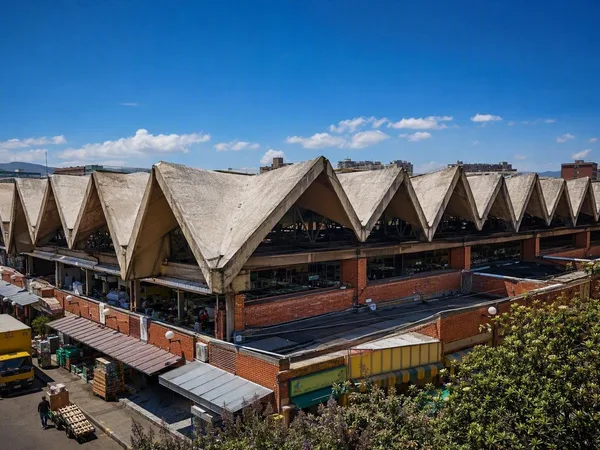
Castro and Mosseri designed a market for large flows of produce and people. A diagonal axis divided the site, and broad passages connected trading areas around patios and a central core. Supply corridors ran along the outer edge. Folded triangular roofs of prefabricated concrete rose above the original sales areas, set apart from the walls to admit indirect daylight. Fixed stalls used pale glazed brick and stood slightly above the walkways.
The full plan was never completed. Traders later used former patios for commerce, roofs covered open areas, and part of the complex took on the character of a large warehouse. The flower sellers concentrated outside the building and along the street, rather than in a dedicated indoor hall.
That history explains the working shape of the flower market. In the morning, the parking area serves as a sales floor, loading space and pedestrian route. By afternoon, the flower stalls have gone and cars use the ground again.
Roses from the Sabana
The clearest documented supply line begins on the Sabana de Bogotá, the high plain around the capital and Colombia’s principal area for cut-flower cultivation. Traders drive early to farms on the Sabana in vans or small trucks, then bring flowers to Paloquemao.
Cota provides a specific connection. Flower trader Marta Liliana Beltrán buys roses from a grower there, either loose or already packed. When she buys loose roses, a truck takes them to her home, where they are selected, ordered and packed. When she collects packed flowers, she first hydrates them in storage beside her home before taking them to Paloquemao.
The distinction matters because it keeps the market’s work in focus without inventing a hidden back room. The sources document sorting, packing and hydration before Beltrán’s roses reach Paloquemao; they do not document a separate sorting room or cold store inside the market. At the market, consignments arrive, sellers set them out at stalls, florists make bouquets, and traders sell both wholesale and by the stem.
Some flowers reach Paloquemao from farms around Cota, Chía, Madrid, Mosquera, Facatativá and El Rosal that also produce for export. Flowers that fail export specifications for size or colour can enter Colombia’s domestic trade as flor nacional and reach the market. Paloquemao therefore handles a local outlet from the same production landscape, not a miniature version of the whole national industry.
Roses, carnations and alstroemerias are among the documented goods, along with foliage and other cut flowers. The market matters less as a display of varieties than as a place where several buyers meet the same supply: a wholesaler ordering in volume, a florist restocking a shop, or a household choosing flowers for the week.
Florists, families and the week’s trade
The customers change over the week. Buyers from outside Bogotá arrive especially on Tuesdays, Thursdays and Fridays. Traders from other parts of the city also come early to stock their own businesses. Lucila Martínez buys carnations, roses and alstroemerias at Paloquemao for resale at her flower stand near Avenida Cali and Calle 80.
Businesses in the market make arrangements and send wholesale orders to florists and events. Later in the morning, private customers buy flowers for homes and other spaces. On Sundays, families buy flowers for the home and for cemetery graves.
This is ordinary urban provisioning, though the purchases do not serve the same purpose. The covered market supplies food. The outdoor flower area supplies a florist’s counter, an event arrangement, a home and a grave. During International Women’s Day and Mother’s Day, supply can tighten and prices can rise.
The trade also leaves a material trace. Dozens of people sell flowers outside the market along Calle 19 each day, and discarded flower matter has become conspicuous there. Perishable goods do not stay fresh by force of colour.
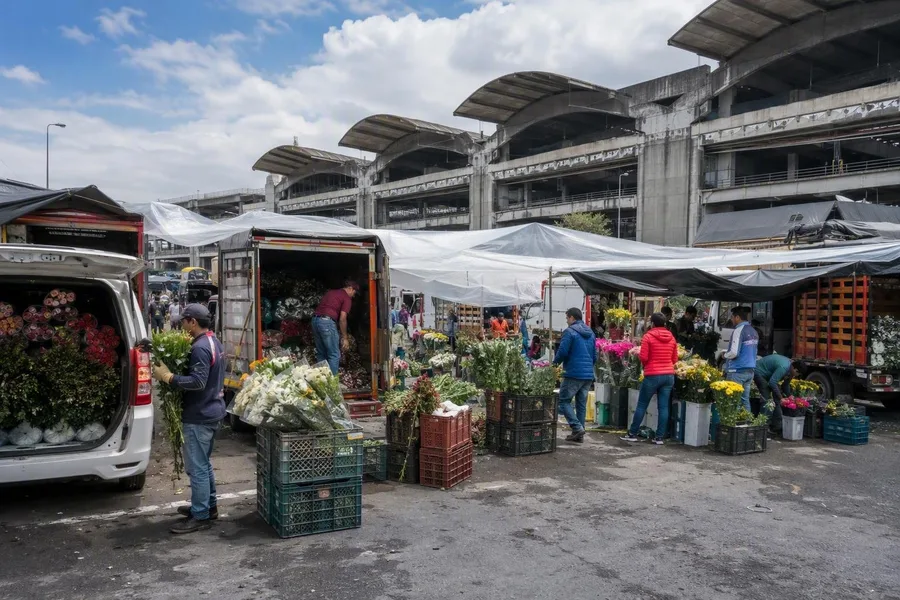 Flower consignments arrive beneath plastic covers in Paloquemao’s parking area near Calle 19.
Practical details
Mercado de Paloquemao stands at Avenida Calle 19 No. 25-04, and admission is free. The main market opens Monday to Saturday from 4.30am to 4.30pm and on Sundays and public holidays from 5am to 2.30pm; the market only guarantees the flower area until 11am, while individual florists may keep different hours. SITP buses run along Avenida Calle 19, and the TransMilenio stop at CAD lies several blocks north; drivers enter via Carrera 25. No fixed market price is published. An online delivery catalogue listing flowers from Paloquemao gave prices of COP 33,900 for 24 red roses and COP 45,200 for 24 roses in other colours.
The morning arrival at Calle 19
The flower area appears with the morning’s deliveries. Vans and small trucks bring consignments into the southern parking area, where sellers unload them and arrange flowers beneath the plastic covers. Crates stand among the vehicles while people carry goods across the same patch of ground. For a few hours, cut stems cover the asphalt outside the unfinished concrete market.
Keep exploring