Sight · Hungary
Chain Bridge
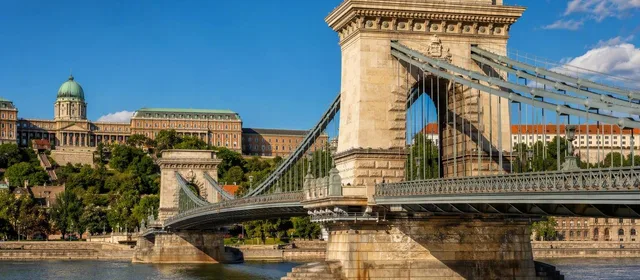
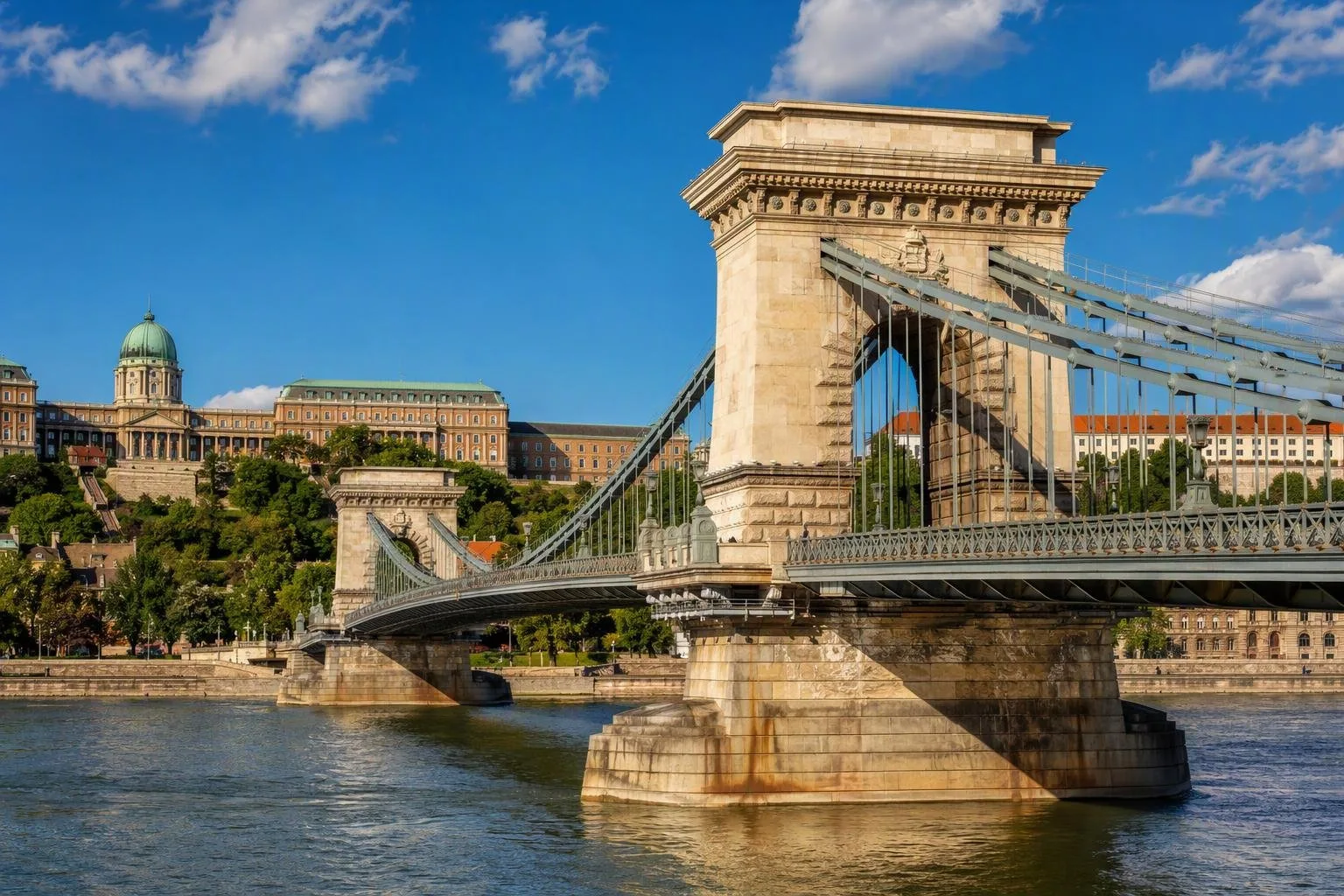
The Chain Bridge is Budapest’s 19th-century chain suspension bridge across the Danube, linking Széchenyi István tér in Pest with Clark Ádám tér at the foot of Castle Hill in Buda.
The crossing
The Chain Bridge—officially the Széchenyi Chain Bridge—spans the Danube between Pest and Buda. Opened in 1849, it was Hungary’s first permanent bridge across the river and made a year-round connection between the two then-separate towns possible.
The bridge runs from Széchenyi István tér on the Pest side to Clark Ádám tér on the Buda side. It is 375 metres long, with a 202-metre main span. Its two stone pylons, triumphal arches and drooping iron chains make it instantly legible from either embankment.
What to look for
Four stone lions guard the bridgeheads. They were added in 1852 by sculptor János Marschalkó. The old story that they have no tongues is false; the tongues are simply hard to see from street level.
Pause beneath a pylon to read the structure: the roadway hangs from linked iron chains rather than the wire cables of a modern suspension bridge. The bridge was designed by English engineer William Tierney Clark and built on site under Scottish engineer Adam Clark.
From the deck, the visual geography of Budapest is unusually clear:
- North: the long riverside front of the Hungarian Parliament.
- West: Castle Hill, Buda Castle and the funicular terminus.
- East: the Pest riverfront, Széchenyi István tér, Gresham Palace and the Hungarian Academy of Sciences.
The bridge forms part of the historic Danube panorama that frames this stretch of central Budapest.
A bridge rebuilt
The original crossing replaced a pontoon bridge that had to be dismantled in winter. Its completion came 24 years before Buda, Pest and Óbuda formally united as Budapest in 1873, but the fixed link made that future city physically practical.
Retreating German forces destroyed the bridge in January 1945; only the stone towers remained. It was rebuilt and reopened in 1949, on the centenary of the original opening. A major restoration finished in 2023, renewing the deck, steelwork, pylons, lions and lighting.
Crossing it now
Walking is free. Use the pedestrian pavements on either side of the carriageway; allow time to stop, as the midpoint gives the cleanest views along the river.
Traffic rule: private cars are not permitted. The roadway is used by public-transport vehicles, taxis, motorcycles and cyclists, so keep out of the carriageway and use the crossings at each approach.
For the Pest end, tram 2 runs along the embankment close to Széchenyi István tér; Vörösmarty tér on metro line M1 is a short walk inland. At the Buda end, Clark Ádám tér leads directly to the Castle Hill Funicular and routes up to the castle district.
From the magazine
Stories about Chain Bridge
Editorial stories linked directly to Chain Bridge.
No stories about Chain Bridge have been published yet.
Routes from our editors
Travel through Chain Bridge
Editorial routes connecting Chain Bridge with other countries, cities and hotspots.
No routes through Chain Bridge have been published yet.
More in Hungary
Related hotspots
Other cities, nature areas and places within Hungary.