National park · Croatia
Plitvice Lakes
Plitvice Lakes is a national park in mountainous central Croatia, where 16 named lakes cascade through forest and limestone canyons. Its tufa barriers and waterfalls form a UNESCO World Heritage landscape.
What Plitvice Lakes is
Plitvice Lakes is Croatia’s oldest and largest national park, protected since 1949 and listed as a World Heritage site since 1979. The lake system has 16 named lakes, plus smaller unnamed ones, stepping downhill through a wooded karst landscape.
Its defining feature is tufa: calcium-rich deposits build natural barriers across the watercourses. Those barriers create the lakes and the cascades between them, so this is an active landscape rather than a static set of waterfalls.
Upper and Lower Lakes
The visitor zone divides naturally into two sections.
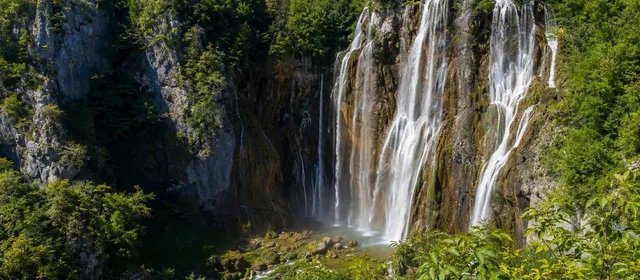
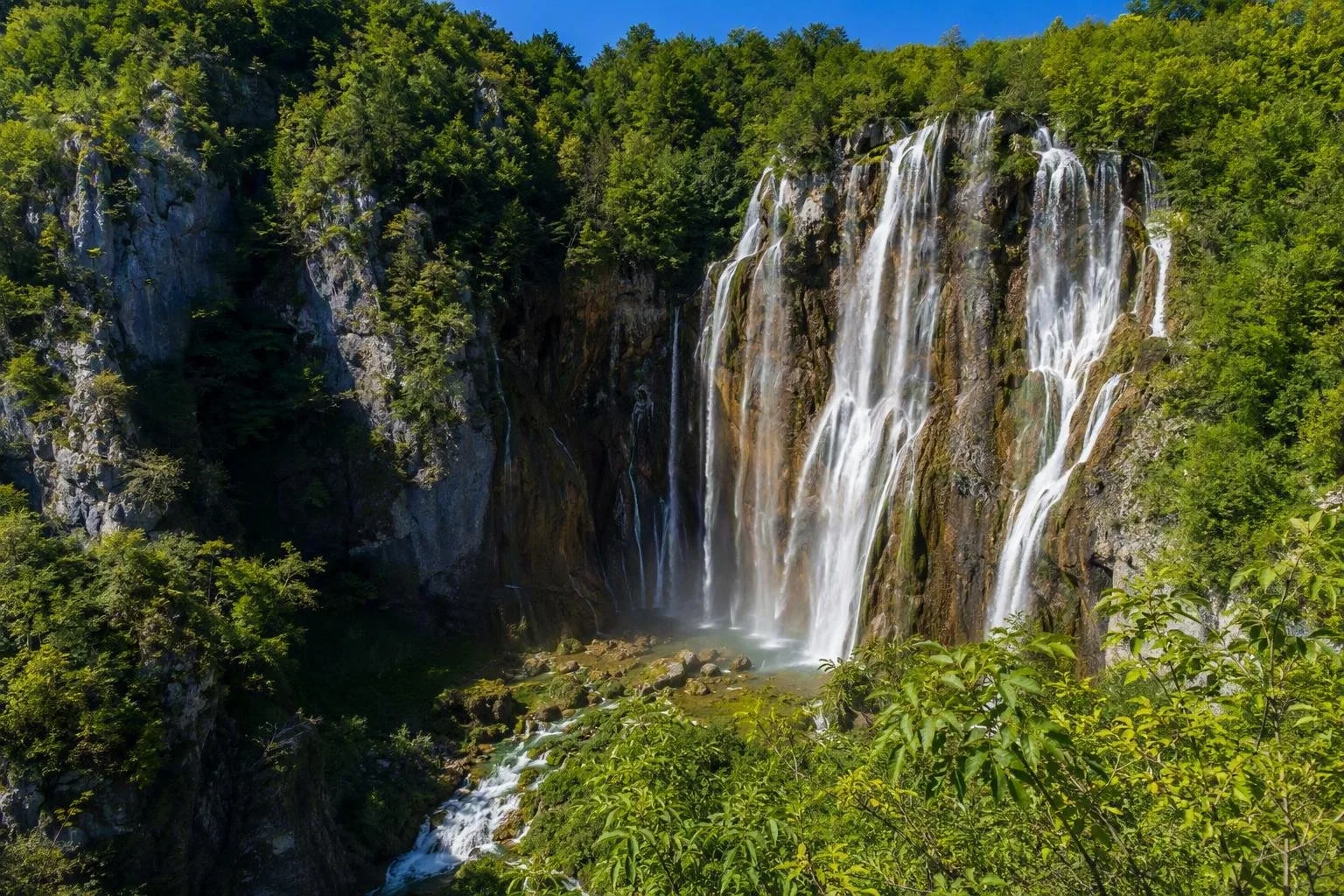
- Lower Lakes: limestone canyon, steep sides and the Great Waterfall (Veliki Slap), Croatia’s largest waterfall. This is the direct focus of the shorter routes from Entrance 1.
- Upper Lakes: broader, wooded lakes, linked by a dense sequence of smaller falls. Routes from Entrance 2 begin here.
- Lake Kozjak: the largest Plitvice lake and the crossing point between the two sections.
Wooden walkways bring you close to the water; keep moving on narrow sections and use the marked viewpoints for longer stops.
Choose a route
Pick the entrance to match the route, not the other way around. Entrance 1 and Entrance 2 are about 3 km apart.
For a short visit, Programme A starts at Entrance 1 and covers the Lower Lakes and Great Waterfall in 2–3 hours over 3.5 km. Programme E starts at Entrance 2 and explores the Upper Lakes in 2–3 hours over 5.1 km.
For the full lake zone, choose Programme C from Entrance 1: 8 km and 4–5 hours, combining both sections with an electric-boat crossing and panoramic vehicle. Programme H from Entrance 2 is another full circuit: 8.9 km and 4–6 hours.
The long K1 and K2 walks take 6–8 hours. They suit visitors who want a substantial day on foot rather than the transport-assisted circuits.
Getting there and moving around
The D429 road runs past both main entrances; each has paid parking and a bus stop immediately nearby. Buses using this corridor connect Croatia’s interior with the coast. The D52 approaches from the Otočac/A1 direction.
A valid park ticket includes the electric boats on Lake Kozjak and panoramic vehicles used by the signed sightseeing programmes. Boat and vehicle schedules vary by season, so allow plenty of time for the final connections rather than starting a long route late in the day.
Access and protection
The park opens year-round, but entrance hours, lake routes and transport services change with the season. Winter conditions can affect the available route network.
Stay on marked paths and boardwalks. The tufa barriers are the living formations that make the lakes possible; swimming is not permitted. Wear footwear with grip: wet timber, spray and uneven trail surfaces are routine around the falls.
From the magazine
Stories about Plitvice Lakes
Editorial stories linked directly to Plitvice Lakes.
Routes from our editors
Travel through Plitvice Lakes
Editorial routes connecting Plitvice Lakes with other countries, cities and hotspots.
No routes through Plitvice Lakes have been published yet.
More in Croatia
Related hotspots
Other cities, nature areas and places within Croatia.