City · Sri Lanka
Galle
Galle is Sri Lanka’s historic southern port, centred on the walled Old Town of Galle and its Fortifications. Its coral-and-granite ramparts contain an inhabited grid of colonial-era streets beside the Indian Ocean.
Orientation
Galle sits on Sri Lanka’s southwest coast. Its essential historic quarter is Galle Fort, a walled promontory between the harbour and the Indian Ocean. This is not an isolated monument: homes, religious buildings, shops and hospitality businesses occupy the streets inside the defences.
The Old Town of Galle and its Fortifications has been a World Heritage site since 1988. Its importance lies in the meeting of European military planning and South Asian building traditions, visible in the street grid, verandas, courtyards and heavy coastal walls.
Read the fort
Portuguese builders established the first fortification in the late 16th century. After taking Galle in 1640, the Dutch rebuilt and enlarged it; much of the surviving defensive circuit dates from that period. The British assumed control in 1796 and added their own layer to the town.
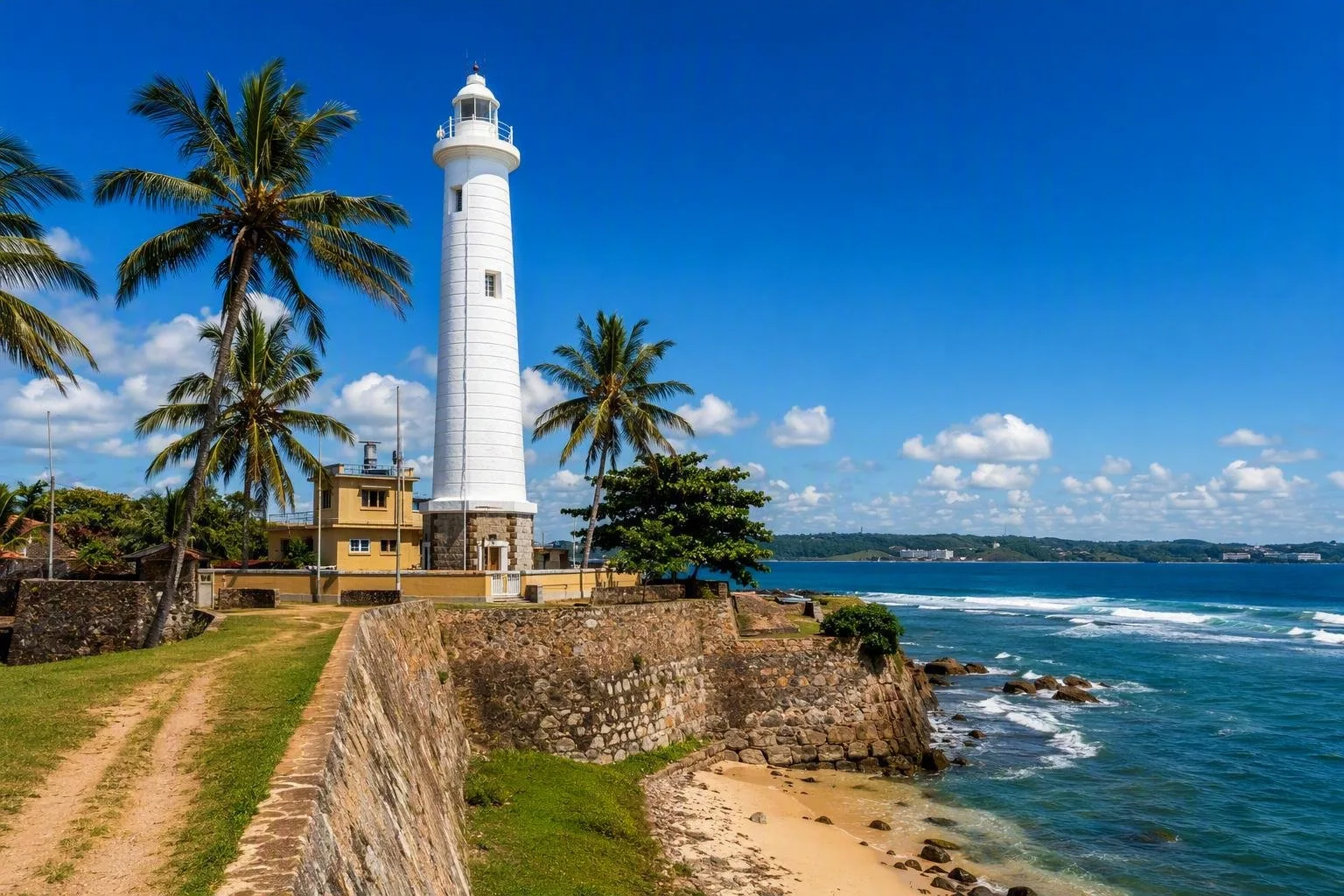
Walk the walls to see how the design follows the rocky headland rather than a textbook geometric plan. Coral and granite are both visible in the ramparts. Bastions punctuate the circuit, while the inland side faces the cricket ground and the seaward side opens directly onto the ocean.
What to see on foot
Begin at the Main Gate and take the ramparts before exploring the interior. The circuit gives the clearest sense of Galle’s relationship with the harbour and open sea.
- Galle Lighthouse: the white, operational lighthouse at Point Utrecht Bastion is a 1939 replacement for an earlier British light. It is viewed from outside; do not expect access to the tower.
- Dutch Reformed Church: built in 1755, with tombstones set into its floor.
- National Maritime Museum: housed in a former Dutch warehouse; useful context for the port and Indian Ocean trade.
- Old Dutch Hospital: a historic institutional building now used for shops and dining.
Between stops, look past restored façades for the fort’s characteristic narrow-fronted houses, columned verandas, deep eaves and internal courtyards.
Getting there and moving around
Galle railway station and bus stand are just outside the fort. From Colombo, the coastal railway is a direct option; road access follows the Southern Expressway or coastal routes. From the station, walk or take a short tuk-tuk ride to the Main Gate.
Inside the fort, go on foot. Streets are compact but surfaces can be uneven, and the ramparts are exposed to sun and rain. Allow at least half a day for the walls, church and museums; longer if you want to explore the lanes at an unhurried pace.
Practical etiquette
The ramparts and streets are part of a residential town, not a closed museum. Keep clear of private doorways and dress modestly for churches, mosques and temples. Some museums and interiors set their own admission charges and visiting hours.
The outer edge of the ramparts can be unrailed. Keep children close and avoid the edge in wet or rough weather.
From the magazine
Stories about Galle
Editorial stories linked directly to Galle.
Routes from our editors
Travel through Galle
Editorial routes connecting Galle with other countries, cities and hotspots.
No routes through Galle have been published yet.
More in Sri Lanka
Related hotspots
Other cities, nature areas and places within Sri Lanka.