Winter Passage from Helsinki’s Olympia Terminal
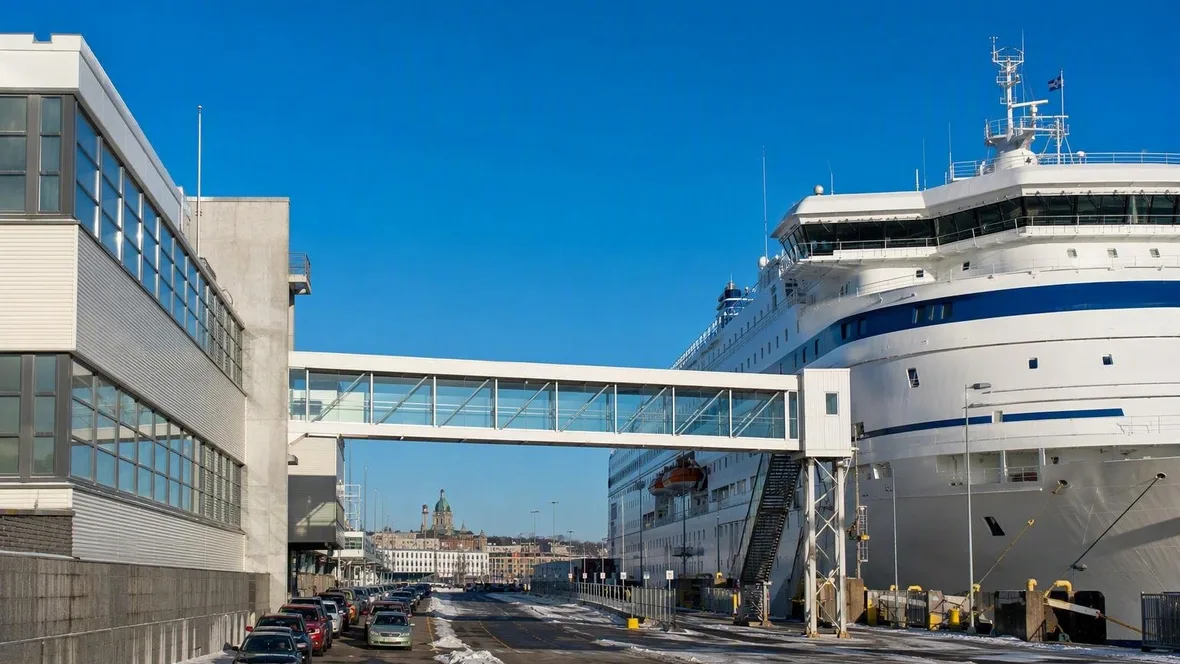
At Helsinki’s South Harbour, cars take the quay road between the Olympia Terminal and the sea while foot passengers pass through a restored 1950s hall to the Stockholm ferry. Winter work stays mostly out of sight, but it matters when snow or harbour ice affects the narrow space between ship and shore.
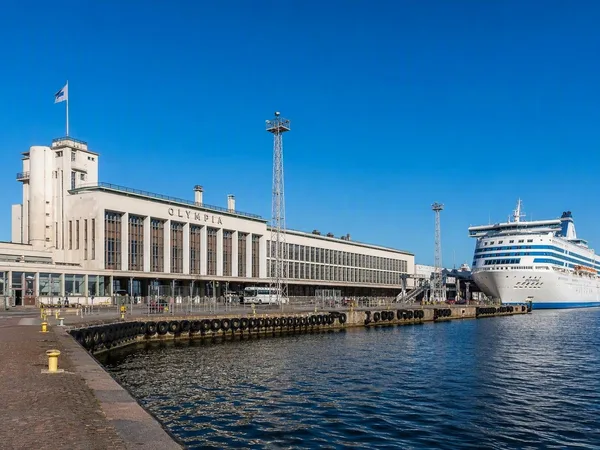
Cars follow marked lanes between the Olympia Terminal and the water at Helsinki’s South Harbour. Foot passengers take renovated corridors and a passenger bridge instead, reaching the ship above the vehicle traffic. The layout puts a night ferry, a city-centre terminal and a working quay within a few minutes’ walk of one another.
That closeness comes from the harbour’s history. Helsinki reshaped a shallow bay in the 19th century, filling land, straightening the shoreline and building quays that made South Harbour the city’s main maritime entrance. Cargo once dominated these berths. Since the 1970s, car ferries have largely taken its place, so the harbour now handles passengers and vehicles at the edge of the centre rather than behind a distant industrial fence.
The Olympia Terminal stands on the southern side of this harbour, near Kaivopuisto. Trams 2 and 3 stop by the terminal, and taxis use the space outside its entrance. For the Helsinki–Stockholm crossing, that is a pleasingly plain start: no long transfer to an airport, no grand departure ritual, just a terminal door and a ship waiting beyond it.
The 1952 terminal
Architects Risto-Veikko Luukkonen and Aarne Hytönen designed the Olympia Terminal as a modern arrival hall for visitors to the 1952 Helsinki Olympic Games. The passenger ship Aallotar called at the terminal in June 1952, shortly before the Games. The building was made to receive foreign visitors arriving by sea, and it still performs that basic task.
The protected functionalist interior has kept its useful oddities. Stone frames surround the windows. Restored leather benches remain in place, a large compass rose lies in the floor, and the door handles form a neat letter O. Refurbishment added LED lighting and renewed the passenger corridors, boarding bridges and check-in gates. Those updates matter more than a commemorative plaque: people still move through the hall on their way to a ship.
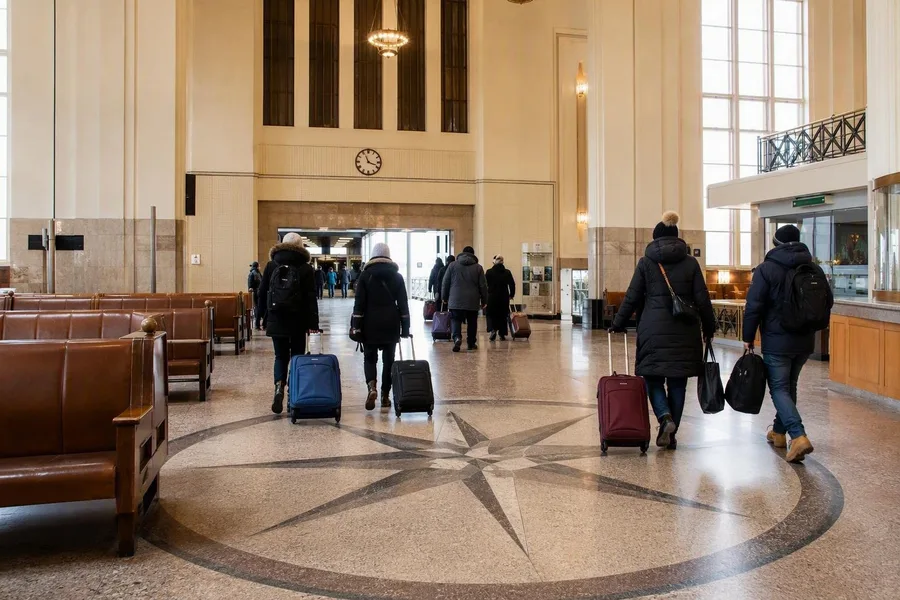 Foot passengers cross the compass-rose floor in Helsinki’s restored Olympia Terminal.
The Silja Serenade and Silja Symphony use the Olympia Terminal for year-round overnight sailings between Helsinki and Stockholm. They take foot passengers and cars, and the South Harbour also handles roll-on, roll-off cargo. The terminal separates those movements from the outset. Drivers follow lanes beside the quay towards the loading area; passengers pass through the hall and board by bridge.
A harbour map shows why the waterfront feels compact: ferry berths, a fixed ramp, an adjustable ramp, the passenger bridge, the terminal and parking facilities sit along the same shore. The arrangement is not quaint. It is a working solution for moving people, vehicles and ships through a small central harbour.
Ice in the basin
Snow and ice do not define every winter departure from Helsinki. When ice forms in the harbour basin or turning areas, however, the work begins before the ferry reaches its berth.
Helsinki uses tug operator Alfons Håkans for icebreaking within the harbour and its turning basins, under coordination by harbour traffic control. The tug normally works early, before an incoming ship arrives. In the severe winter of 2025–26, icebreaking took place daily in South Harbour from mid-January; every ship reached its berth, although some small delays occurred. That was an exceptional season, not a standing promise of ice outside every cabin window.
The job requires more accuracy than simply opening a channel. In heavier ice, a ferry has to come close alongside the quay. Ice left between the hull and the shore can stop the passenger bridge from reaching the ship. The ordinary icebreaking service clears the harbour basin and turning area. A ship must order separate work if ice needs pushing, towing or washing away from the narrow gap beside its hull.
Winter ships calling at Helsinki have ice-strengthened classification. Specialist harbour companies handle mooring and unmooring in South Harbour, and harbour traffic control authorises a ship’s movements in the port. Those procedures belong to every normal call. Ice can add time and extra work, but it does not automatically turn the Helsinki–Stockholm ferry into an Arctic expedition.
Snow brings a different, quieter task. Before arrivals in snowy conditions, harbour operations clear snow and grit walking and working surfaces so staff, vehicles and passengers can use the shore-side areas needed for the ship-to-terminal connection. The point is not a pretty white quay. The point is a usable route between the terminal, the ramp and the berth.
From quay road to cabin
The route keeps its separate lanes to the last practical moment. Check-in takes passengers through the terminal gates and on towards boarding-pass control and the passenger bridge. Drivers continue in their vehicles towards the ship by the quay-side route. Cars, freight and people therefore share one harbour without sharing one loading space.
Practicalities. Tallink Silja sells Helsinki–Stockholm tickets through its website, app, sales offices and contact centre. The company sets no number or weight limit for luggage and charges no luggage fee, but passengers carry their own bags; the terminal has no baggage trolleys. Drivers should take essential belongings to the cabin because the vehicle deck is inaccessible during the crossing. The terminal kiosk provides paid luggage storage, priced by locker size.
The overnight ferry turns travel time into sleeping time. It carries cars below deck and passengers in cabins across the Baltic towards Stockholm. The old-fashioned part is not the terminal’s leather seating. It is the simple bargain of the route: board in one capital, go to bed, and leave the ship in another.
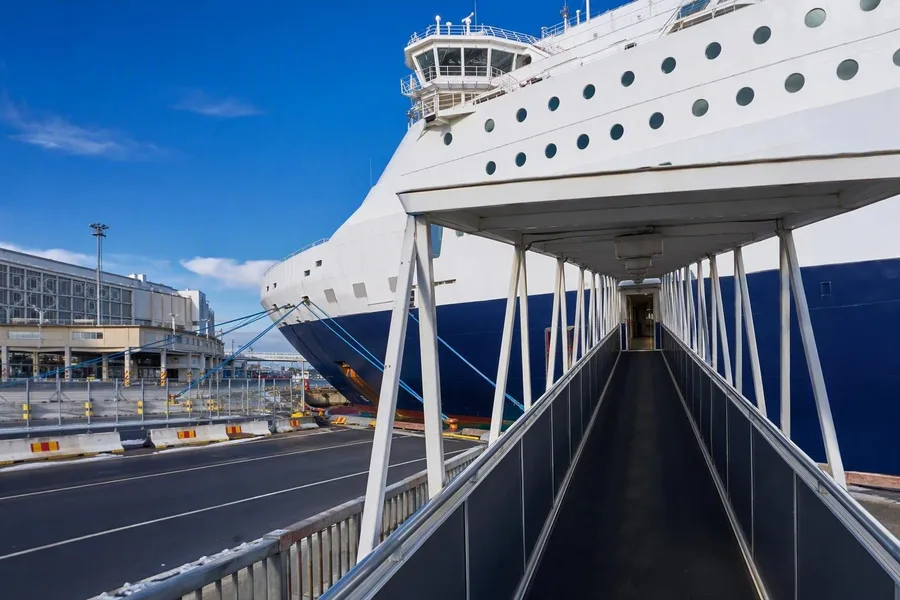 A passenger bridge connects the Olympia Terminal to a ferry at Helsinki’s South Harbour.
The bridge at the berth
When winter ice affects an arrival, the harbour’s work narrows to a few metres of water and steel. Icebreaking has cleared the basin where needed. The ferry comes alongside. Harbour workers secure it at the berth.
Then the passenger bridge reaches from the terminal towards the hull. Inside, the compass rose still marks the floor of the 1952 hall. Outside, the quay road keeps cars apart from the pedestrian route. The bridge meets the ship, and the last exposed stretch between city and ferry disappears underfoot.
Keep exploring