The world’s ten greatest bridges, ranked
These ten bridges are ranked by three things: the force of their design, the history held in their fabric, and the precision with which they meet their river, strait, valley or city. Pont du Gard starts the list; Stari Most finishes it above the Neretva.
Engineering alone does not secure first place. Each bridge must also carry its past convincingly and fit the water, rock or streets around it.
10. Pont du Gard, France
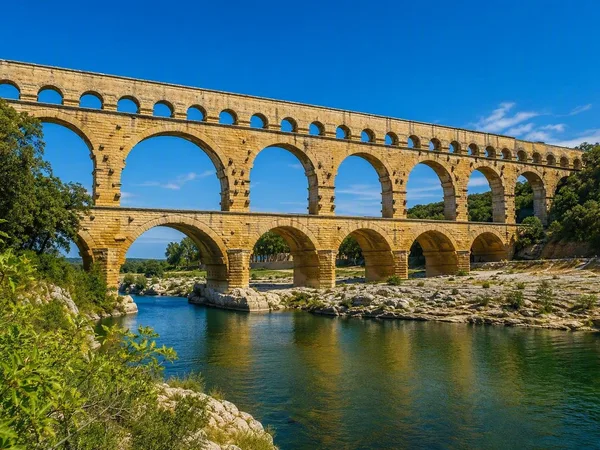
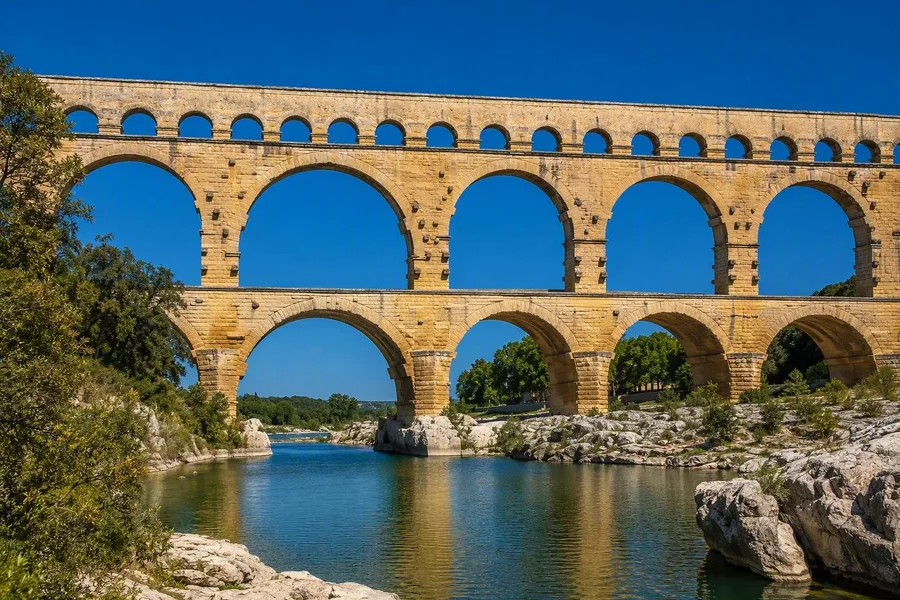 Pont du Gard’s three tiers of arches cross the rocky Gardon valley near Nîmes.
Roman engineers built Pont du Gard to carry an aqueduct across the rocky Gardon valley, not to move people or carts. Three tiers of arches raised the water channel towards Nîmes, while the broad main arch and pointed protections on the piers helped the structure withstand sudden floods.
After the aqueduct stopped working around the beginning of the sixth century, medieval users adapted the crossing for people and animals. Later restorations preserved an unusually legible piece of Roman water engineering. Its repeated stone arches and practical response to a volatile river earn it architectural weight. It takes tenth place because it now functions chiefly as a monument, rather than an everyday city crossing.
9. Øresund Bridge, Denmark-Sweden
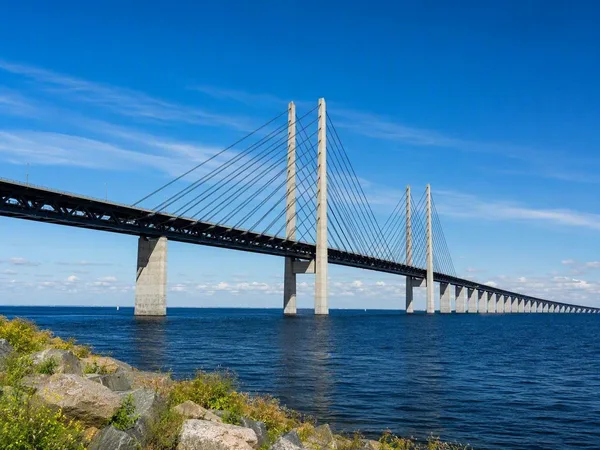
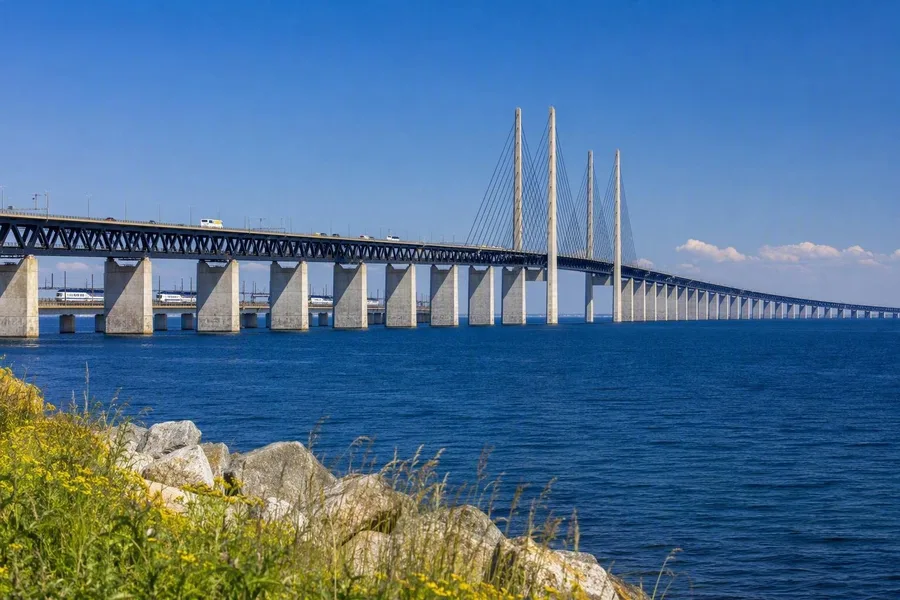 Road traffic passes above trains on the Øresund Bridge between Denmark and Sweden.
Road traffic runs above trains on the Øresund Bridge. Both then pass across the artificial island of Peberholm and enter a tunnel towards Copenhagen. The fixed link opened in 2000 and stretches 15.9 kilometres between Denmark and Sweden, combining 7,845 metres of bridge, Peberholm and 4,050 metres of tunnel.
The crossing answers the open strait with a practical sequence rather than a single heroic span. Its 203.5-metre pylons give the crossing a clear outline above the water. The bridge ranks ninth because its hybrid design is excellent, but it has less historical depth and pedestrian life than the bridges ahead. The coast gives the fullest public view; this is a road-and-rail crossing, not a promenade.
8. Akashi-Kaikyo Bridge, Japan
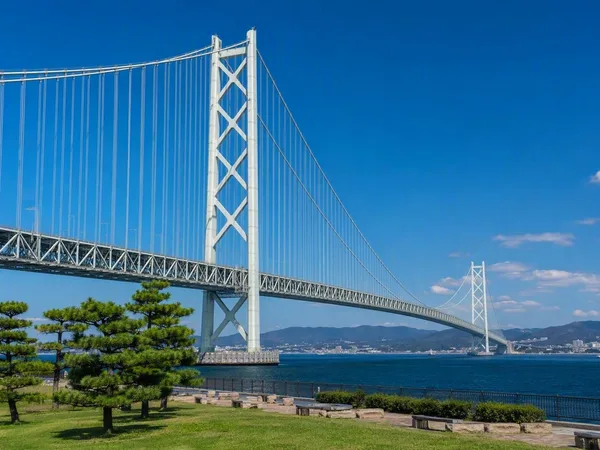
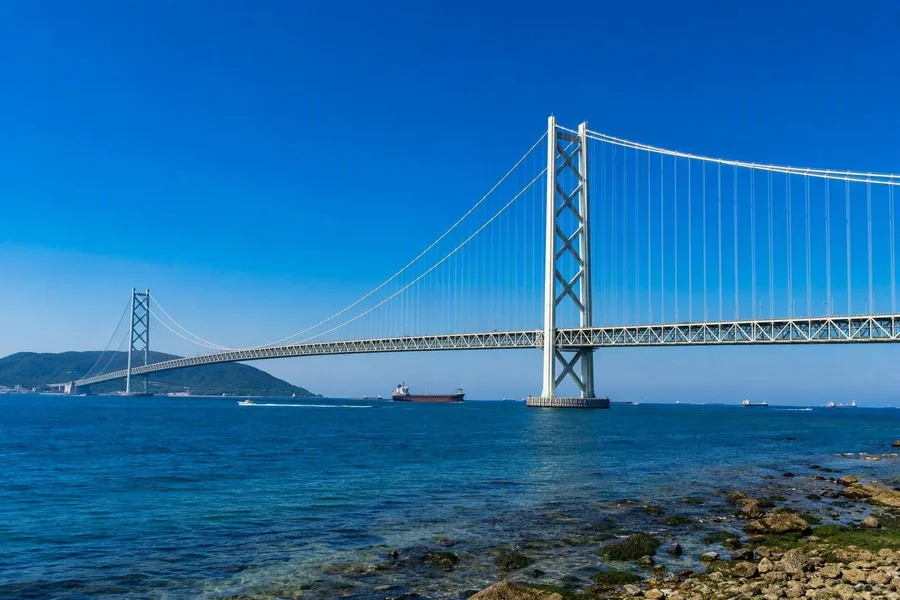 The Akashi-Kaikyo Bridge spans the shipping channel of the Akashi Strait between Kobe and Awaji.
The Akashi Strait combines deep water, fast tides, shipping, wind and earthquake risk between Kobe and Awaji. Engineers answered with a three-span suspension bridge, a stiffened truss deck and a 1,991-metre main span. The bridge leaves a high channel open for ships below.
Construction ran from 1988 to 1998. The 1995 earthquake shifted the unfinished towers far enough that engineers had to alter the planned deck before completion. That adjustment gives its huge scale a specific historical edge. It ranks eighth because the structure solves an exceptionally hard site, though it has a more distant relationship with street life than the city bridges above it.
7. Viaduc de Millau, France
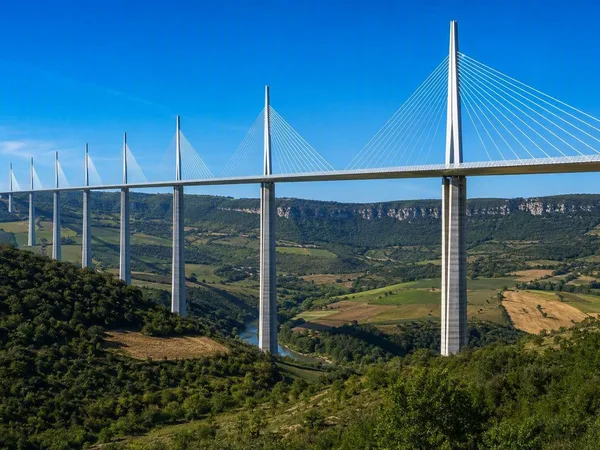
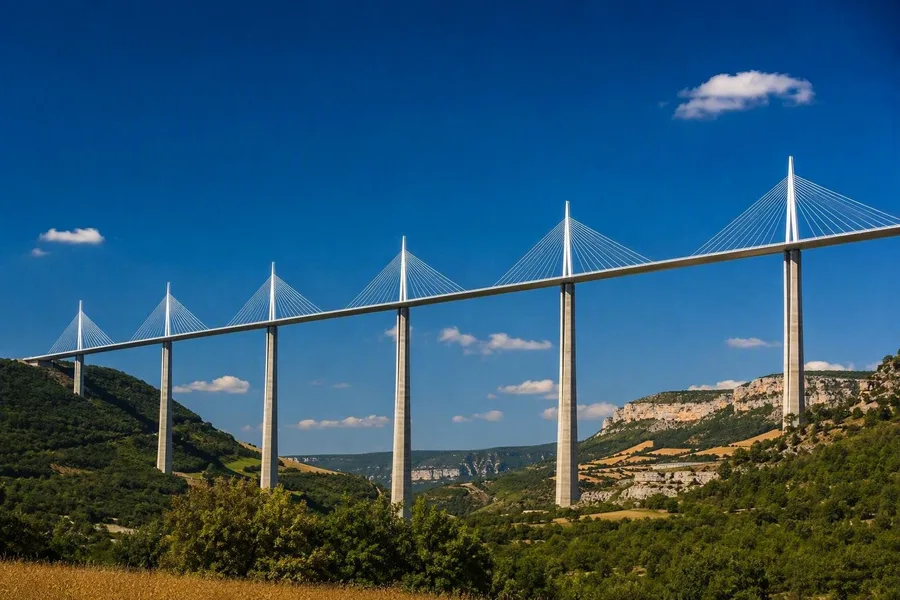 The Viaduc de Millau crosses the Tarn valley on concrete piers and white cable stays.
The A75 does not descend into the Tarn valley at Millau. It runs from limestone plateau to limestone plateau on a thin steel deck, supported by seven concrete piers and white cable stays.
Norman Foster and engineer Michel Virlogeux completed the viaduct in 2004. Self-climbing formwork, high-performance concrete and wind-conscious design helped place its 2,460-metre deck across the valley. From below, the varying heights of the piers trace the depth of the gorge. It ranks seventh: a remarkably disciplined motorway structure, but one with less human-scale use than the historic urban crossings ahead.
6. Tower Bridge, London
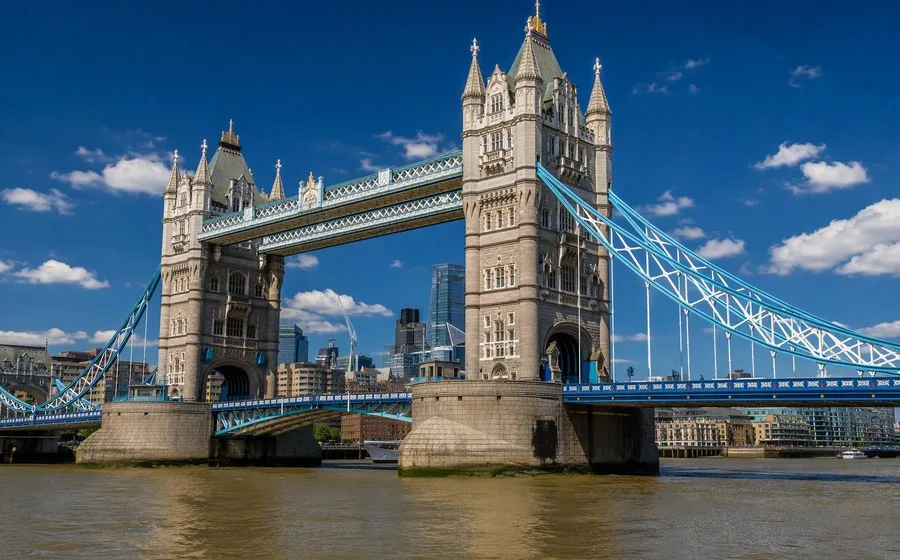
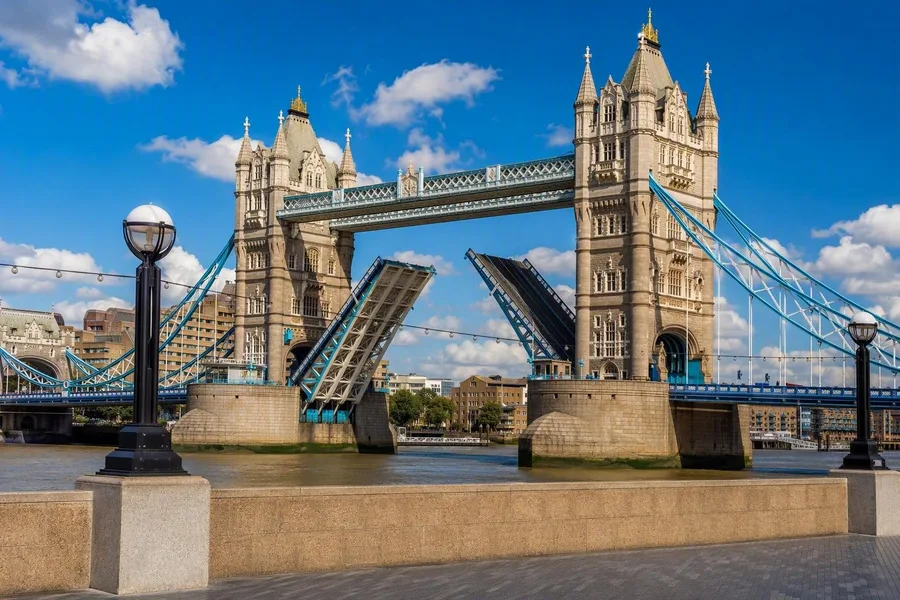 Tower Bridge’s stone-clad towers frame its raised bascules above the Thames in London.
Tower Bridge looks medieval from the Thames embankment, but its stone-clad towers contain a Victorian steel machine. Horace Jones and John Wolfe Barry designed two lifting bascules so cargo ships could continue towards the Pool of London; hydraulic machinery raised the roadway between the towers.
Construction lasted from 1886 to 1894. Cornish granite and Portland stone cover a steel frame assembled with more than 13 million rivets. The Gothic exterior matches the nearby Tower of London, while the opening roadway still allows river traffic through. It takes sixth place because engineering, city history and daily movement meet with rare clarity, even if the costume does rather a lot of work.
5. Golden Gate Bridge, San Francisco
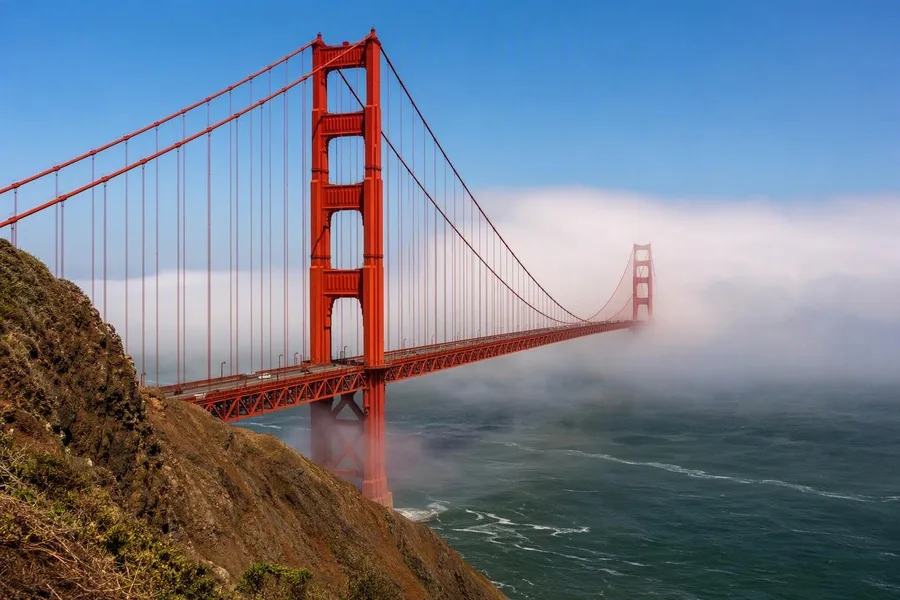 International Orange towers and deck emerge through fog at San Francisco Bay’s entrance.
International Orange is not mere decoration. The colour helps the Golden Gate Bridge remain visible when Pacific fog gathers around the deck and towers, while foghorns guide ships through the entrance to San Francisco Bay.
The steel towers rise 227 metres above the water, and the main span measures 1,280 metres. Spun-wire cables and a suspended deck allow calculated sideways movement in strong winds, rather than trying to hold rigidly still. The narrow, foggy strait shaped its scale, colour and maritime equipment. It misses the top four because New York, Florence, Prague and Mostar carry deeper layers of urban history.
4. Brooklyn Bridge, New York
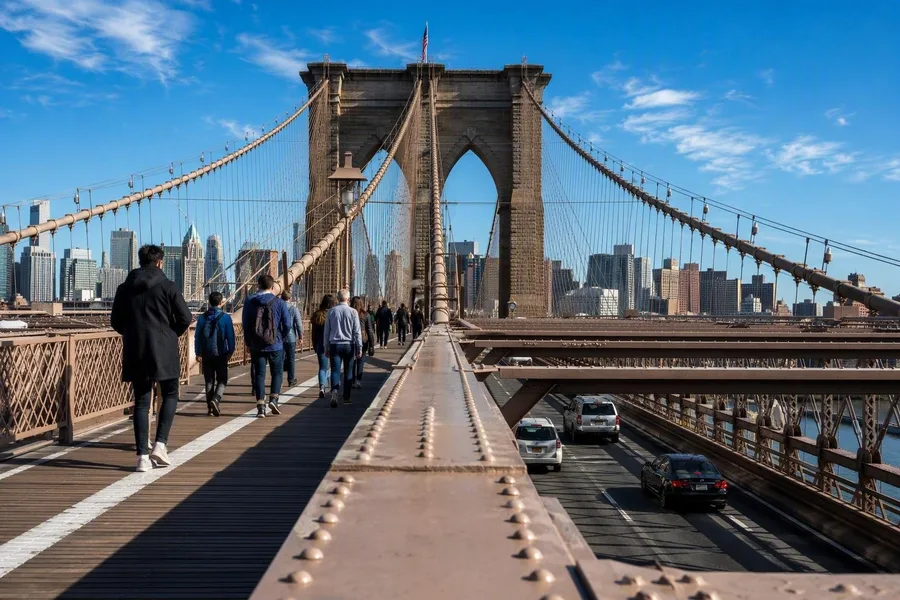 Pedestrians cross Brooklyn Bridge’s raised promenade between stone towers above East River traffic.
John A. Roebling’s bridge joined Manhattan and Brooklyn in 1883 after fourteen years of construction. Its galvanised steel suspension cables marked a major technical advance, while its stone towers gave the new material the gravity of city gates.
A raised pedestrian promenade passes through the towers’ pointed arches above road traffic, with a separate two-way cycle path alongside. The bridge spans the East River between two dense boroughs, letting water traffic pass below while people, bicycles and vehicles cross above. Its continuing civic role puts Brooklyn fourth: the technical leap remains visible in daily use.
3. Ponte Vecchio, Florence
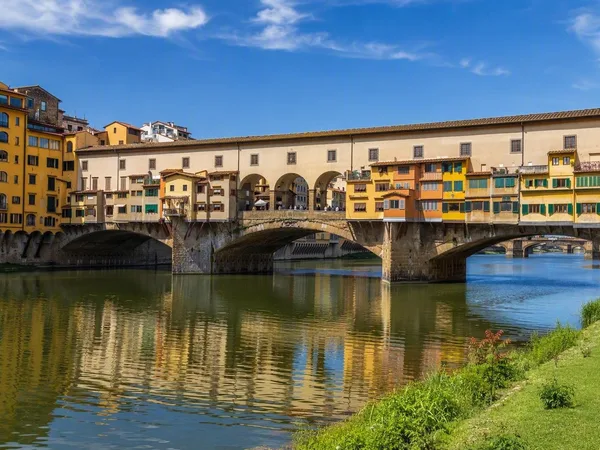
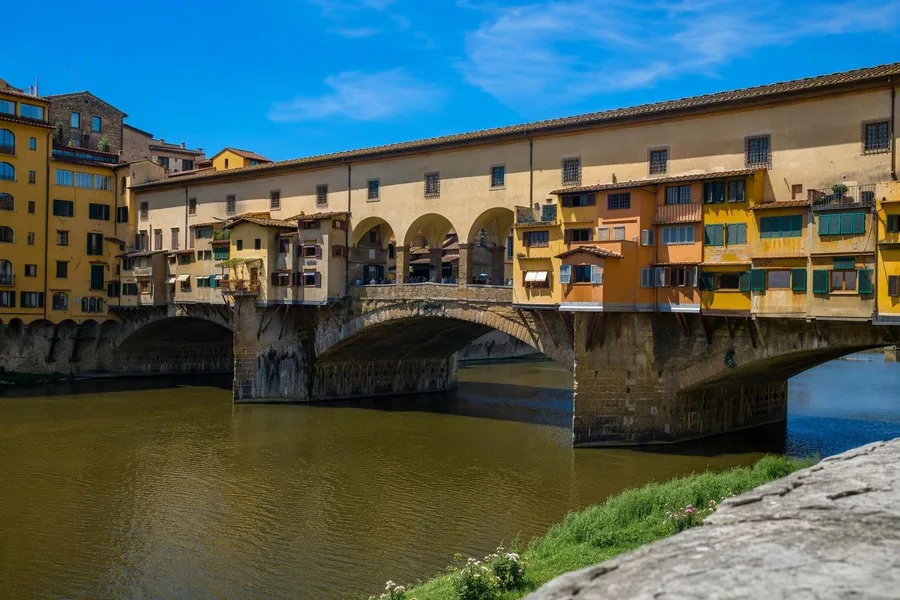 Ponte Vecchio’s projecting shops and enclosed Vasari Corridor span the Arno in Florence.
Ponte Vecchio is bridge, street and commercial building at once. Florence rebuilt it after the flood of 1333 with three shallow stone arches, fewer piers in the Arno and shops projecting over the water on wooden supports.
Goldsmiths and jewellers replaced butchers and leather workers in 1593. The enclosed Vasari Corridor ran above the shopfronts between the Uffizi side of the city and Palazzo Pitti. Retreating German forces spared the bridge in 1944, while Florence’s other Arno bridges were destroyed. Few bridges pack so much ordinary city use into their structure. It ranks third because its architecture is rich but visibly accumulated, rather than as wholly resolved as Prague’s and Mostar’s crossings.
2. Charles Bridge, Prague
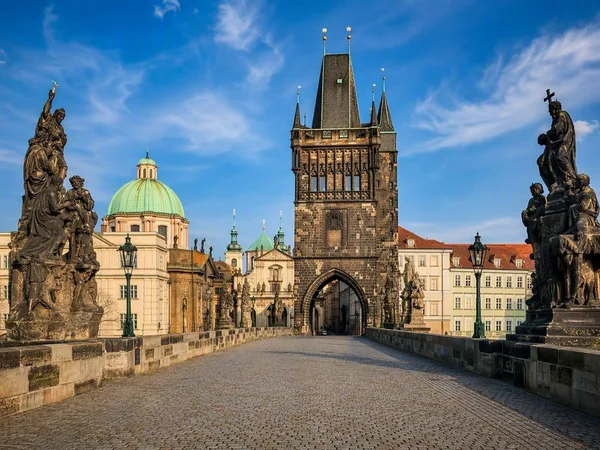
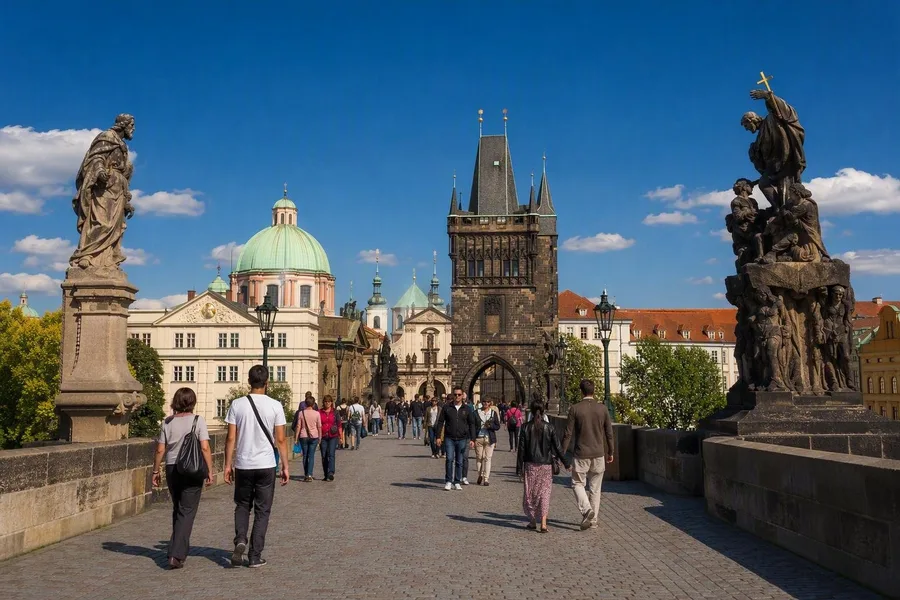 Pedestrians cross Charles Bridge past Baroque statues between Prague’s Gothic towers.
Charles IV commissioned this stone bridge after floods destroyed much of its predecessor. Built between 1357 and 1402, its sixteen arches connected Prague’s Old Town with Malá Strana and remained the city’s only Vltava crossing until 1841.
Thirty mostly Baroque statues turned the Gothic deck into a long sculptural passage between towers. Floods continued to leave their mark: debris destroyed three arches in 1890, and repairs and replica statues form part of the bridge seen today. Pedestrians have had the deck to themselves since 1965. Charles Bridge ranks second because architecture, ceremony and ordinary movement still join historic Prague across a river that repeatedly tested the structure.
On foot, by road, and from the bank
Pont du Gard, Brooklyn Bridge, Ponte Vecchio, Charles Bridge and Stari Most can be approached or crossed on foot without a bridge ticket; guided access is required for Pont du Gard’s upper water channel. Øresund is a tolled road-and-rail crossing, while Akashi’s public viewpoint sits in the Maiko Marine Promenade. Millau has a free exhibition and a reservable guided path beneath the deck. Tower Bridge charges for its towers, glass walkways and engine rooms. Pedestrians use the Golden Gate Bridge’s eastern pavement, and the Vasari Corridor requires a timed Uffizi reservation.
1. Stari Most, Mostar
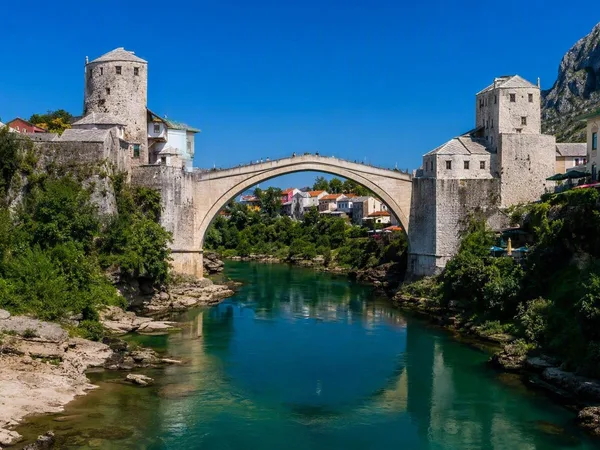
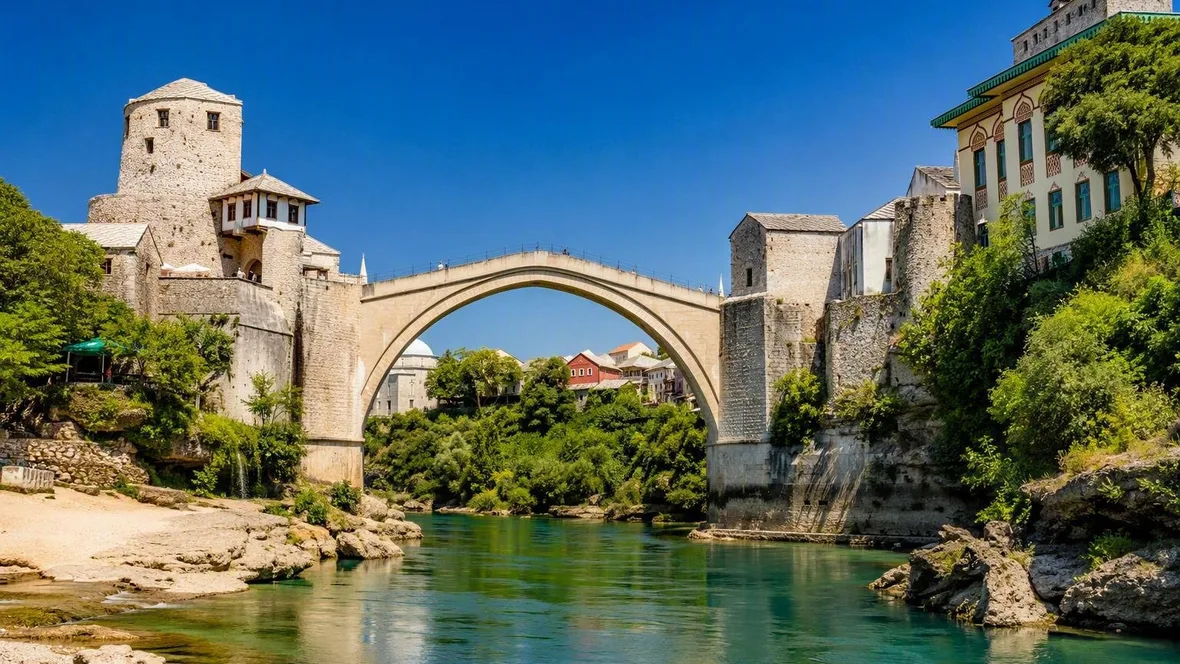
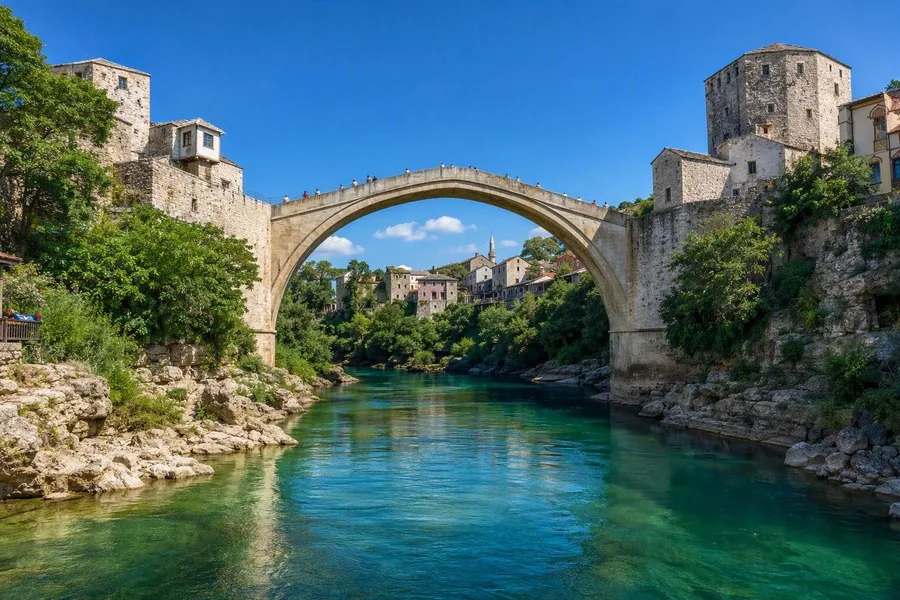 Stari Most’s pale stone arch rises above the green Neretva between Mostar’s rocky banks.
Hayreddin built Stari Most for Sultan Süleyman between 1557 and 1566, setting one slender masonry arch across the narrowest part of the Neretva gorge. Local tenelija limestone, iron clamps and molten lead formed a four-metre-wide crossing between Mostar’s steep banks, with towers at either end.
Shelling brought the bridge down on 9 November 1993 during the war in Bosnia and Herzegovina. Reconstruction used stone from the original quarry, recovered blocks and sixteenth-century building methods; the bridge reopened in 2004.
Stari Most takes first place because its construction, destruction and reconstruction are inseparable from its site and city. Pale stone rises in one steep, narrow arc between rocky banks and old streets, held above the Neretva by a single curve.
Keep exploring
Places in this story
Europe
10 landen en gebieden

Asia
Pont du Gard
Øresund Bridge
Akashi-Kaikyo Bridge
Viaduc de Millau
Tower Bridge
Tower Bridge is London’s Grade I-listed Victorian bascule bridge across the River Thames, between Tower Hamlets and Southwark. Its road crossing is a working bridge; the towers, high-level walkways and Engine Rooms form the ticketed visitor route.
Ponte Vecchio
Charles Bridge