Jagalchi: Fish, Fire and Busan’s Working Waterfront
At Jagalchi, Busan’s fishing trade reaches the city through tanks, wooden boxes, knives and charcoal grills. The market sits on the edge of South Harbour, where vendors, cooks and customers turn seafood into an everyday meal.
A market built at the edge of the sea
Jagalchi stands on the seaward side of Nampo-dong, Busan’s old centre, along the Namhang waterfront, also known as South Harbour. City streets meet a coast road here. Across it, market stalls fill a narrow strip between the buildings and the water.
The name keeps hold of an older shoreline. Jagal means pebbles in Korean, and a pebble beach once edged Nambin before colonial-era land reclamation changed the coast and created South Harbour. Fish markets and wholesalers gathered around the new harbour. Small fishing boats and Korean street vendors followed, selling catches along the quay.
Jagalchi began as this loose waterfront trade, not as a planned market hall. After Korea’s liberation and during the Korean War, returnees and refugees came to Busan looking for work. Many women, including war widows, sold fish from makeshift stalls. Busan came to know them as the Jagalchi-ajimae, whose work supplied the city and became closely tied to its post-war survival.
A fish and shellfish processing building came before the market’s formal registration in 1972. Rebuilding later produced the present hall in 2006. Yet Jagalchi remains more than its large modern building. Outdoor seafood stalls, the dried-fish market, ShindongA Seafood Market and neighbouring street traders make up the wider district.
South Harbour beside the stalls
Jagalchi sits within Busan’s working waterfront, though large catches do not necessarily land beside its retail stalls. Farther along South Harbour, purse-seine vessels unload crates at the Busan Cooperative Fish Market, where auctioneers call the sales. Jagalchi forms the public-facing stretch of the same waterfront: traders sell seafood there, and nearby kitchens cook it.
That layout leaves room for several kinds of work. The harbour has quays and wholesalers. Jagalchi has stalls, tanks, dried goods and kitchens. The market does not present one tidy trip from fishing boat to plate; it shows the separate hands and places that handle seafood around the harbour.
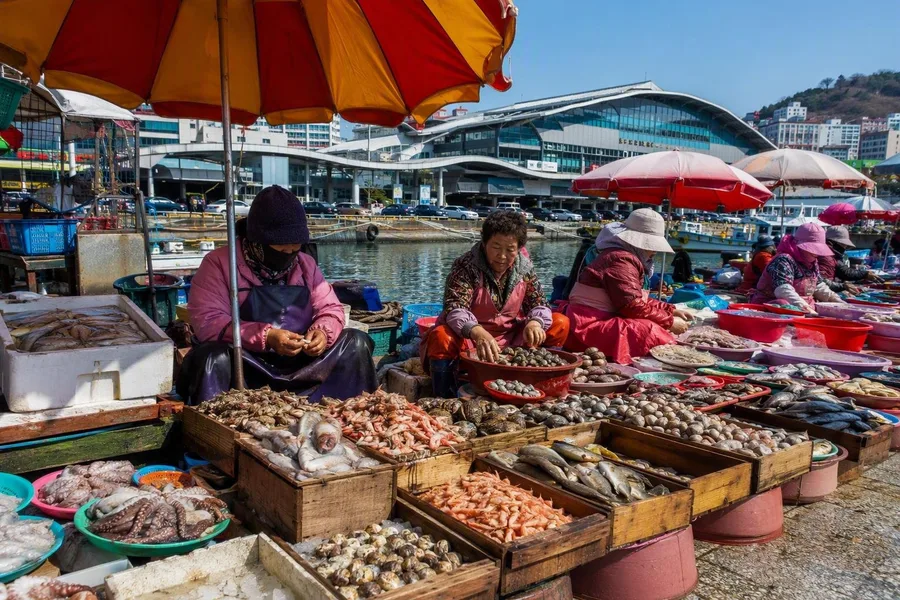 Sellers arrange seafood beneath parasols beside Jagalchi’s Namhang waterfront.
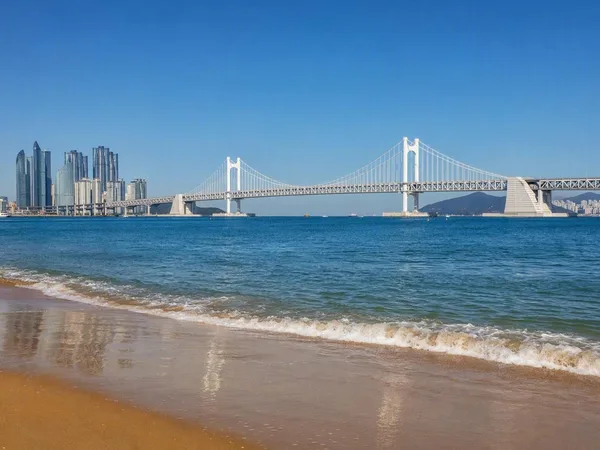
Water stays close. From the lookout above the hall, moored fishing boats sit in South Harbour, with Yeongdo across the water and the Namhang, Busan and Yeongdo bridges in view. At street level, parasols cover low stalls beside the coast road. Sellers arrange seafood in baskets, tubs and wooden boxes.
The 2006 building makes a sharp contrast with those roadside stalls. Blue-tinted glass covers its waterfront façade, while three huge white V-shaped metal roof forms create a gull-like outline. Fresh and live seafood sellers occupy the first two floors. Restaurants, other public spaces and a roof observatory rise above them. The redevelopment kept fish sales in the lower levels, so buying and eating remained physically linked.
Tanks below, food above
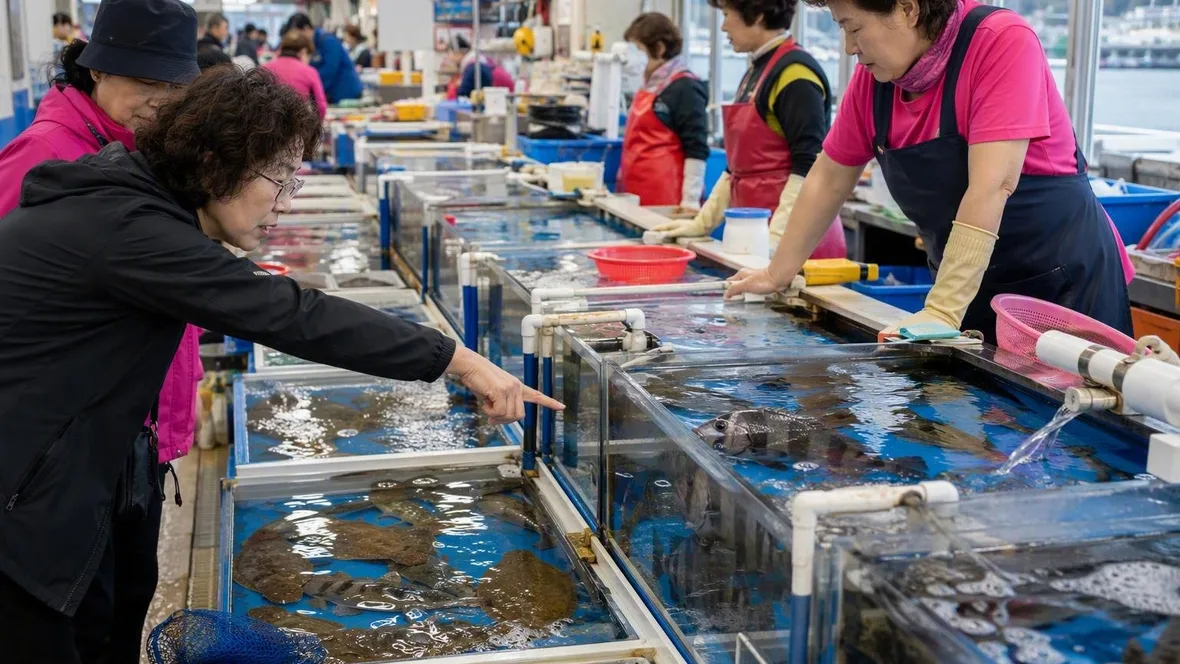
The market hall makes that link especially clear. Customers choose live fish from tanks on the first floor. Staff send the purchase upstairs, where cooks slice it to order as hoe, Korean raw fish.
This is not merely a restaurant serving seafood. The tank, the choice and the cutting board belong to one visible transaction. Rows of tanks keep the product in sight until the moment a cook prepares it.
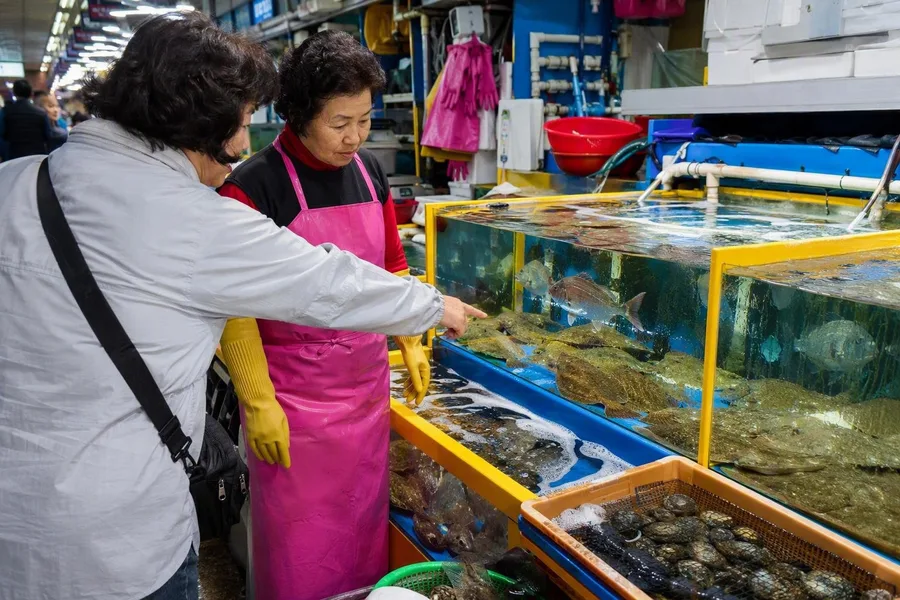 A customer selects a live fish from tanks on Jagalchi Market’s first floor.
Outside the hall, the older market format continues. Vendors sell fish and seafood under colourful parasols, including mackerel and ascidians such as sea squirts. The coastal strip also carries waves and ship horns to the outer stalls, while sellers call customers toward live seafood. Those sounds belong to a working shore rather than a harbour view kept at a distance.
Knives, grills and broth
Jagalchi’s food culture depends on tasks that remain close to the point of sale. Workers clean fish in the street zone. Nearby eating places grill fish over charcoal. Near the entrance, a sharpening cart holds filleting knives and heavier cleavers inside a small vinyl-enclosed booth.
Raw fish provides the clearest example of the market’s kitchen culture. Flatfish can appear as hoe-baekban: thick-cut raw fish served with rice, clear fish soup and side dishes. Other kitchens serve grilled fish and spicy fish stew. Heat, broth and raw slices all have a place here.
Live gomjangeo, or kkomjangeo sea eel, takes another route. A Jagalchi restaurant grills it over briquettes at the table, either salted or seasoned. The dish keeps the seafood’s connection to the market district in plain view, without claiming that every stall or restaurant follows the same practice.
The streets around Jagalchi extend the trade beyond fish that must be eaten quickly. Toward Yeongdodaegyo Bridge, shops and wholesalers sell dried anchovies, squid and seaweed. These goods belong to the same coastal food economy, but their purpose differs: they carry seafood into home kitchens after drying has made it keepable.
Arriving from Nampo-dong
From Nampo-dong, pedestrians cross the coastal road to the market strip beside South Harbour. Wooden boxes, baskets and tubs stand under parasols at the water’s edge. Behind them, the market hall rises in blue glass and white metal.
At the entrance, the vinyl-covered sharpening booth holds rows of filleting knives and cleavers. Beyond it, tanks of live fish fill the first floor, while the harbour water and moored boats lie just beyond the market.
Keep exploring