Inside George Town’s Working Kopitiams
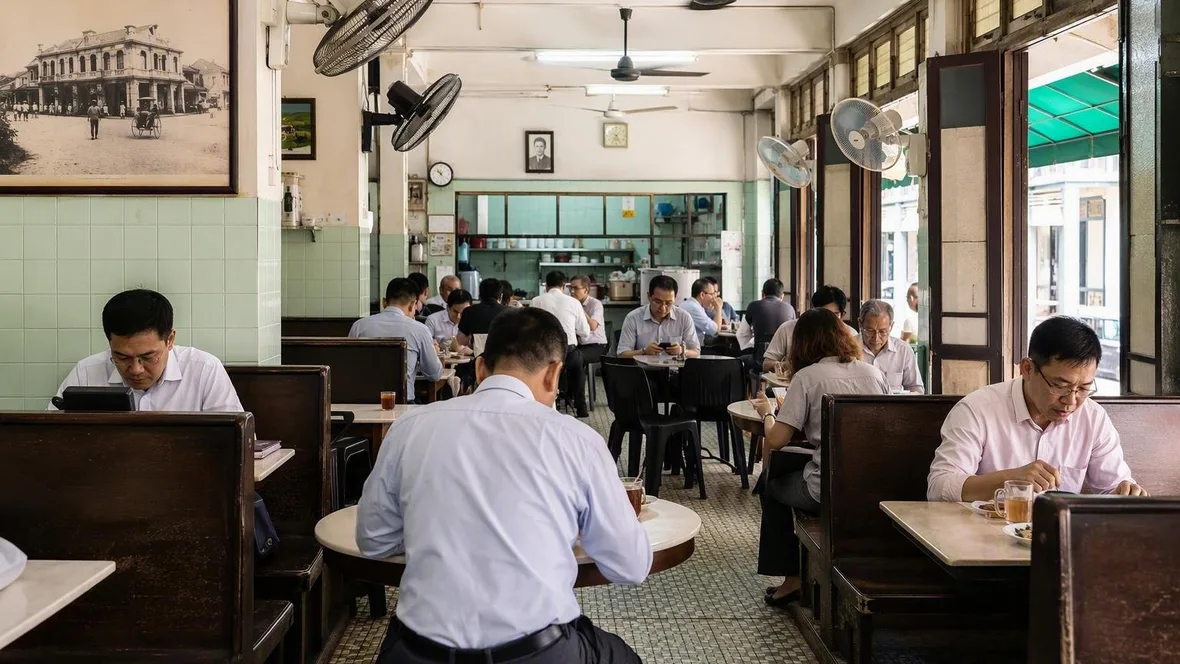
At lunchtime, Kek Seng on Jalan Penang fills with office workers, returning regulars and visitors under ceiling fans, among old tiles and booth seats. The room shows why George Town’s kopitiams still matter: they give small food traders, workers and longtime customers the same practical place to eat.
Lunch at Kek Seng on Jalan Penang
Kek Seng has kept its old booth seats, tables, tiles and windows. Ceiling fans and plastic chairs serve a dining room that remains in daily use, while a photograph of the entrance from 1906 hangs inside. The family’s third generation has chosen not to expand or substantially renovate the shop.
That decision has not turned Kek Seng into a display piece. Nearby office workers place orders there, and the room fills around lunch, especially during school holidays and long weekends. Former workers from the area return for lunch, while visitors from China seek out the old coffee shop as part of a trip to George Town. The tables hold people with different reasons for coming, but they share the same brisk middle-of-the-day rhythm.
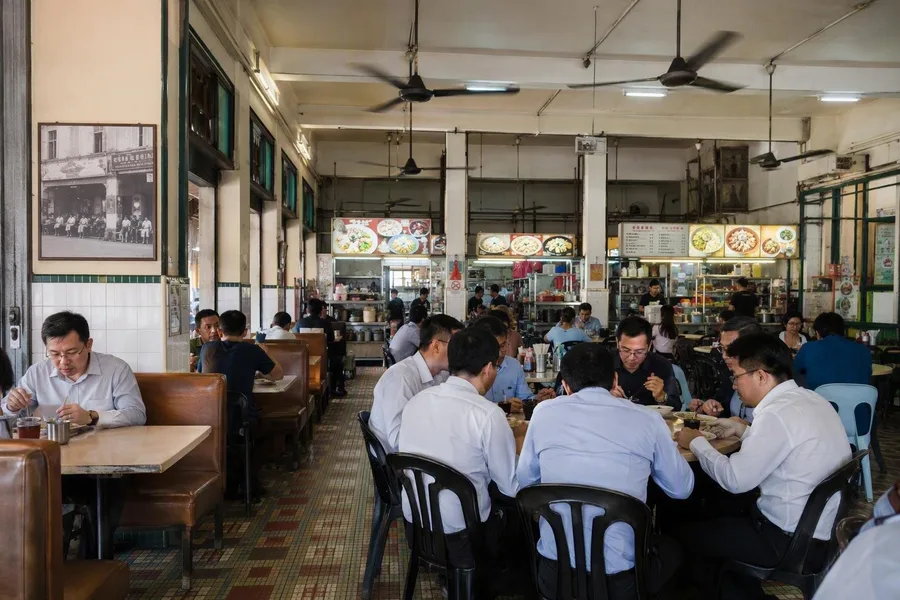 Office workers eat lunch among the food stalls at Kek Seng on Jalan Penang.
Five independent food stalls work inside the coffee shop. The family that runs the premises supplies drinks and tables; separate hawkers prepare food and pay for their places in the room. A customer can buy coffee from the shop and lunch from a stall without changing tables. That arrangement gives small vendors an established dining room and gives office workers a quick meal close to work.
The kopitiam also leaves space for a longer stay. Research on central George Town coffee shops records office workers at lunch, then older men who remain over newspapers, Chinese chess or conversation after the peak has passed. Women appear more often at shops near markets, before or after shopping. These patterns do not make every kopitiam the same, but they show how coffee, food and ordinary errands have long shared one room.
The social circle has clear limits. Many traditional kopitiams are Chinese-run, use Hokkien or Mandarin, and serve dishes containing pork or lard. They are generally not halal, so they do not serve as everyday eating places for many Muslim residents. George Town contains Malay, Indian, Chinese and other food worlds; the kopitiam belongs specifically to its Chinese migration history rather than representing the whole city at one table.
A port city in a coffee-shop room
George Town began as a British free port in 1786 on the Strait of Malacca. Trade drew merchants, labourers and families from China, India, the Malay Archipelago, the Middle East and Europe, and the growing settlement relied on migrants for labour and capital. Those communities traded and lived close to one another, creating a multilingual city whose food reflects Malay, Chinese, Indian, European and Peranakan traditions.
Rows of shophouses gave daily trade a durable shape. These long, narrow buildings put businesses at street level, with storage or living space above. Thick brick walls, lime plaster, terracotta floors, timber shutters and internal air wells helped occupants manage heat, shade, moisture and ventilation. Covered five-foot ways ran below the façades, allowing people to move past open shopfronts with some shelter from sun and rain.
Kopitiams grew from this port economy as affordable places where migrant workers could eat, drink, exchange news and rest. Their name joins kopi, the Malay word for coffee, with tiam, the Hokkien word for shop. The name fits a city built through contact rather than a single culinary line.
Hainanese migrants became especially important to the trade. Hokkien, Cantonese, Hakka and Teochew communities had already secured many occupations by the time many Hainanese arrived, so Hainanese men often worked as cooks and domestic servants in colonial homes. From the 1920s, Hainanese operators developed coffee shops as a speciality. Coffee, kaya toast and soft-boiled eggs came from Chinese enterprise, colonial cooking habits and local ingredients, not from an untouched recipe transported from China.
The traditional business model still suits a dense old city. One family can run the drinks counter while several hawkers cook at the room’s edges. Closely packed tables, shouted drink orders, cooking sounds and the movement between stalls make the meal public and efficient.
Toh Soon’s narrow alley
Toh Soon Café, near Lebuh Campbell, provides a sharper contrast with Kek Seng. The family business opened in 1950 and is now run by its third generation. Metal tables and plastic chairs line both sides of a narrow, dim alley between shophouses, under awnings and large umbrellas; an open kitchen stands against one wall.
The alley sets strict terms. Seated customers, staff and people waiting for a table all use the same narrow passage, so tables change hands quickly. Coffee drips through filters into a tin cup and is filtered again. Nearby, cooks toast bread over charcoal, and the family makes its own bread and kaya.
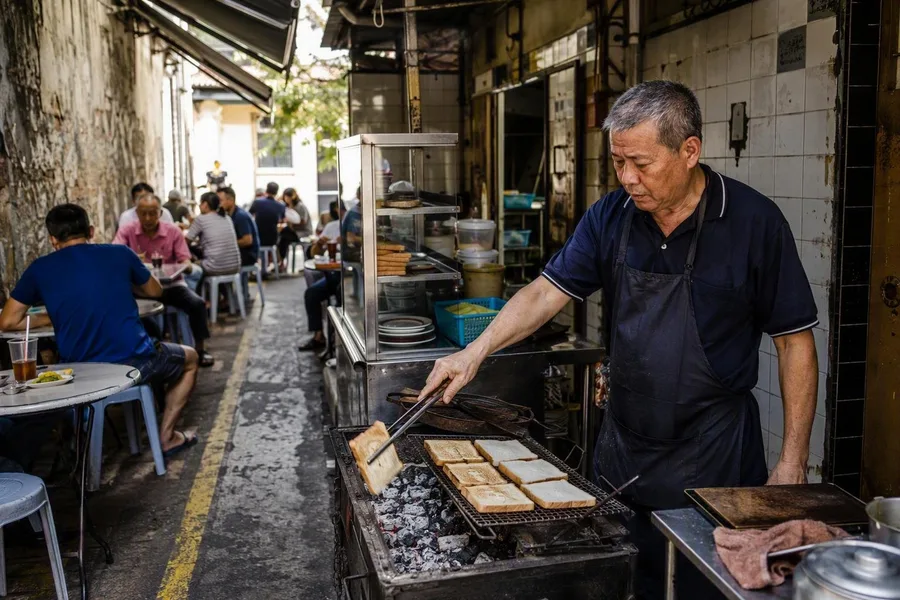 A Toh Soon worker toasts bread over charcoal beside tables in the narrow George Town alley.
By about 9am, tourists, often in groups carrying cameras, make up much of Toh Soon’s queue after finding the café through travel blogs and social media. Local Penang residents still come as well, including people who connect the breakfast with habits kept by parents or grandparents. Toh Soon is not an untouched relic, nor is it merely a stop for visitors.
The business has changed its handling of the crowd while retaining the charcoal grill and open kitchen. Younger staff manage arrivals at the entrance, and e-wallet payments sit alongside older working methods. The narrow space also keeps the service direct: few workers must move people, drinks and food through a passage already occupied by tables.
A changing trade
Tourism has altered the streets around the café as well. In George Town’s heritage core, restored shophouses increasingly house boutique accommodation, cafés and other visitor businesses, though hawkers, residents and family shops remain in the same area. Campbell Street ranks among the more expensive locations for pre-war shophouses, and rents in the heritage core rose by more than 20 percent between 2024 and 2026.
Family succession matters just as much. Some third-generation coffee shops continue because relatives and stallholders have successors; others close when an ageing owner retires and no relative takes on the labour and cost of restarting elsewhere. Kek Seng keeps its place through office deliveries, lunch trade and a restrained approach to renovation. Toh Soon keeps its charcoal toast while making room for a visitor queue in an alley built for a far smaller flow of customers.
Practical: Toh Soon Café is on Lebuh Campbell, George Town. Listed hours are Monday to Saturday, 8am–5pm, with Sunday closed; weekend mornings can bring a queue, while arriving before 10am is generally quieter.
At the mouth of the alley, the line reaches the plastic chairs and weathered walls. Behind them, bread crosses the charcoal grill in the open kitchen.
Keep exploring
Places in this story

Asia
4 landen en gebieden
Middle East

Europe

Malaysia

China

India
Penang
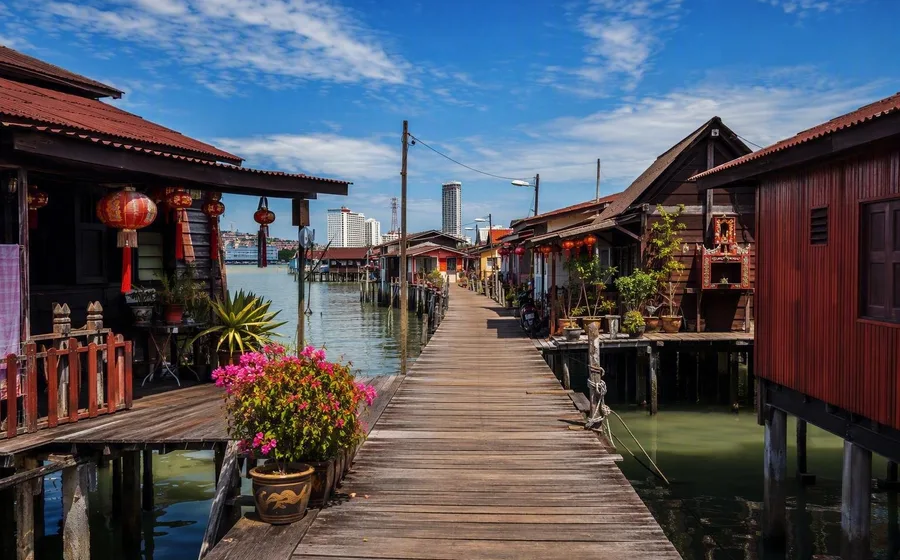
Penang is a Malaysian state on the north-west coast of the peninsula, made up of Penang Island and mainland Seberang Perai. Its capital, George Town, is the practical base for heritage streets, hawker food and the island’s hill and coastal escapes.