Gold Between Paper
In Kanazawa, gold passes through fire, rollers, hammers and specialist hands before it reaches a Buddhist altar, a lacquer box or the top of a soft-serve cone. The city produces more than 98 per cent of Japan’s gold leaf, yet its finest sheets still rely on bamboo tools, carefully prepared paper and close judgement at every stage.
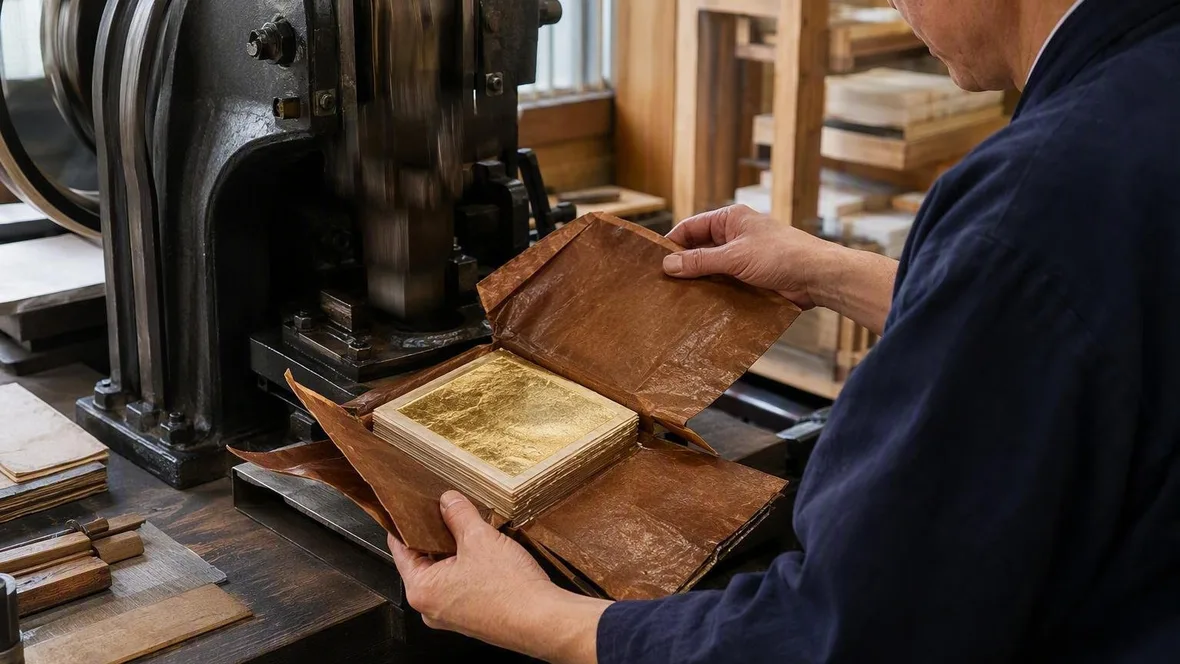
A mechanical hammer strikes a leather-wrapped bundle again and again. Inside, small pieces of gold lie between hundreds of sheets of treated paper and spread a little farther with every round of blows. The machine provides force, but a craftsperson decides when to stop, open the bundle and let it cool. Too much heat makes the leaf stick to the paper.
That balance between machinery and handwork sits at the heart of Kanazawa gold leaf. Mechanical hammers increased output in the early 20th century, but makers still prepare the paper, transfer the metal with bamboo tools and inspect sheets too fragile for bare fingers.
From the Maeda castle town to the workshop
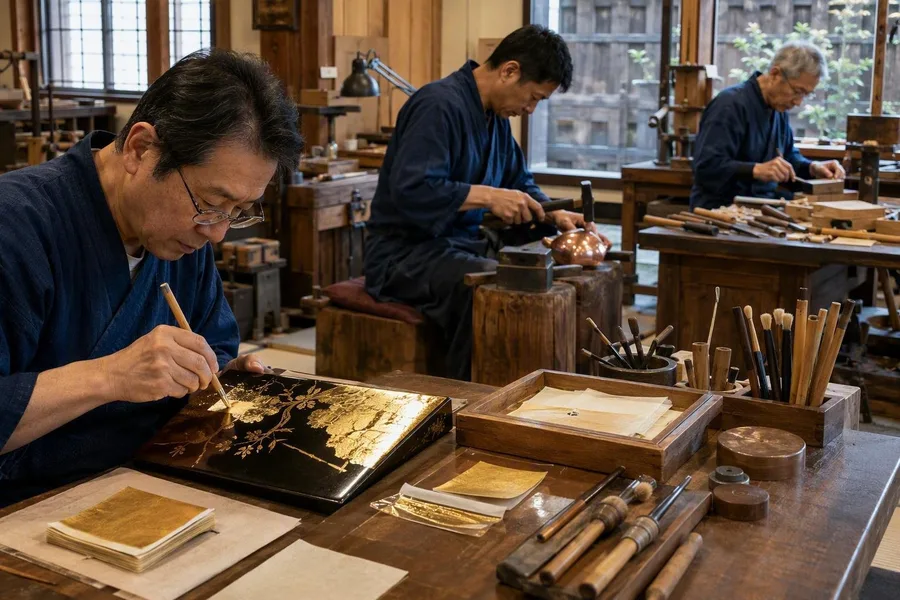 Craftspeople work side by side at the Osaikusho workshop near Kanazawa Castle.
Kanazawa’s gold-leaf trade began in the late 16th century, when Maeda Toshiie, founder of the wealthy Kaga domain, ordered gold and silver leaf. The Maeda family financed Noh theatre, tea ceremony and decorative arts, and brought craftspeople from Kyoto and Edo to their castle town.
Near Kanazawa Castle, the Osaikusho grew from a workshop for repairing weapons and armour into a place where lacquer workers, metalworkers, painters and woodworkers worked alongside one another and trained apprentices. Their skills came together in furniture, folding screens, Buddhist altars and Kaga maki-e lacquerware made for the domain’s elite.
The work did not continue without interruption. In the 18th century, the Tokugawa shogunate restricted gold- and silver-leaf production and sales to a guild in Edo. Kanazawa recovered the craft in the following century, when the Kaga domain brought gold beaters from Kyoto during the rebuilding of its fire-damaged castle. Local makers learned their methods and later gained the right to make gold leaf openly.
After the Meiji Restoration ended the guild controls, Kanazawa workshops developed their own quality and production system. Mechanical hammers raised capacity from the 1910s, while production in Edo declined. Hokuriku’s humid climate also helped makers handle a material that dry air and static electricity can tear.
Gold, alloy and 1,800 sheets of paper
Kanazawa-haku does not begin as pure gold. Makers blend gold with small amounts of silver and copper; the proportions change with the intended colour and kind of leaf. They melt the alloy at about 1,300°C, cast it, then roll it repeatedly into a narrow strip called nobegane.
A maker cuts the strip into small squares and places them between sheets of beating paper. The bundle goes into a leather cover and under a hammering machine. After each round, the gold moves to larger paper, then may be cut and beaten again.
For traditional entsuke leaf, the paper needs months of preparation. Craftspeople treat handmade ganpi washi with water, lye from straw ash, persimmon tannin and sometimes egg white. They beat, moisten and dry the paper repeatedly until it becomes smooth and strong but flexible enough to let the metal spread evenly. A maker who cannot prepare this paper properly has not mastered the whole craft.
The gold eventually reaches an intermediate stage called uwazumi, a square of about 20 centimetres and roughly one micrometre thick. Makers divide it with chopstick-like bamboo tools, combine pieces to even out the final weight, and place them one by one between about 1,800 sheets of paper.
Short spells beneath the hammer alternate with opening and cooling the bundle. The leaf finally reaches about 0.1 micrometre thick. At that point, a faint current of air or a static charge can crease or tear it. Makers lift each sheet with bamboo tongs, inspect it and keep it temporarily in a book of mitsumata paper.
On a board covered with deerskin, they transfer the leaf with bamboo and cut it with a square bamboo frame. A standard finished sheet measures 10.9 centimetres square. Each sheet then sits on a slightly larger piece of mitsumata paper. That visible border gives entsuke, or “with edge,” its name.
Gold on altars, lacquer and carved wood
Kanazawa leaf has long covered other materials rather than served as an object by itself. The region’s strong Jodo Shinshu Buddhist tradition created steady demand for temples, ritual objects and household altars. Inside a Kanazawa butsudan, carved wood, black lacquer, maki-e and gold leaf form a gilded interior that represents the light of the Buddhist world.
Lacquer artists set leaf and gold powder into fine patterns with lacquer. Tea utensils and writing boxes could gain rich decoration without being made from solid gold. Screen makers attach individual sheets with animal-based glue, then use the lacquer beneath to produce either a soft sheen or a reflective finish.
The same thin, pliable layer works over curves, relief and detailed carving. Historical buildings including Kinkaku-ji and Nikkō Tōshōgū use gold leaf, while traditional entsuke leaf remains important in the restoration of significant cultural properties. Craftspeople apply sheets separately with lacquer or adhesive, allowing gold to cover a complex carved surface without hiding its form.
Gold leaf beyond the altar
Modern Kanazawa uses the same material for different purposes. Traditional entsuke leaf helps restore historic surfaces, including cultural properties, while more efficiently cut tachikiri leaf supplies contemporary crafts, cosmetics and consumer goods.
At Hakuichi, gold appears on wooden tableware, fountain pens and USB sticks. Hakuza uses gold and platinum alloys on plates, accessories and bags; its Hikari-gura in Higashi Chaya has a platinum-leaf exterior and an interior lined with 24-carat gold leaf.
Cosmetic shops use gold as a visible ingredient rather than a restoration layer. KINKA in Higashiyama specialises in gold-leaf cosmetics and blotting paper. Hakuza’s Chaya Bijin sells skincare, make-up and body products containing gold from a protected former teahouse.
Food offers the most immediate example. Food-safe gold leaf has no taste or smell, so restaurants and patissiers use it as a visual finish. Sakuda sells edible gold-leaf products beside screens and other craftwork. Hakuichi covers its signature soft-serve with one complete sheet.
Three stops in Kanazawa
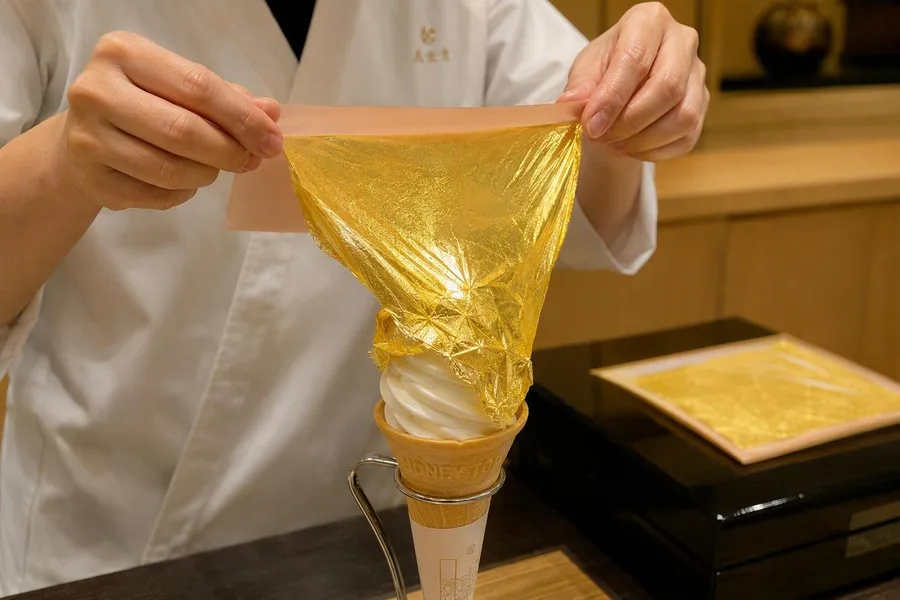 A Hakuichi staff member lays a full gold-leaf sheet over soft serve in Kanazawa.
Hakuza Main Store at 1-30-4 Moriyama offers advance-booked programmes that can include hammering demonstrations, placing gold between paper and cutting it with a bamboo frame; it opens daily from 9.30am to 5.30pm. The Kanazawa Yasue Gold Leaf Museum at 1-3-10 Higashiyama displays tools, screens, lacquerware, textiles and Buddhist art; admission costs ¥310, and it opens from 9.30am to 5pm, except Tuesdays. Hakuichi Hakukokan at 2-1-1 Morito has free demonstrations, a shop and a café; its paid gold-leaf application workshop requires a reservation.
At Hakuichi, staff lower one whole sheet onto a soft-serve cone, using the same light transfer motion that moves leaf in the workshop. The gold settles over the white spiral in one unbroken, gleaming skin.
Keep exploring