Sight · Greece
Acropolis of Athens
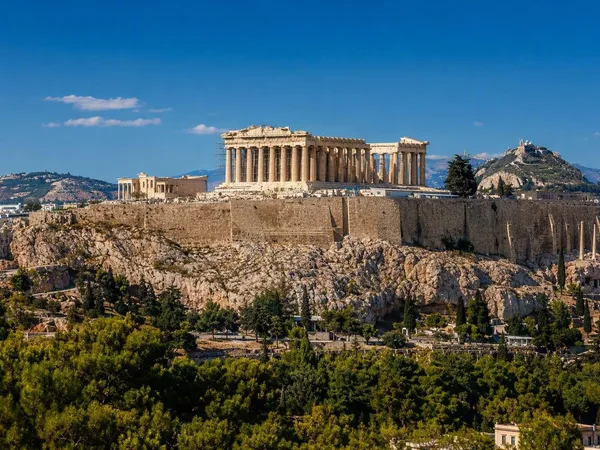
Athens’s Acropolis is the fortified limestone hill above Plaka, crowned by the Parthenon and the principal sanctuaries of classical Athens. The archaeological site includes the summit and its historic slopes.
Read the site as a sacred hill
The Acropolis is not one temple but a compact hilltop sanctuary shaped over millennia. Its steep rock rises about 156 metres above the Athens basin; the summit is roughly 170 by 350 metres. Fortifications existed here in the Mycenaean period, while the hill became a sanctuary of Athena by the 8th century BC.
The monuments that define the skyline were built largely in the second half of the 5th century BC, after the Persian destruction of earlier buildings. Enter from the west, as ancient visitors did, and let the sequence explain the place: gate, sanctuary, temples and city views.
The essential monuments
- Propylaea: the monumental gateway on the west side. It sets the ceremonial threshold before the summit.
- Temple of Athena Nike: a small Ionic temple on the defensive bastion south of the gateway.
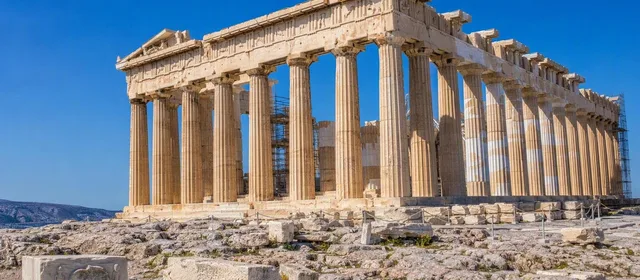
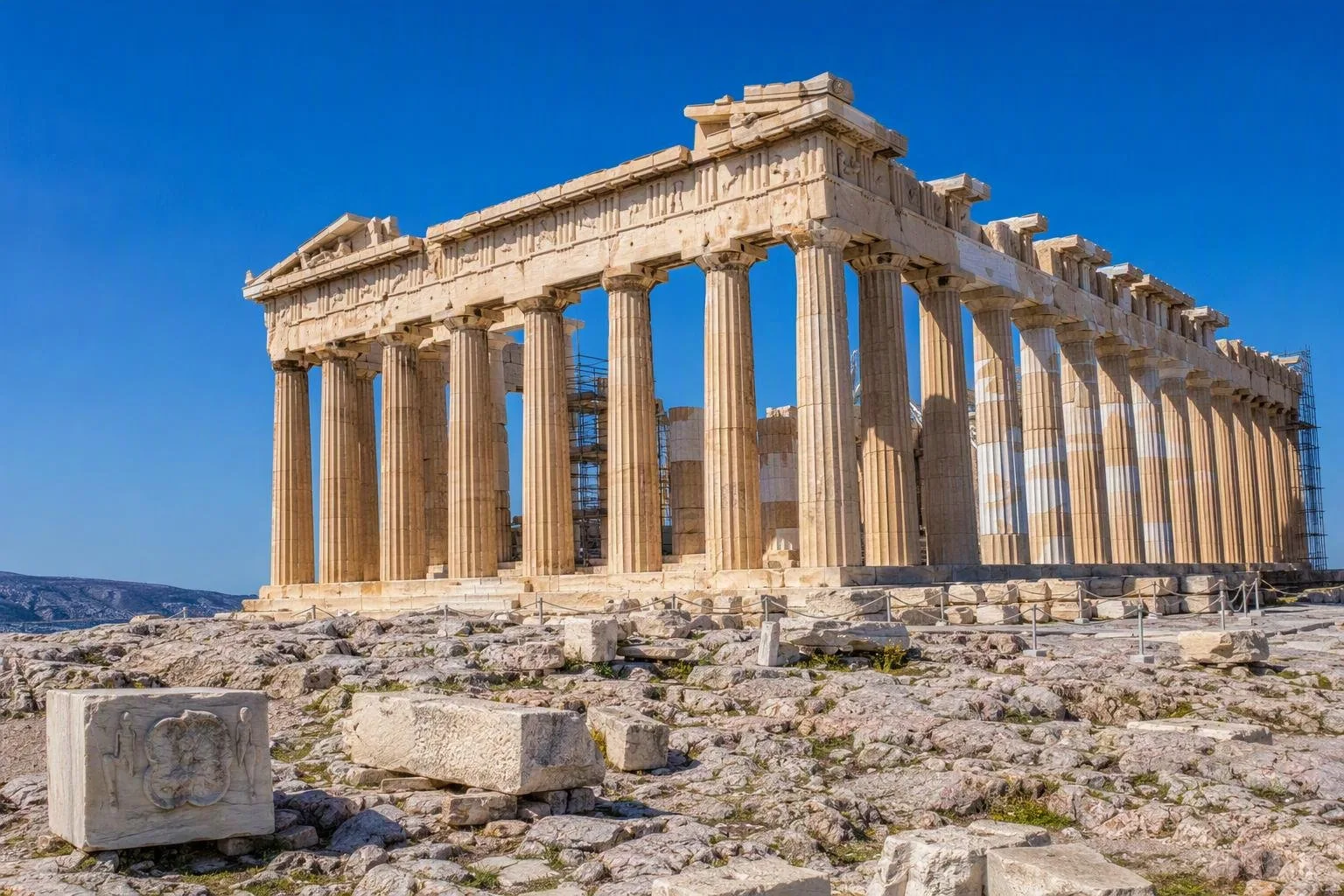
- Parthenon: the dominant Doric temple, built from 447 to 438 BC for Athena Parthenos. Walk its perimeter to understand the building’s scale and the relationship between columns, rock and city.
- Erechtheion: on the north side of the plateau, built between 421 and 406 BC. Its Porch of the Caryatids is the defining detail; the figures on the building are copies, preserving the originals.
Do not rush directly to the Parthenon. The uneven terrain and the spacing between monuments are part of the architecture of the site.
Approach and route
Metro Acropolis on Line 2 is the straightforward approach via Dionysiou Areopagitou Street. The main entrance is on the west slope; the south-slope entrance gives access past the Theatre of Dionysus and the Odeon of Herodes Atticus before the uphill route. A ticket for the Acropolis and its slopes is single-use: leaving either area ends re-entry.
Allow time for the uphill approach, security and the plateau. The rock, ancient marble and ramps can be uneven and slippery when wet. Wear shoes with reliable grip and keep to signed routes; stepping onto restricted ground or touching monuments is prohibited.
Access and timing
The site operates on seasonal hours, with shorter winter days and changing closing times through September and October. Use an official timed ticket before arrival, particularly in the busier months. Food, drink and smoking are not allowed within the archaeological site; bring only a small bag, as large luggage is not accepted.
Accessibility is partial. A dedicated lift on the north side serves wheelchair users and visitors with reduced mobility, reaching the plateau north of the Erechtheion. It is weather-dependent, and the accessible route still includes uneven surfaces and a steep section. Entry for this service is through the main entrance, not the south entrance.
From the magazine
Stories about Acropolis of Athens
Editorial stories linked directly to Acropolis of Athens.
No stories about Acropolis of Athens have been published yet.
Routes from our editors
Travel through Acropolis of Athens
Editorial routes connecting Acropolis of Athens with other countries, cities and hotspots.
No routes through Acropolis of Athens have been published yet.
More in Greece
Related hotspots
Other cities, nature areas and places within Greece.