
City · Germany
Lübeck
Lübeck is a Hanseatic city in Schleswig-Holstein, northern Germany, built around an Old Town island between the Trave, Wakenitz and canal. Its brick churches, merchant houses, Holstentor and salt storehouses preserve the working structure of a major medieval trading centre.
Why Lübeck matters
Founded in 1143, Lübeck became one of the leading cities of the Hanseatic League, the merchant network that shaped trade across the Baltic and North Sea. Its medieval core was inscribed as a UNESCO World Heritage Site in 1987.
This is not a single monument city. The strength of Lübeck is its urban form: an island of streets, gabled houses, church towers, waterside quays and narrow residential passages. The historic centre still shows an old division in the city’s fabric: wealthy merchants’ trading and residential houses to the west, smaller trades and workshops to the east.
Read the Old Town island
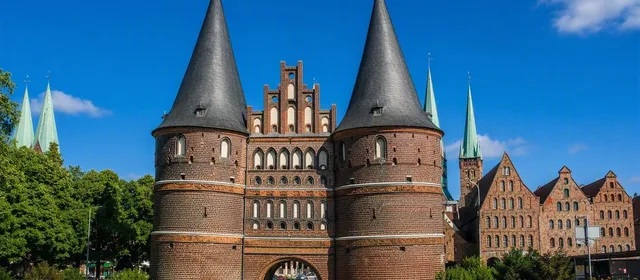
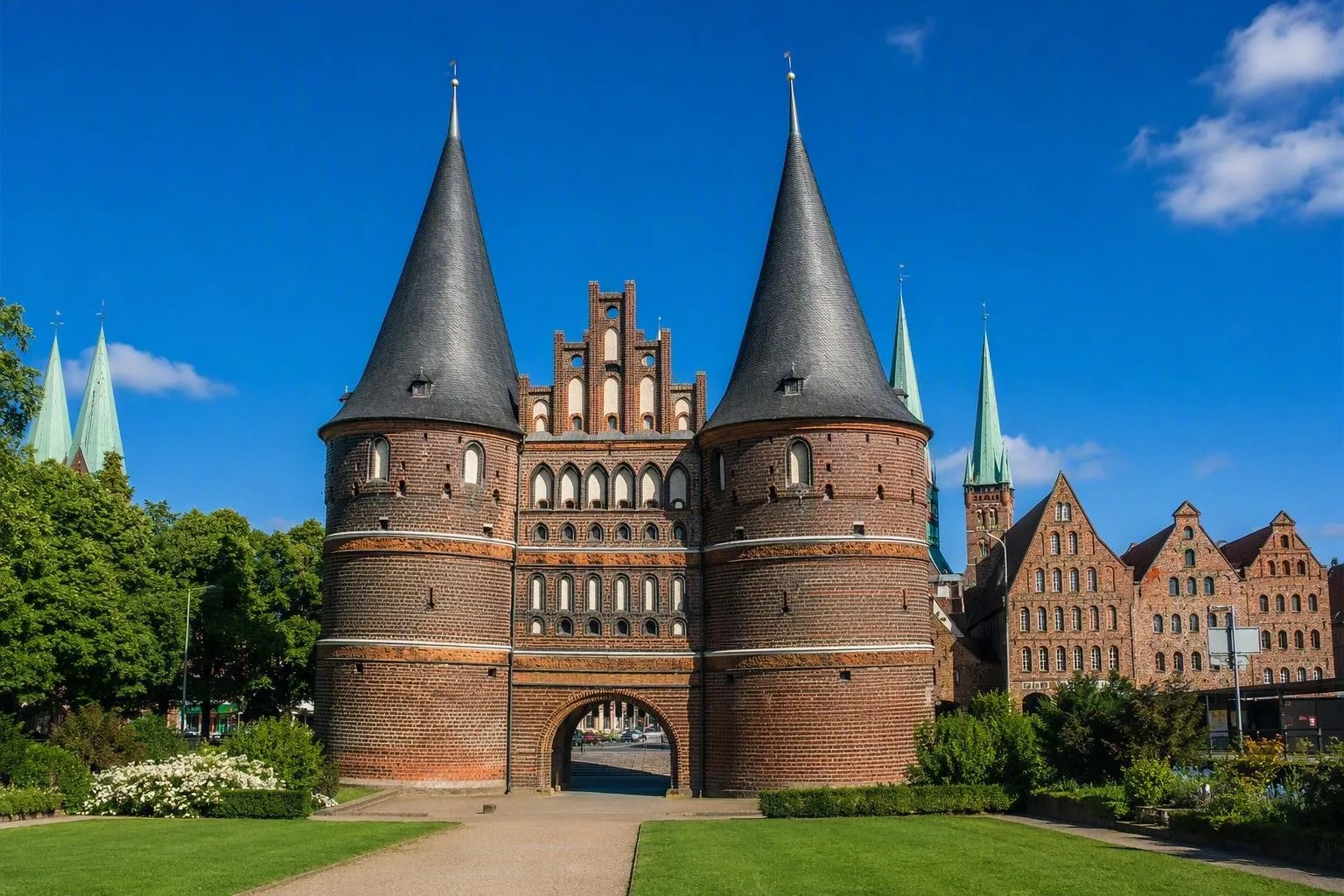
Use the Holstentor as the western threshold. The late-Gothic brick gate, built from 1464 to 1478 as part of the fortifications, was designed for defence and display. Its paired round towers and arched passage make the city’s most direct architectural statement.
From here, follow the Obertrave waterfront. The row of Salzspeicher stands immediately beside the gate. These brick-Renaissance warehouses were built between 1579 and 1745 to hold salt brought in by road, canal and barge. Lübeck exported it north for fish preservation; the warehouses make the city’s commercial history visible without leaving the riverbank.
Continue inland towards the Market, Town Hall and St Mary’s Church. Together they form the civic heart of the medieval city. The skyline is defined by seven spires belonging to five major Old Town churches; keep looking up as you cross the island rather than treating them as isolated stops.
What to seek out
- Koberg and the Hospital of the Holy Spirit: a well-preserved northern Old Town quarter. The hospital was completed in 1286 and its small interior living cubicles reveal its long social function.
- Alleys and courtyards: Lübeck’s Gänge lead from main streets into compact residential courts. They were developed behind merchant plots; many remain homes, so pass through quietly and do not treat doorsteps as viewing platforms.
- European Hansemuseum: the clearest choice for understanding the rise, power and decline of the Hanseatic League and the world of Low German merchants.
- Brick detail: look for stepped gables, tall façades and the repetition of red brick rather than rushing between headline buildings.
Getting oriented
The Old Town is compact enough to explore on foot. Begin at Holstentorplatz, where the Tourist Information is located, then work north or south through the island. Cobblestones and narrow passages reward slower walking; the waterside route is useful for resetting your bearings.
Lübeck’s main station and the Old Town are connected by a short approach across the western edge of the island. Arriving by rail makes Holstentor a natural first landmark rather than a final photo stop.
Food and local character
Try Lübecker marzipan, a local speciality produced under defined quality requirements. It is a practical edible souvenir, but Lübeck’s deeper food history is salt: the Salzspeicher and the Trave explain how a preservative became part of the city’s wealth and northern trading reach.
From the magazine
Stories about Lübeck
Editorial stories linked directly to Lübeck.
Routes from our editors
Travel through Lübeck
Editorial routes connecting Lübeck with other countries, cities and hotspots.
No routes through Lübeck have been published yet.
More in Germany
Related hotspots
Other cities, nature areas and places within Germany.
There are no other hotspots in Germany yet.