Up the Cuestas: Churches and Old Houses in Central Tegucigalpa
Tegucigalpa began beside silver mines, not on a surveyor’s tidy grid. A walk from Los Dolores to Parque Central follows steep streets past adobe houses, republican palaces and two baroque churches that still serve the city.
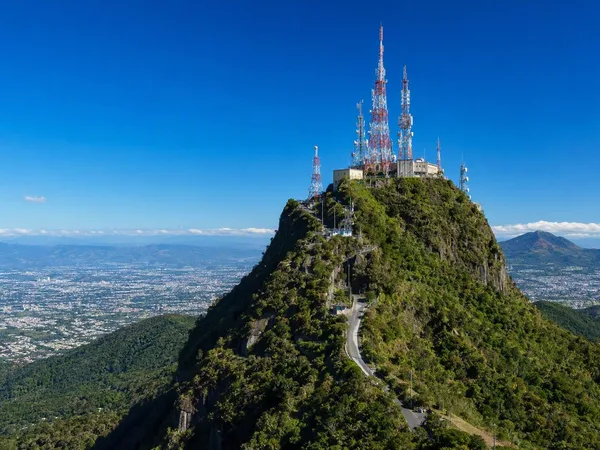
Tegucigalpa’s historic centre occupies a broken valley hemmed in by El Picacho and other steep hills, with Comayagüela across the Río Choluteca. Its narrow lanes bend, climb and squeeze between buildings. Stone, cement and concrete now cover different stretches, while old cuestas still follow paths once used by pack animals and carts.
This is not the familiar colonial image of a ruler-straight grid radiating from a plaza. Tegucigalpa began in 1578 as the Real de Minas de San Miguel de Tegucigalpa, a settlement whose early homes clustered near silver workings on the slopes. The terrain decided where people built. Churches, government offices and wealthy households gathered around a formal central square only later.
Start at Los Dolores, away from the grandest façade. Its history brings the social divisions of the mining town into view.
Los Dolores and Barrio Abajo
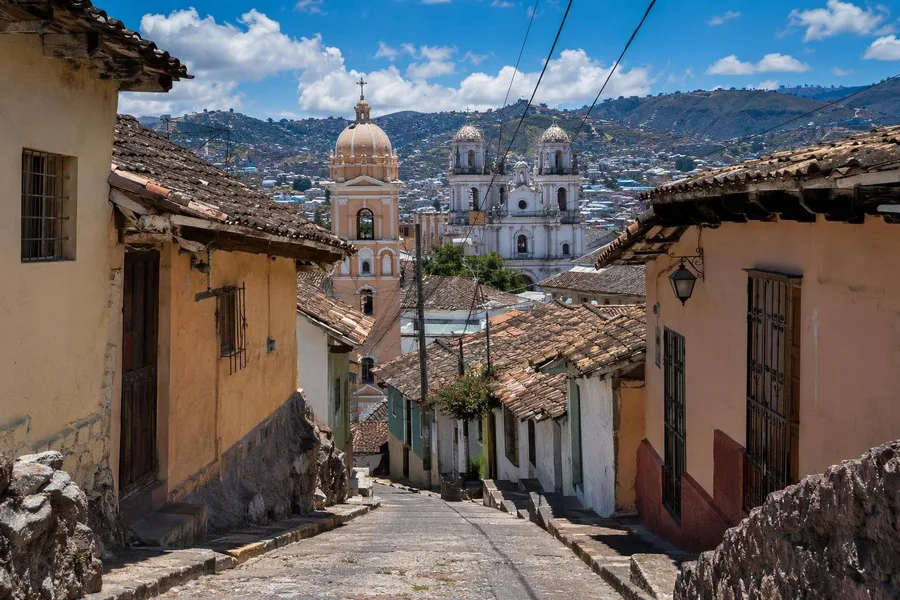 Low houses and church towers line a steep street in central Tegucigalpa.
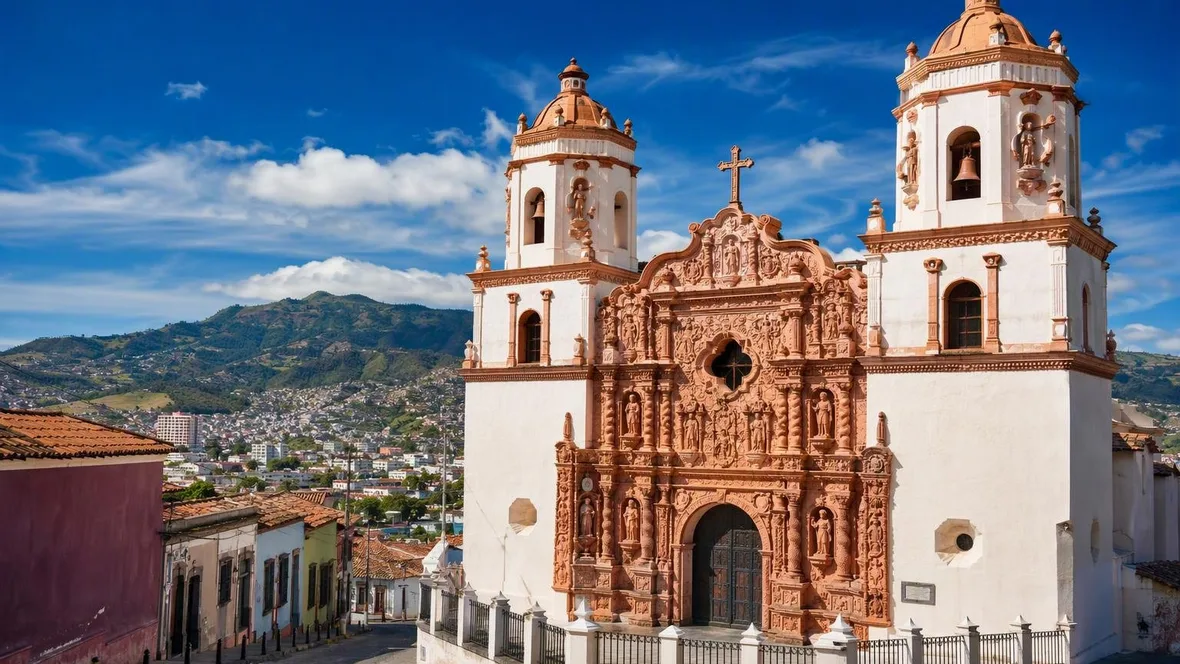
A simple Franciscan chapel stood near the present Iglesia de Santa María de los Dolores around 1579, close to an early Spanish settlement. Builders began the present church in 1732 and completed it in the early nineteenth century, with funding and skilled work from the mixed-race and African-descended residents of Barrio Abajo. Their role matters. The elaborate baroque façade did not come solely from the colonial elite.
Two towers frame a central front dense with estípite columns, cherubs, angels and Marian symbols. Polychrome terracotta figures appear among suns, moons, grapes and glazed fruit, giving the church a markedly local visual language. Moisture, roof leaks and fading colour have also left their marks, so the façade shows both its craft and its fragility.
Later work divided the interior into three naves and added a dome above the enlarged chancel. Retables by the painter and assembler Blas de Meza preserve paintings on wood; other works include San Francisco, La Santa Cena and a sculpture of the Holy Trinity. Los Dolores remains an active parish and a setting for processions. It is not a church preserved behind glass.
Patio houses on the climb toward the centre
The slopes from Barrio Abajo lead towards streets lined with former homes. Along Avenida Miguel Cervantes, old casonas retain adobe walls, interior patios and wrought-iron balconies, although shops, offices and cultural spaces now fill many of their rooms. Clay-tile roofs still mark the historic streetscape.
The patio solved practical problems as well as social ones. It brought daylight and ventilation to rooms behind thick external walls. These inward-looking homes sit beside the public architecture added after Tegucigalpa became Honduras’s permanent capital in 1880, when institutions and republican buildings went up among older churches and houses.
Casa Morazán, on Avenida Cristóbal Colón, makes the shift from private home to public monument especially clear. Builders completed the house in 1761, and the Morazán family lived there from 1792 for more than half a century. Its historic rooms and a modern rear extension now form a museum with documents, portraits and objects connected to Francisco Morazán, the Honduran statesman associated with Central American union. A modest colonial house now holds a national political memory.
Casa Valle often appears beside Casa Morazán in accounts of Honduran independence figures, but it does not belong on this walk. José Cecilio del Valle’s birthplace stands in Choluteca, not Tegucigalpa. Its arcade, adobe walls, exposed beams and paved patio belong to the same colonial housing tradition, but moving it mentally to the capital erases the distance between the two cities.
From domestic walls to presidential display
The Antigua Casa Presidencial presents power in a different register. Built between 1916 and 1922, the L-shaped republican palacete served as the presidential residence from 1922 until 1990. Its four eclectic façades combine neo-medieval, neo-Gothic and neo-Renaissance details around an interior garden.
The contrast with the colonial patio house is direct. Thick adobe walls screened domestic life from the street; the presidential residence used decorated façades, formal corridors and reception rooms for public authority. The National Archive, an ethnohistorical archive and a specialist library now occupy the building, while tours can include the Salón Azul, once used for receptions and celebrations.
Casa Casco offers another republican variation. Augusto Bressani designed the neoclassical house for the Casco family between 1919 and 1924. It remains private property, but restoration returned it to residential use for students with limited means. That use keeps a former elite residence in the daily life of the centre rather than turning it into another ceremonial museum.
Practical details: Museo Casa Morazán has free entry Monday to Friday, 9.30am–4pm. Los Dolores and the cathedral are active churches with several daily Masses, but neither publishes separate tourist hours or admission fees; access outside worship can vary. The Museo para la Identidad Nacional also runs occasional guided Zotz Tours that include Los Dolores, Casa Morazán, Plaza Morazán and the cathedral; it announces dates through the museum and tour operator.
Parque Central and the cathedral of San Miguel
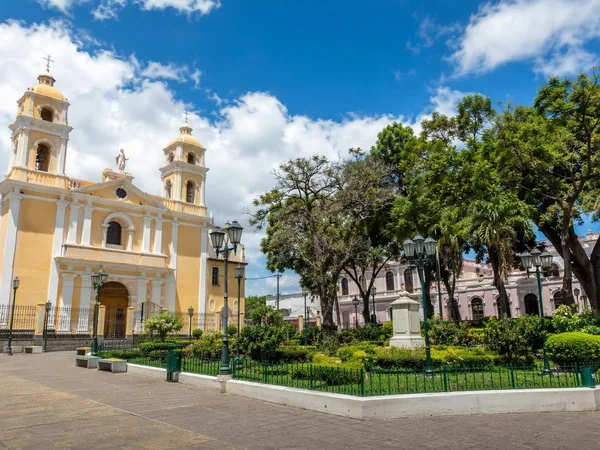
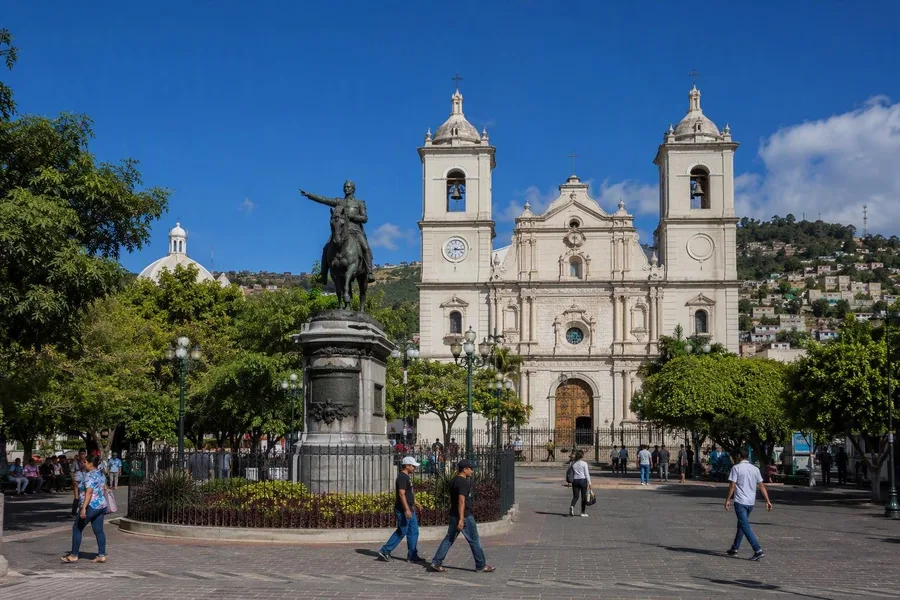 Morazán’s equestrian statue faces the cathedral across Parque Central in Tegucigalpa.
Parque Central, officially Plaza Cívica Francisco Morazán, grew from the colonial Plaza Mayor, the site of Tegucigalpa’s principal civic and religious ceremonies. After the capital moved here in 1880, the square received an equestrian statue of Morazán and figures representing the four seasons. Gardens, benches, a fountain and a metal globe share the space with pedestrians, traders and shoe shiners.
The Catedral Metropolitana de San Miguel Arcángel stands on the square’s eastern side. Iglesia de San Miguel Arcángel and the metropolitan cathedral are the same church and parish, not separate stops. Builders began it in 1765 after an earlier parish church burned down; they consecrated the new church in 1782.
Its compact baroque façade reads like a stone retable. Heavy rusticated pilasters divide the front, two bell towers rise at its sides, and San Miguel stands in the central niche beneath the clock. Inside, a single barrel-vaulted nave leads to a gilded cedar high altar carved by Vicente Gálvez, where seven archangels surround the Immaculate Conception. José Miguel Gómez painted the four evangelists on the pendentives beneath the dome.
Morazán faces El Picacho from the middle of the square. Across Parque Central, the cathedral’s carved stone towers rise above the low roofs and climbing streets, with the hills that shaped the old mining settlement visible beyond them.
Keep exploring