Five ways to get to know Bengaluru
Bengaluru cannot be summed up by a single neighbourhood or monument on a first visit. Start among bamboo and granite, try a long-established breakfast dish, watch the early market trade and finish among bookshops and restaurants in the centre.
1. Walk through Cubbon Park to Vidhana Soudha
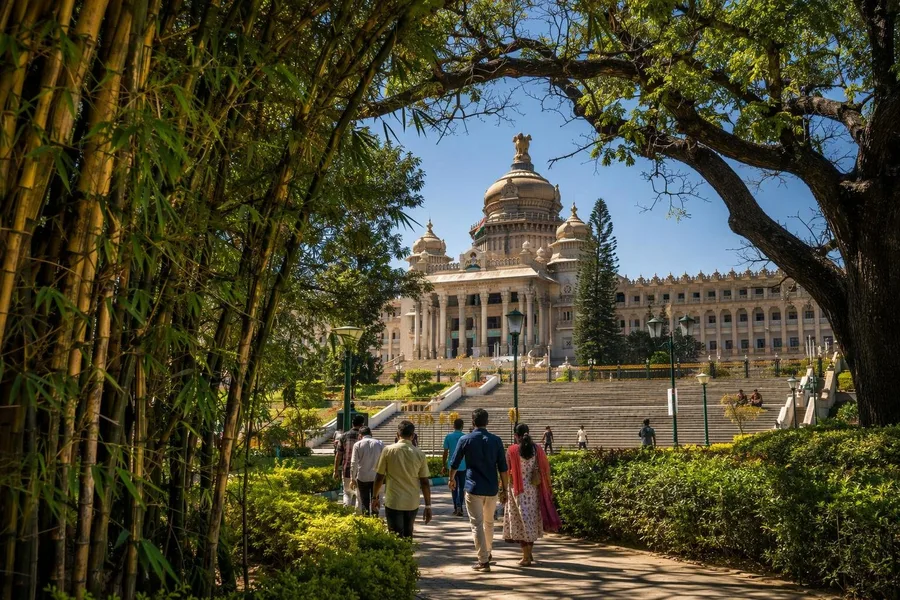 Pedestrians walk through Cubbon Park toward Vidhana Soudha in Bengaluru’s administrative centre.
Cubbon Park sits at the heart of Bengaluru's administrative district and offers a useful starting point for getting to know the city. British engineer Richard H. Sankey designed the park in 1870. Rather than turning the site into a flat, formal garden, he incorporated its slopes, rocks and water features into the layout.
Walk past open lawns and shaded paths towards the broad avenue beside the Government Museum and the bandstand. Military bands played here until independence in 1947; music programmes have since returned. Silver oaks introduced in 1870 still stand alongside several varieties of bamboo.
At the edge of the park, two buildings bring different chapters of the city's political history into sharp focus. The red Attara Kacheri served as a colonial administrative building and now houses Karnataka's High Court. Across the road stands Vidhana Soudha, the seat of the state legislature. Construction began in 1952 and finished in 1956.
Take time to look up at it from outside. Broad steps, tall columns and a central dome define the building, which is constructed largely from Bengaluru granite. The legislature describes its style as neo-Dravidian, combining British, Dravidian and Indo-Islamic elements. Together, the courthouse's red facade and Vidhana Soudha's heavy grey stone tell you a great deal about Bengaluru, without requiring a visit to a museum.
2. Watch Kalasipalya wake up at KR Market
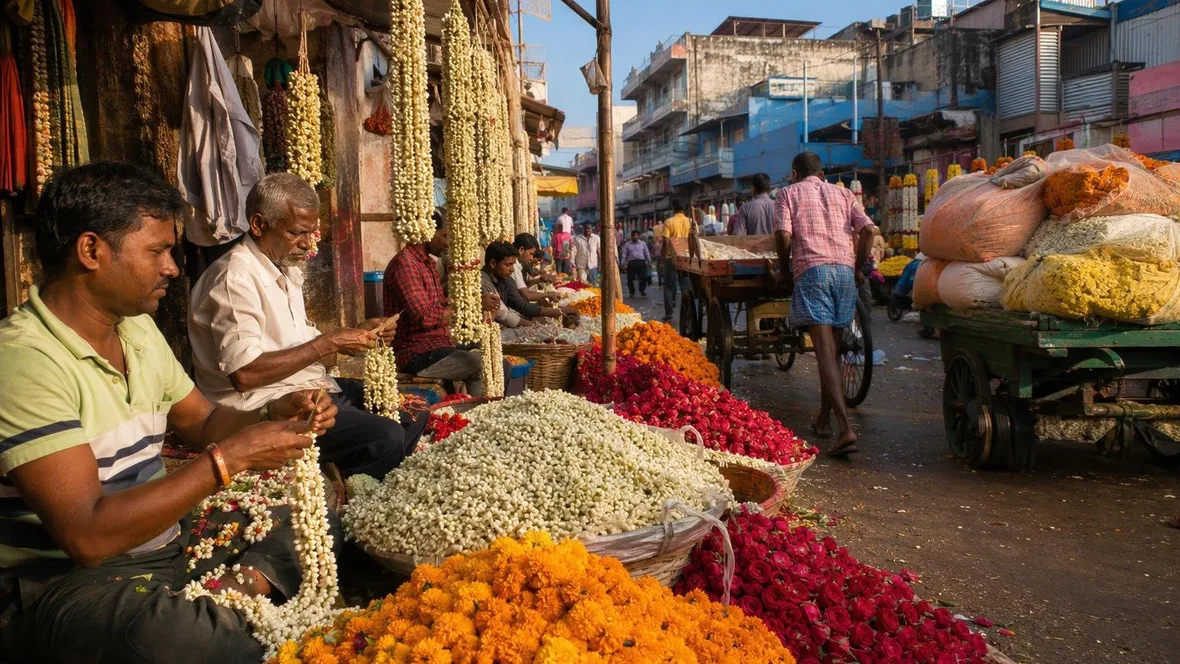
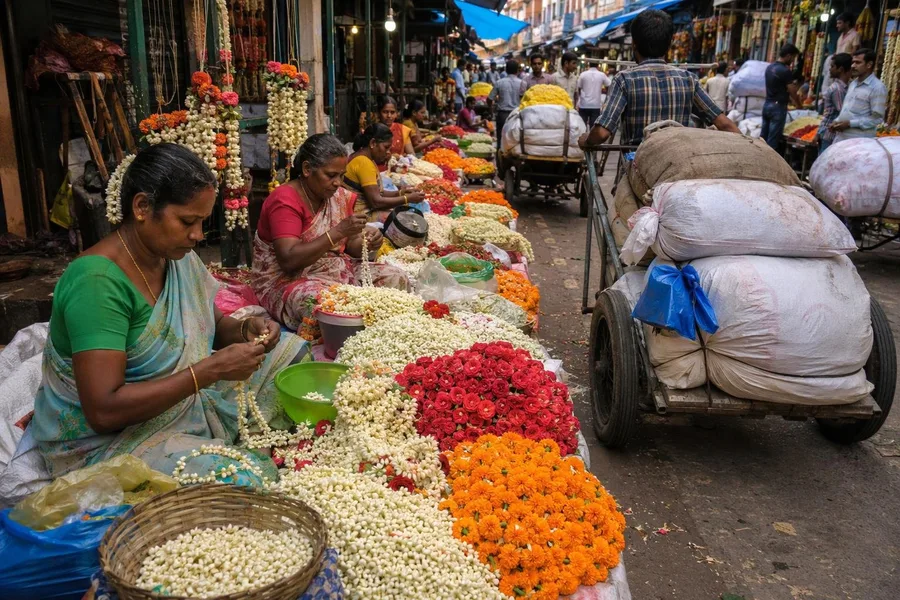 Vendors string jasmine garlands amid flower heaps at KR Market in Kalasipalya.
KR Market, also known as City Market, stands in Kalasipalya, Bengaluru's old trading district. Do not come expecting a neatly contained visitor attraction. This is a working wholesale hub for florists and buyers sourcing flowers for temples, weddings and pujas.
In the early hours, marigolds, roses, chrysanthemums and jasmine lie in sacks and heaps ready for sale. Vendors thread jasmine into tight garlands. Buyers inspect the flowers, handcarts move through narrow passageways, and scooters squeeze past the trading stalls. After the early rush of flowers, fruit and vegetables take up more space. Elsewhere in the district, shops sell metal utensils, tools, plumbing supplies and machine parts.
This mix of trades reflects the history of the site. It was once occupied by Siddikatte, a reservoir on the edge of the old Pete trading town. A weekly market grew around the water. After the reservoir was filled in during the nineteenth century, fruit and vegetable traders took over the land and trading became a daily affair.
The current market building opened in 1921. Modelled on Calcutta's Sir Stuart Hogg Market, it originally had a single storey and a clock tower; another floor was added later. Look beyond the flowers, too. The surrounding streets show why trade here has extended far beyond a single market hall for generations.
3. Follow the long views through Lalbagh Botanical Garden
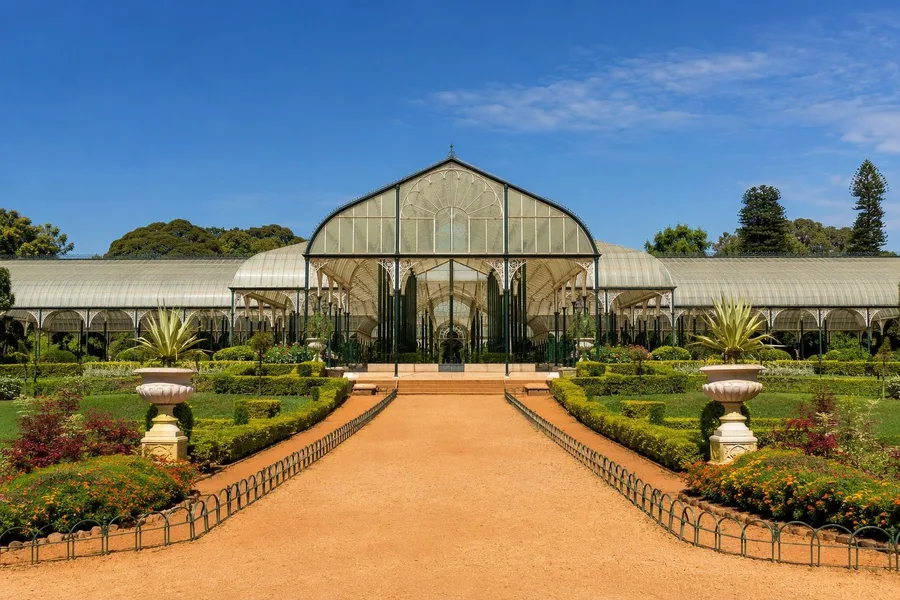 The iron-and-glass Glass House stands on Lalbagh Botanical Garden’s central walking axis.
Lalbagh began as a botanical collection in 1760 and continued to grow. The garden has 2,150 plant species from 673 genera and 140 plant families, including both native plants and species introduced from elsewhere. Three mango trees beside the fernery are said to be about 250 years old and still bear fruit.
The central walking axis provides a clear route through the large park. During the nineteenth century, garden superintendent John Cameron laid out terraces, lawns, formal flower beds, topiary and symmetrical pairs of trees here. Buildings mark the line of sight.
At its centre stands the Glass House, an iron-and-glass structure built in 1889–90 and modelled on the Crystal Palace. It initially served to acclimatise exotic plants. Today, it hosts flower shows twice a year. Outside those events, Lalbagh remains principally a garden where local people walk and jog.
Continue towards Lalbagh Lake and finish at the Peninsular Gneiss rock. This granitic rock is more than three billion years old. A sixteenth-century watchtower stands on top, one of four boundary markers commissioned by Kempegowda I, Bengaluru's founder. From the rock, the botanical garden and the city's earliest boundaries come into view together.
4. Have breakfast at MTR on Lalbagh Road
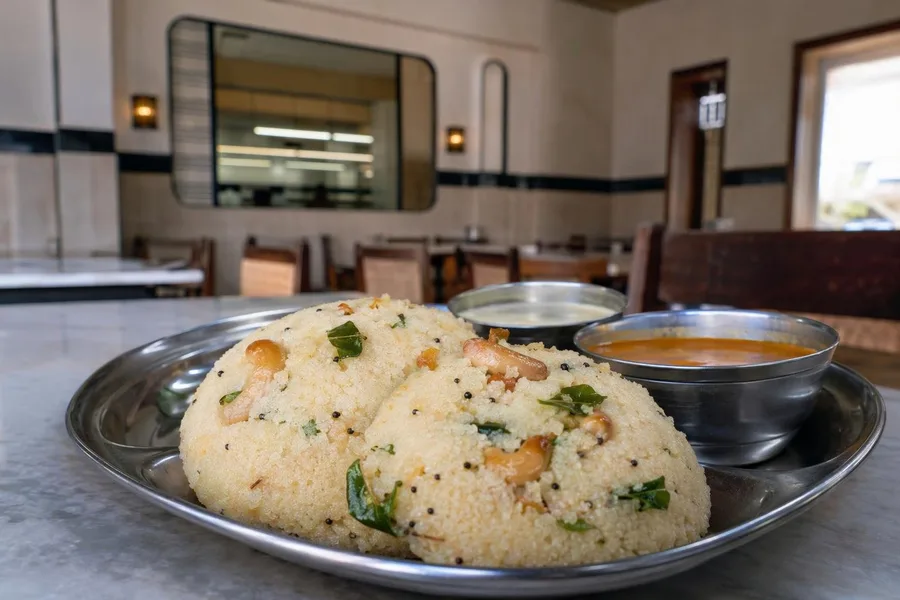 Rava idli with cashews and curry leaves at MTR on Lalbagh Road.
Mavalli Tiffin Rooms, usually called MTR, is a good place to understand Bengaluru's vegetarian breakfast culture. The Maiya brothers, originally from Udupi, opened the business in 1924 as Brahmins Coffee Club. Its present two-storey premises on Lalbagh Road, with an art deco facade, date from 1960.
Order rava idli here. These steamed semolina cakes originated when rice was scarce during the Second World War. The kitchen switched to semolina and created a dish that endured. Yoghurt, cashews, curry leaves and mustard seeds give the idli flavour and texture.
Masala dose has been on the original menu since 1924. The kitchen cooks a pancake made from fermented rice and black lentil batter in ghee, then fills it with spiced potato. To try more, choose bisibele bhath, made with rice, lentils, vegetables and tamarind, or filter coffee. On Sundays, MTR also serves chandrahara, a sweet fried dish from Karnataka.
Practical details: Cubbon Park is free to enter from Tuesday to Sunday, 6am–6pm; it is closed on Mondays and the second Tuesday of the month. View Vidhana Soudha from outside unless official access has been arranged in advance. For the flower trade at KR Market, arrive before 7am; Krishna Rajendra Market station is on the Green Line, and wet floors can be slippery early in the day. Lalbagh opens daily: entry is free from 6am–9am and 6pm–7pm, while daytime admission costs ₹30 for adults. MTR closes on Mondays and serves breakfast from Tuesday to Sunday, 6.30am–11am. Church Street is a few minutes' walk from MG Road metro station.
5. Browse bookshops and eat on Church Street
Church Street runs parallel to MG Road in the former British cantonment. Both Church Street and St Mark's Road appeared on a map from 1854. MG Road was then called South Parade Road and served as the cantonment's principal commercial street.
Church Street still has plenty of shops, but its bookshops give this short street a character of its own. In 2022, it had around ten of them. Independent businesses such as Blossoms Book House and The Bookworm keep that tradition alive. Looking for a book is an activity in itself here, with cafes and restaurants dotted between the shops.
A redesign turned Church Street into a 700-metre corridor with a granite-cobbled roadway and pavements between 2.5 and 4 metres wide. Heavy traffic around the restaurants damaged parts of the paving, prompting repairs in late 2024. The street is not permanently pedestrianised: closures to motor traffic in 2020 and 2021 were temporary weekend trials.
Come towards the end of the day, when the shopfronts light up and the granite cobbles carry walkers, diners and people with newly bought books along the street towards MG Road.
Keep exploring