Three Wooden Churches at the Heart of Chiloé
Castro wraps its timber frame in yellow and purple metal. Achao holds an older sanctuary together with wooden pegs. Dalcahue faces the channel behind nine wooden arches. These three churches show how Chiloé’s carpenters adapted Catholic forms to an island world of timber, boats and wet weather.
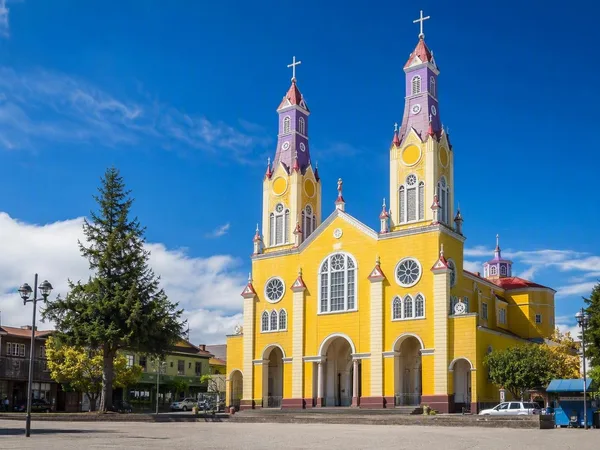
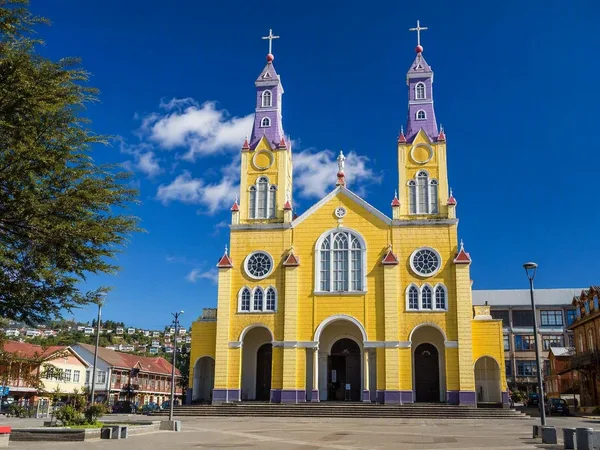
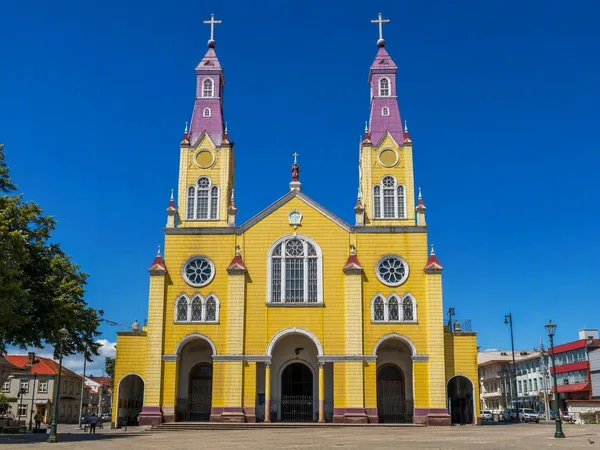
San Francisco stands on Castro’s Plaza de Armas, large enough to unsettle any easy idea of Chiloé’s wooden churches as rustic chapels. Its yellow-and-purple façade, twin towers and octagonal dome belong to the town’s everyday centre. Behind the painted galvanised iron, however, sits a timber structure made by Chilote carpenters.
Castro, Achao and Dalcahue belong to the 16 Chiloé churches inscribed as World Heritage in 2000 and protected in Chile as national historic monuments. That protection covers more than the buildings: their forecourts, relationship with the sea and continuing religious life form part of their significance. These remain parish churches, not timber shells preserved at a distance from island life.
Castro’s timber church in a metal skin
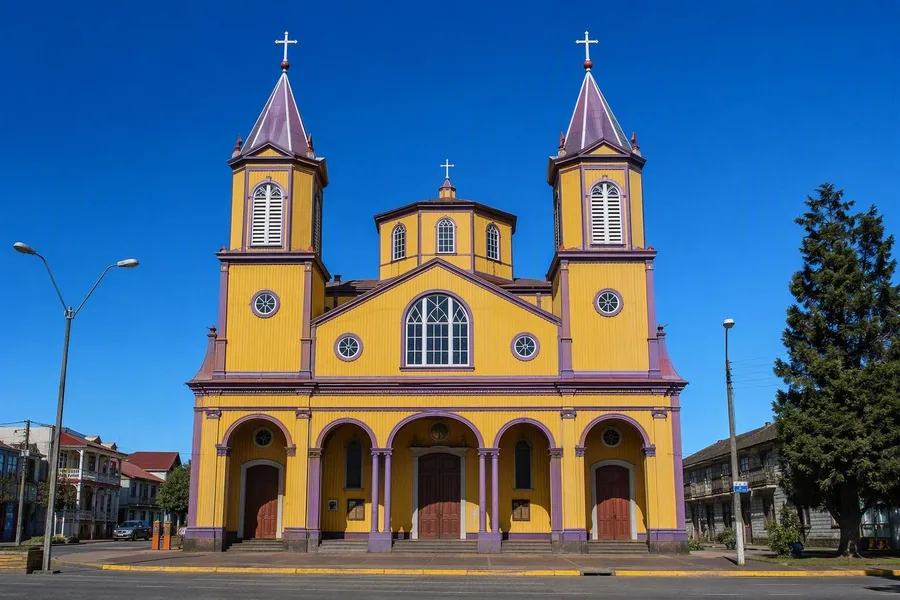 San Francisco Church’s yellow-and-purple façade faces Castro’s Plaza de Armas.
The present church of San Francisco dates from 1910–1912. Italian Franciscan Eduardo Provasoli supplied a neo-Gothic and classical design, and local builders made it in alerce, ciprés, coigüe and other native woods before cladding the façade, roof and exterior walls in painted galvanised iron. The metal makes Castro the outlier among these three churches. Its woodwork is most legible indoors.
Ribbed vaults, round arches and columns draw the eye through the nave. Raulí and olivillo panelling catches coloured light from stained glass. The forms recall European masonry churches, but their structure comes from an archipelago where carpenters built roofs and towers from joined lengths of wood. The fitted timbers and joints of those upper structures carry techniques closely related to local boatbuilding.
Castro had served as the departure and return point for maritime missionary circuits from the 17th century. San Francisco came much later, yet its scale fits that older role as the urban base of a scattered island network.
The church still serves the parish of Apóstol Santiago, with weekday and Sunday Masses. In 2025, a diocesan pilgrimage ended on the square before young participants carried a jubilee cross and an image of Jesús Nazareno into the church. The plaza has not become a backdrop for a monument. It still accommodates the public movements that brought a church, a forecourt and a town centre together.
Repair has altered the building without disguising its needs. Workers structurally reinforced the towers in 2008, and the current yellow-and-purple paint dates from 2012. Electrical work and exterior lighting later addressed fire risk in the timber building.
Achao’s old frame and sea-facing door
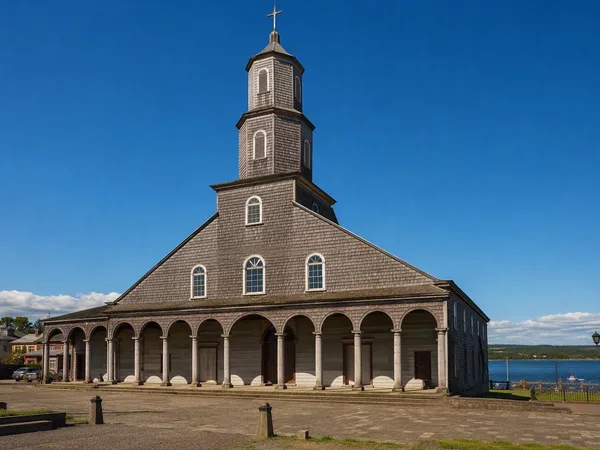
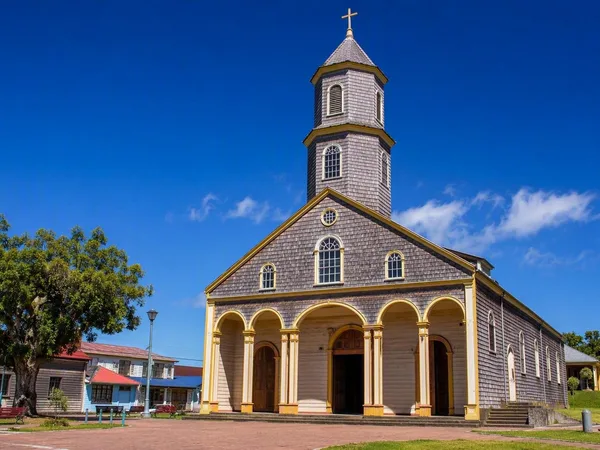
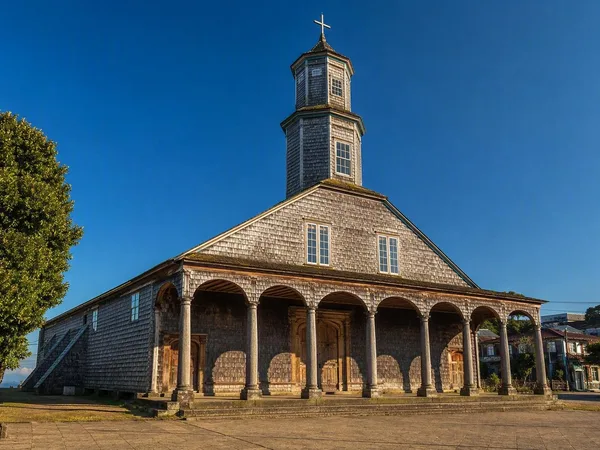
On Isla Quinchao, Santa María de Loreto stands lower on Achao’s plaza. It preserves fabric from 1730 and is generally dated to around 1740, making it the oldest surviving church in the Chiloé group. A covered wooden portico, bell tower and pitched roof clad in overlapping alerce shingles give the exterior a restrained profile.
Achao makes the mission history concrete. Jesuits began work in Chiloé in 1608, but did not establish a chain of permanent mission towns for the dispersed Huilliche communities. They travelled by boat on an annual misión circulante, visiting chapels around the islands and sheltered inland sea. Achao became a fixed mission station near the end of the Jesuit period, and the church entrance faces the sea at short distance from the shore.
Island communities supplied labour and materials for early chapels. A locally chosen lay official, the fiscal, oversaw worship and the church when no priest was present. Franciscans continued the maritime network after the Jesuits’ expulsion in 1767. The Catholic rite arrived from abroad, but local people kept the buildings and their religious calendar working through the year.
Achao’s construction records that local knowledge plainly. Ciprés de las Guaitecas forms the structure, alerce covers it, and mañío appears in decorative parts. Carpenters used mortise-and-tenon joints, wooden pins and dowels rather than metal nails. Three naves, barrel vaults, carved columns, a polychrome altarpiece and a pulpit give the timber interior a formal richness without concealing how it was made.
Sunday Mass and the December patronal feast keep the church in parish use. Each New Year, communities from Matao, Quinchao, Putique and Coñab carry their saints’ images to Achao for Mass, then take them home with hymns and pasacalles. The old pattern of dispersed communities gathering at one church still has a physical presence.
The tower was completely rebuilt in the 1960s, when alerce shingles also covered the entire exterior. Achao’s value does not rest on a fiction of untouched wood. Generations have replaced exposed elements while retaining an old structural tradition and an active place of worship.
Dalcahue’s nine arches by the channel
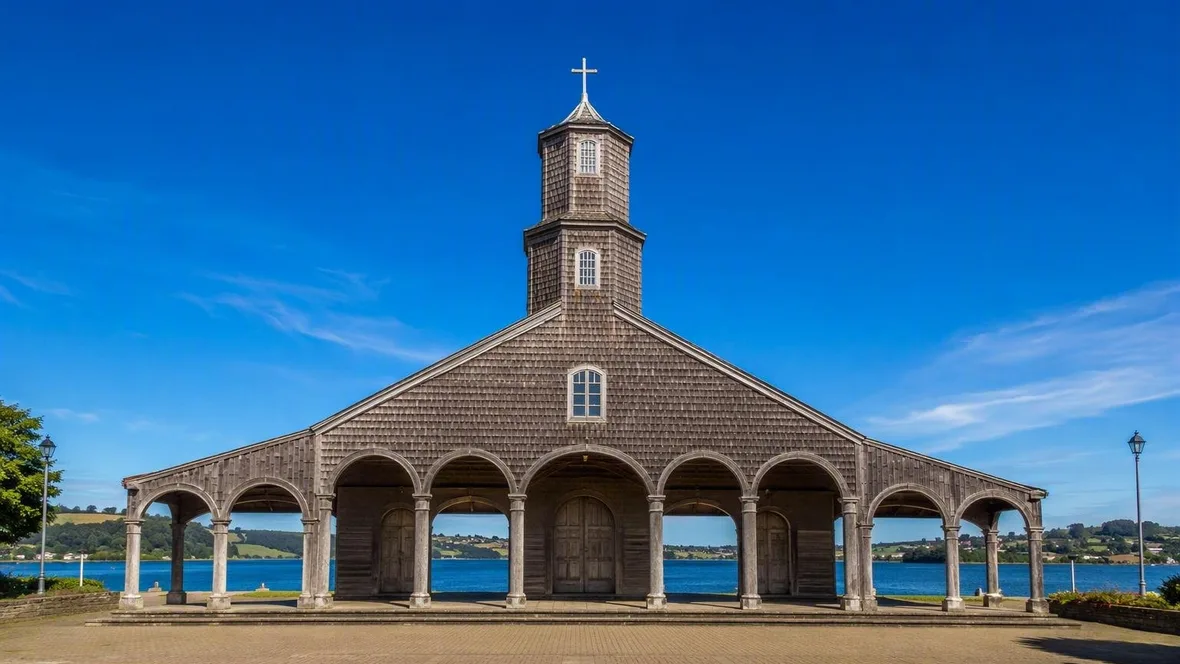
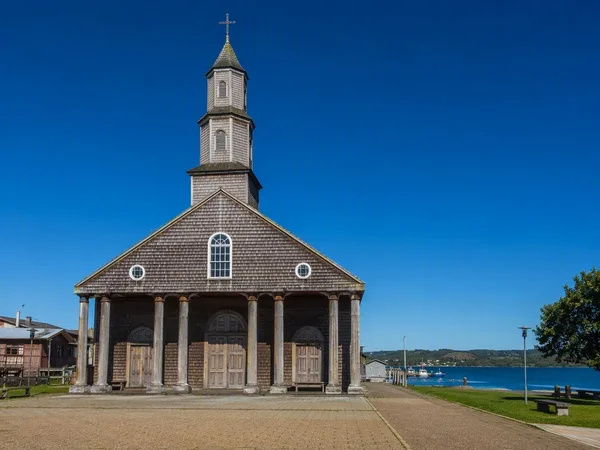
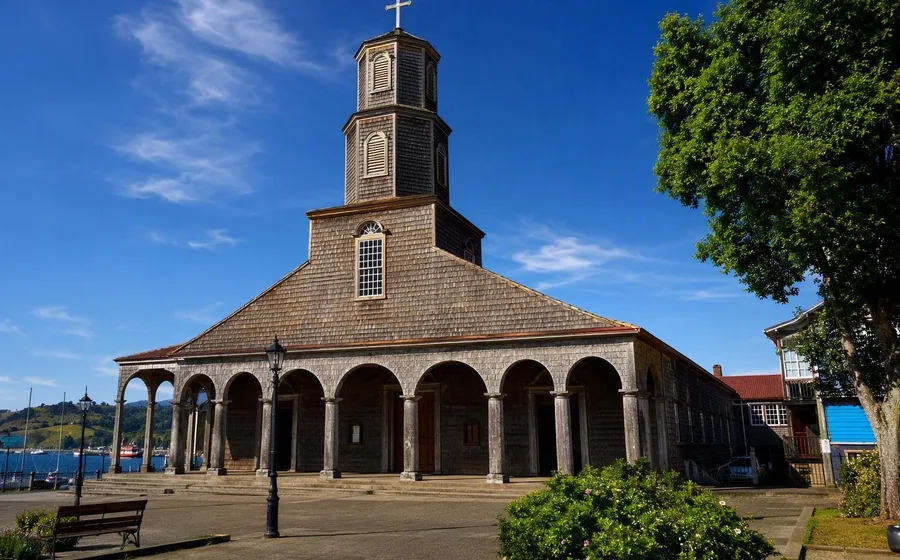
Nuestra Señora de los Dolores stands on Dalcahue’s Plaza de Armas, opposite the sea. The town’s name refers to the dalca, an Indigenous boat. Built between 1893 and 1902 on the site of an earlier mission chapel, the church places a bell tower over a broad portico of nine semicircular wooden arches. That open threshold links the plaza to the three-aisled nave and keeps the channel to Quinchao in view.
Ciprés and ulmo support the structure; alerce shingles form its rain-shedding outer layer. A hinged crucifix behind the altar serves the Good Friday rite of taking Christ down from the cross. Wednesday and Sunday Masses, the September patronal feast and civic commemorations bring regular use to the church and the explanada outside.
Dalcahue also offers the clearest record of what wooden heritage needs. During restoration in 2013–2015, workers dismantled the church, numbered beams, posts and boards, then assessed and reused sound timber. Some damaged posts went into side walls; decayed floor beams became steps to the tower. Rot fungi had affected the wettest exposed wood, while insects damaged softer tepa in the lofts. Moderately affected pieces remain visible in the tower and roof space so they can be inspected and treated.
New foundations stabilised the building. Restorers also returned pale interior colours and marble imitation to the columns and frieze. The work preserved a practical logic: this is a built-up wooden structure whose parts can be opened, judged and fitted back together.
Practical details
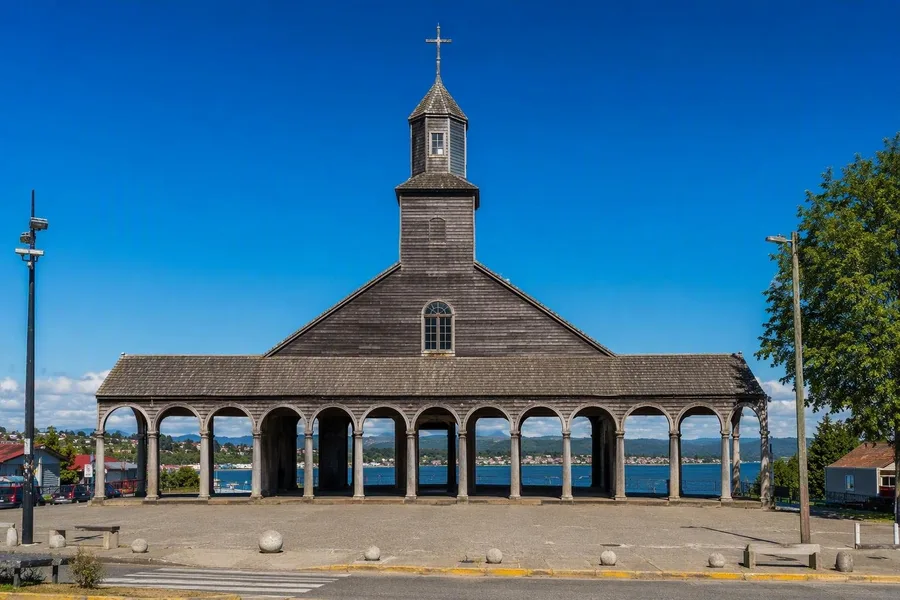 Dalcahue’s nine-arched wooden portico stands between the plaza and the channel to Quinchao.
San Francisco stands on Castro’s Plaza de Armas; Dalcahue’s church is beside its plaza and waterfront; Santa María de Loreto faces Achao’s plaza on Pedro Montt. The churches have no guaranteed visitor hours and no standard admission ticket is listed, so daytime visits outside services offer the best chance of interior access; a small maintenance donation is appropriate. Dalcahue lies 20 kilometres north of Castro and can be reached by local bus, colectivo or car. Achao requires the onward ferry crossing to Isla Quinchao.
At Dalcahue, the plaza ends at the nine-arched portico. Beyond it, the timber nave begins; behind it, the channel runs towards Quinchao.
Keep exploring
Places in this story
South America
3 landen en gebieden
Chile
Chiloé
Castro, Chiloé
Isla Quinchao
Achao
Dalcahue
Dalcahue is a small channel-side town on the eastern coast of Chiloé Island, 20 km north of Castro. Its World Heritage wooden church, waterfront artisan fair and Quinchao ferry link heritage, craft and island travel in one compact centre.
San Francisco Church, Castro
Santa María de Loreto Church, Achao