Manises: Where Clay Still Marks the Town
On Carrer del Sagrari, eighteenth-century tiles sit beneath the windows of Casa Ferraro. Inside, the Museu de la Ceràmica de Manises traces the local work that made Manises known far beyond Valencia, then leads back out to workshops, a ceramics school and tiled public spaces.
Casa Ferraro on Carrer del Sagrari
Casa Ferraro stands three storeys high on Carrer del Sagrari, with a central entrance, wrought-iron balconies and eighteenth-century polychrome tiles beneath its windows. The house dates from 1784; it was a residence, not a factory. A tiled Holy Trinity panel sits on the first floor of the façade, and a late-fifteenth-century Gothic doorway remains inside.
The Museu de la Ceràmica de Manises provides a useful base in a town where pottery appears in fragments: a tiled façade here, a street monument there, a workshop behind another door. Its collection contains more than 5,500 objects, mostly made in Manises, from the fourteenth to the twentieth centuries and into the present day. Excavated pieces and donations from residents and manufacturers connect the displays with the town’s own ground and businesses.
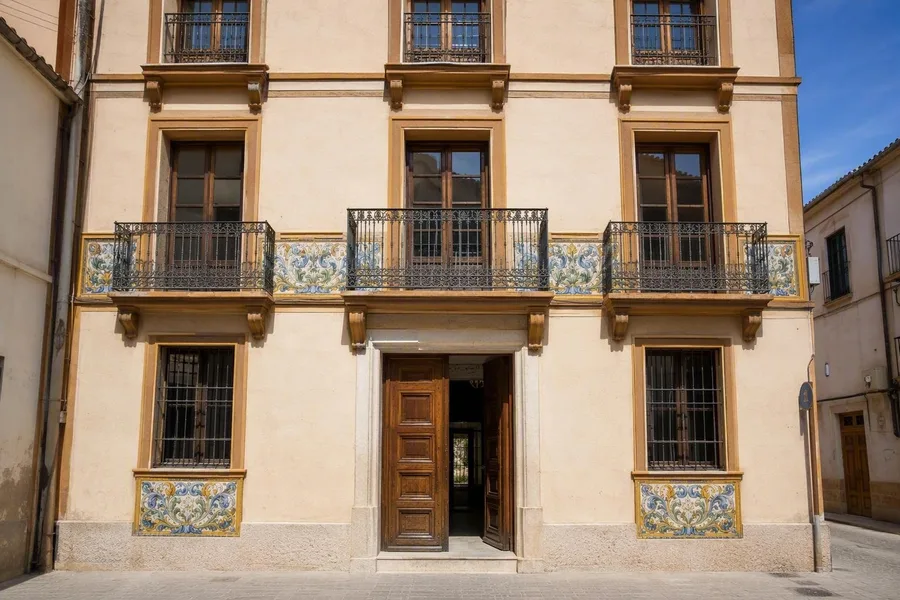 Eighteenth-century polychrome tiles sit beneath the windows of Casa Ferraro on Carrer del Sagrari in Manises.
A restoration and extension from 1985 joined the old house to newer spaces with stairs and ramps around a central void beneath a translucent vault. The galleries follow local production in chronological order. In the technology room, original tools explain clay preparation, shaping, glazing, decoration and firing. A late-nineteenth-century tile press, an Arab-type kiln for metallic lustre and a model of a mid-twentieth-century faience factory show the work behind a finished plate or tile.
Medieval kilns, blue glaze and gold lustre
Manises grew from Islamic pottery workshops that continued after the Christian conquest of Valencia. Pere Boïl, the local lord, secured suitable potters' clay and maintained connections with Nasrid Granada. Documents record lustreware production here by about 1325. Islamic technical knowledge, Mudéjar craftspeople and Christian patrons worked within the same production centre.
The town's signature was reflejo metálico, or metallic lustre. Potters laid a very thin layer containing silver and copper compounds over a lead-tin glaze, then fired the piece in an oxygen-poor kiln. The surface could turn gold or copper-coloured, with an iridescence that changes as light strikes it from another angle. Early texts called this opus aureum, meaning golden work.
The best-known Manises palette uses a cream-white tin glaze, cobalt blue and gold-to-copper lustre. Tin made the ground opaque. Cobalt produced dense blue lines, leaves and ornaments. Early bowls and dishes often carried repeated geometry, interlacing patterns, stylised foliage and forms resembling Arabic script. Later commissions added more naturalistic Gothic plants and coats of arms.
A late-fifteenth-century dish attributed to Manises shows how these elements could work together. Raised ribs divide its cream-white surface into petal-like sections; blue decoration, matt-brown lustre and a central coat of arms cover the dish. Clay, glaze and relief give it some of the visual force of precious metalwork.
Valencia's port sent Manises lustreware to northern Italy. Patrons also commissioned heraldic tiles for popes and ceramic work for castles in Naples and Gaeta. That trade explains why a small town near Valencia gained an international medieval reputation, and why the museum holds both domestic vessels and architectural ceramics.
Tiles after the medieval boom
The expulsion of the Moriscos in 1609 removed many master potters from Manises and weakened blue-and-lustre production. In the late eighteenth century, fine earthenware and brighter polychrome decoration gained ground under the influence of the Alcora factory. Metallic lustre remained part of local production, but it no longer carried the whole trade.
Nineteenth-century workshops developed into factories producing fine earthenware, tiles, plates and jugs for daily use. Tile production returned on a large scale from the 1840s. In the twentieth century, white calcareous bodies, plaster moulds and stencils supported serial production. Relief and tube decoration appeared on tiles in Art Nouveau and Art Deco styles.
The museum puts these shifts in sequence: local green-and-manganese ware, cobalt blue, blue-and-gold lustre, Baroque polychrome ceramics and twentieth-century tilework. Works by Alfons Blat and Arcadi Blasco, alongside prize-winning pieces from the international ceramics biennial, extend the collection into contemporary practice. Local makers adapted clay to domestic use, decoration and industrial production across successive periods.
Workplaces and ceramic streets
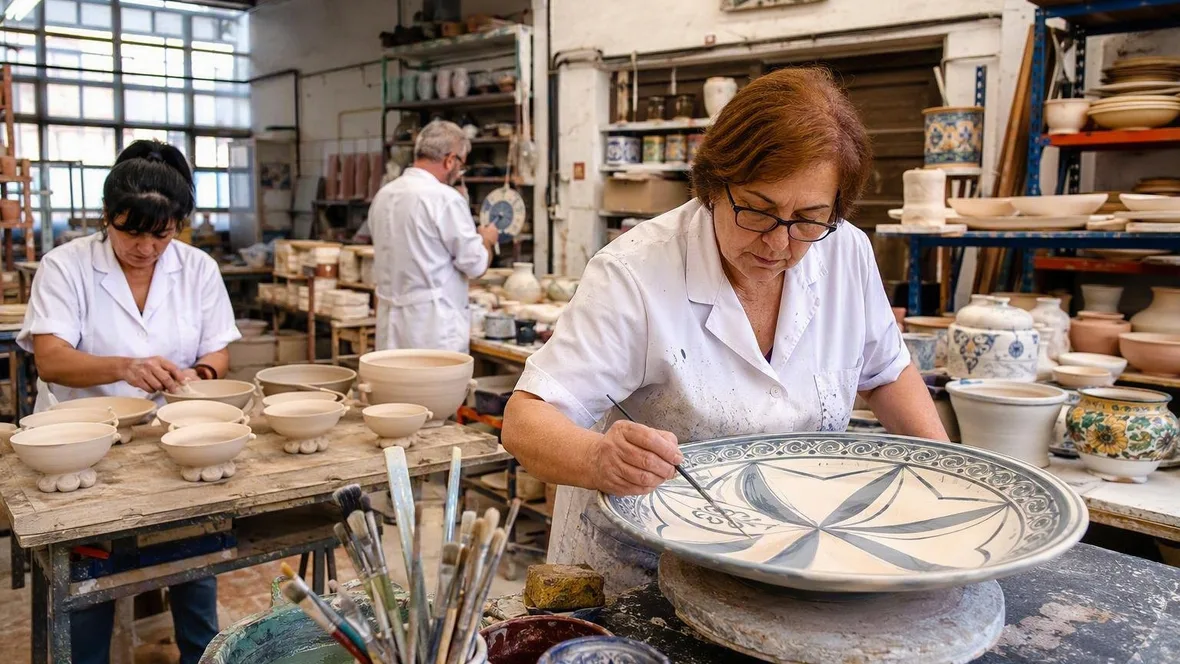
In Barri d'Obradors, La Cerámica Valenciana de José Gimeno Martínez stands above a fifteenth-century pottery workshop. The factory has operated continuously for a century and includes eight exhibition rooms. During its factory visits, craftspeople model, glaze and decorate ceramics in view of visitors. This is one place where the source confirms the work, rather than merely the address.
A public ceramics route links the factory with the museum, the former ceramics school, AVEC-Gremio and El Arte. El Arte combines tilework with an Arabising section decorated in metallic lustre. Along Avenida Blasco Ibáñez, ceramic inlays and monuments include a tribute to José Gimeno Martínez. Tiles and fired clay form part of the town's ordinary surfaces.
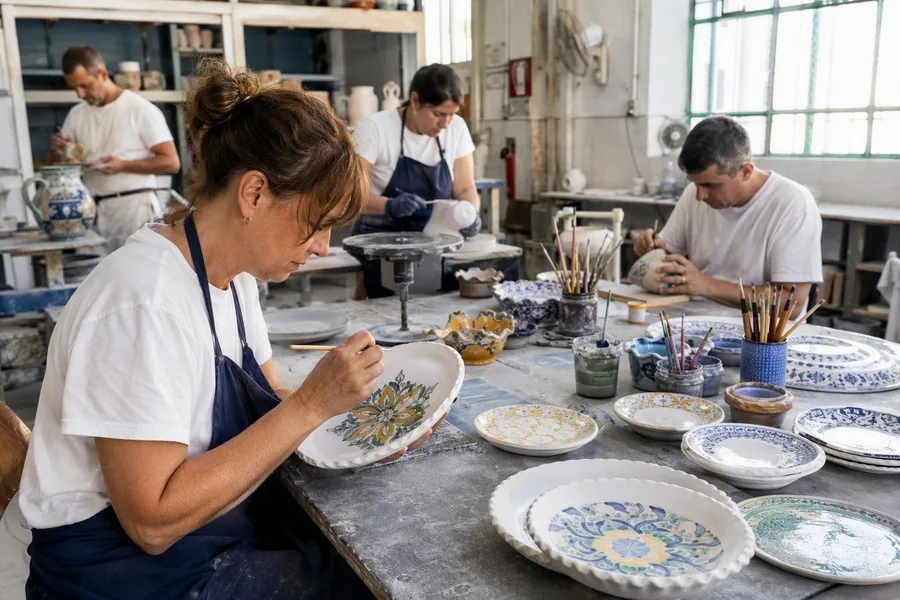 Craftspeople model, glaze and decorate ceramics at La Cerámica Valenciana in Manises.
The Escola d'Art i Superior de Ceràmica de Manises keeps ceramics in formal teaching through a four-year degree, a two-year higher vocational course and a master's programme. Its facilities cover modelling, sculpture, digital techniques and mould-making. Each July, the Festa de la Ceràmica takes working methods onto Avenida Blasco Ibáñez. The 2026 programme lists demonstrations of metallic lustre, painting, raku, wheel-throwing, ceramic flowers, ceramic weaving and socarrats; visitors can also work with clay.
Practical details
The Museu de la Ceràmica de Manises, at C/ Sagrario 22, has been closed for building work since 1 August 2026, with no reopening date announced. Metrovalencia lines 3, 5 and 9 stop at Manises, while buses 106, 150 and 161 serve the town. A factory visit at La Cerámica Valenciana costs €5.
The ceramic circle by the tourist office
Beside the tourist office, a round ceramic wall relief marks another stop on the route through town. Ceramicists from Manises, Barcelos and Paducah made it during the 2022 Festa de la Ceràmica. Its glazed circle refers to the sun, fire, metallic lustre and the potter's wheel.
Keep exploring