
Ascensor Reina Victoria: Valparaíso in 40 Steep Metres
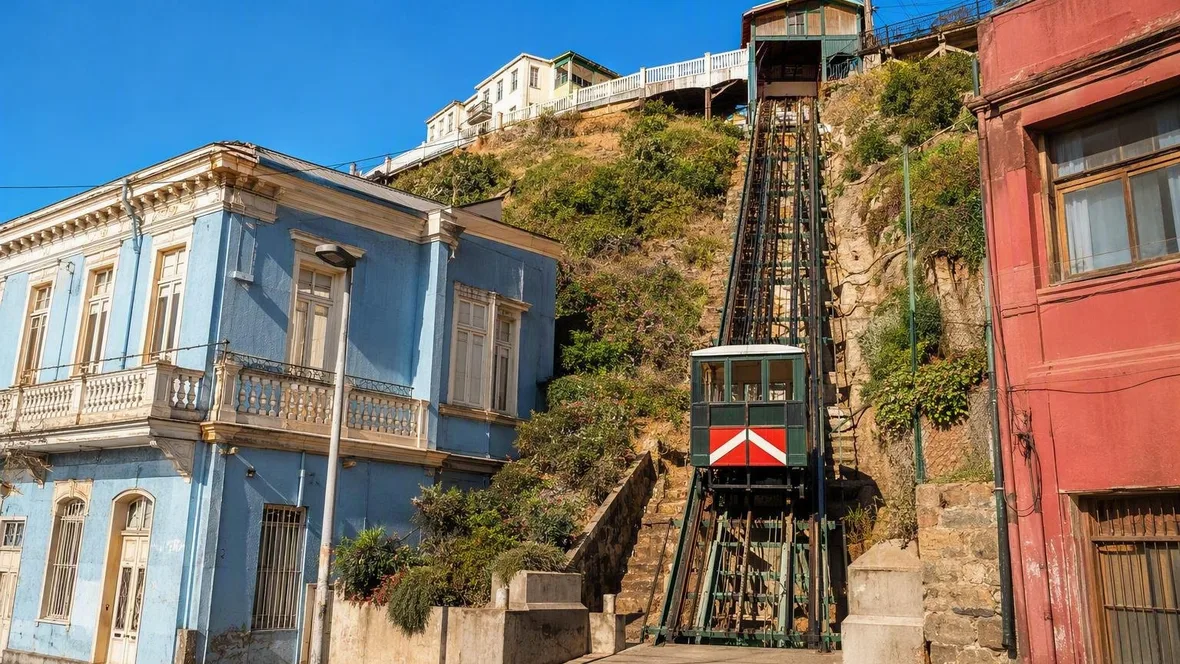
At the bend in Calle Elías, two rails run straight into the hillside at 52 degrees. Ascensor Reina Victoria covers only about 40 metres, but it links the lower plan of Valparaíso with the pedestrian streets of Cerro Alegre in one steep, compact movement.
Calle Elías: where the rails leave the street
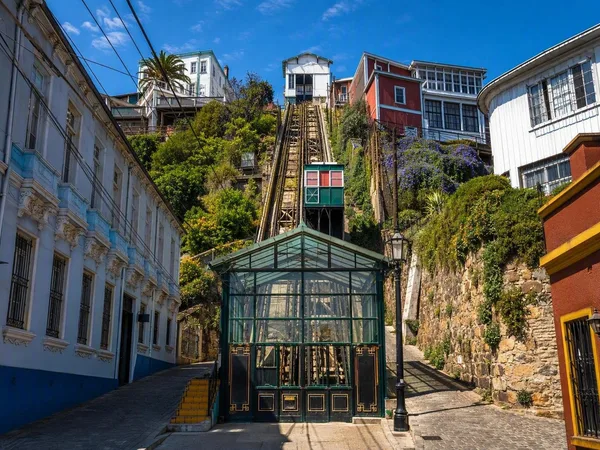
Calle Cumming rises from Plaza Aníbal Pinto towards Calle Elías, where the lower station stands at the street’s beginning and bend. From this point, the rails break sharply from the street line and climb the slope.
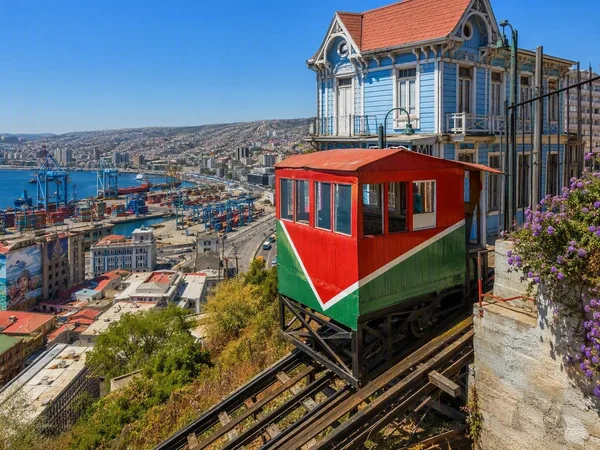
That abrupt change in level shaped much of Valparaíso. The city spread from its flatter commercial lower district, the plan, into an amphitheatre of hills and ravines. Stairs, narrow passages and winding streets connected homes on the slopes with work and trade below, but those routes required hard climbing. Funiculars gave the cerros a daily connection with the lower city.
Reina Victoria does not cross the city. It removes one particularly severe barrier in an ordinary walk: roughly 30 metres of height over a track of about 40 metres.
The lower station has none of the scale of a railway terminus. Small windows and light-permeable construction appear in both the station and cabin, details that draw on the forms of local domestic architecture. The building faces Calle Elías; behind it, the line commits immediately to the hill.
A cabin made for an incline
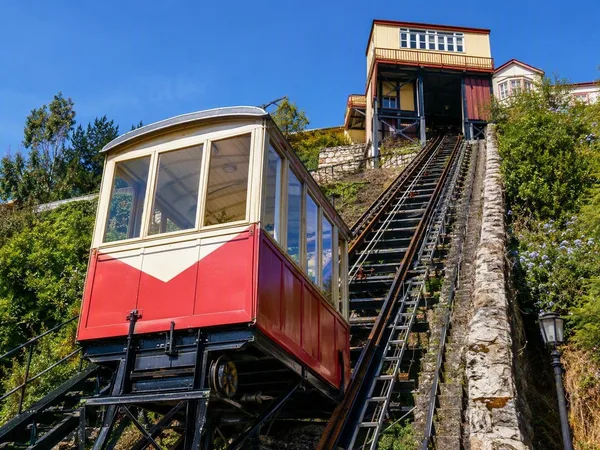
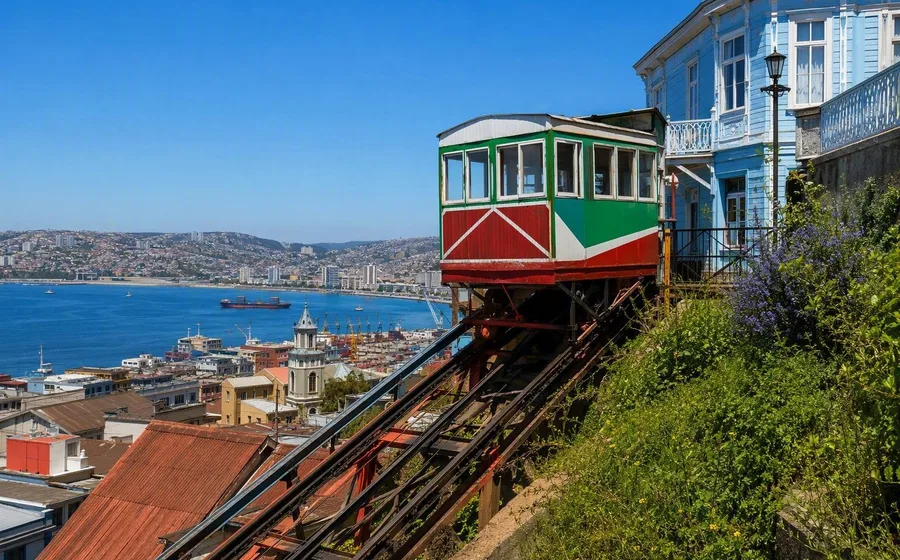
Ascensor Reina Victoria is a cable funicular, not a vertical elevator. Wooden sleepers hold the exposed rails to the hillside, and the cabin travels diagonally along them.
The cabin holds ten people. Its small windows admit light, while the short body and steep track keep the mechanics of the journey visible from outside. This is a steep slide beside the slope, not a gradual ascent behind closed lift doors.
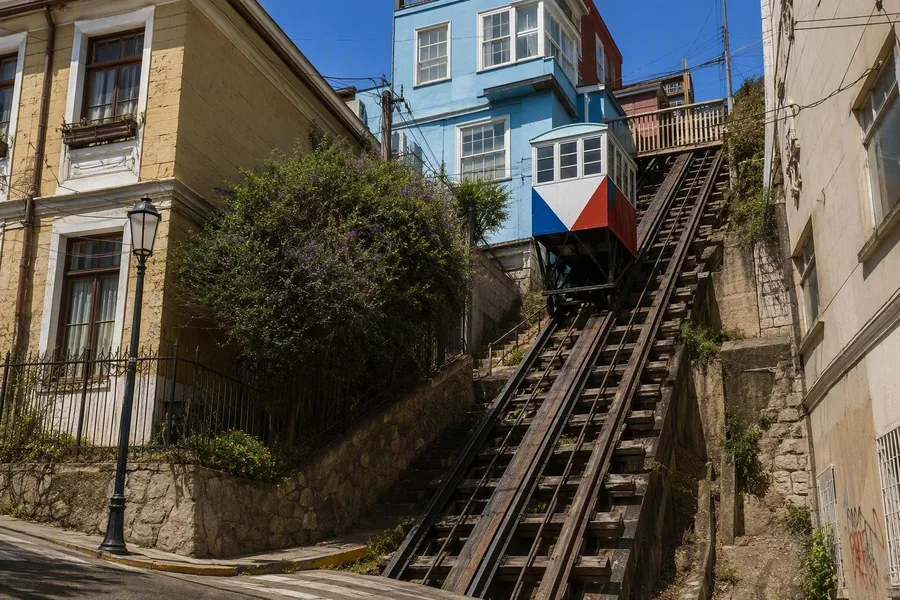 Ascensor Reina Victoria’s small cabin climbs the steep rails above Calle Elías.
The line was built in 1902 and opened on 4 March 1903. Its name honours Queen Victoria, who had died two years earlier. The original system used water ballast as a counterweight; later electrification changed its power source, and a complete redesign in 1986 still underpins its operation.
Those changes matter because the line has never been merely an old object left on display. It began as practical transport in a city where dense lower streets and hillside neighbourhoods met at punishing gradients. The cabin still carries pedestrians from a street with vehicle traffic to a district reached on foot.
The hill above the track
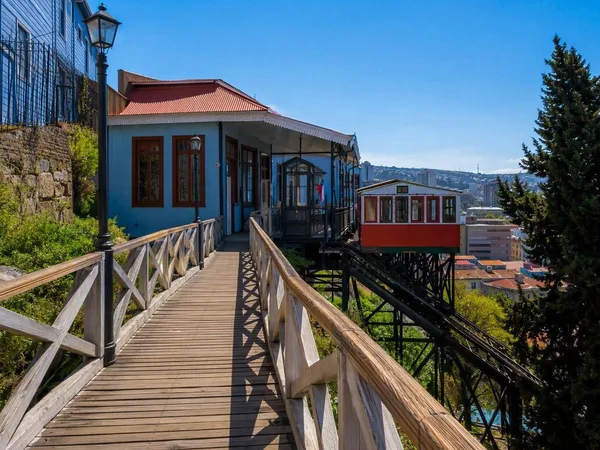
The upper station opens onto a small plaza and a footbridge leading to Paseo Dimalow. The passage is pedestrian-only and connects with Calle Capilla and Almirante Montt on Cerro Alegre.
Paseo Dimalow dates from 1870. Its predominantly English-influenced buildings belong to the protected urban ensemble of Cerro Alegre and Cerro Concepción. English and German immigrants played a major role in the planned development of these hills from the first half of the nineteenth century.
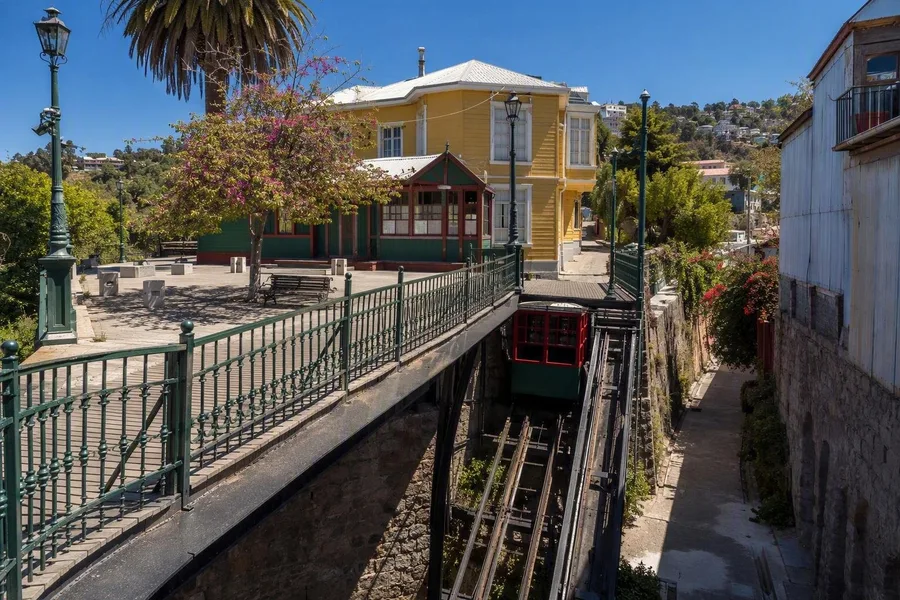 The upper-station footbridge connects Ascensor Reina Victoria with Paseo Dimalow on Cerro Alegre.
The terrain gave that development its particular shape. Relatively straight streets meet curving hillside roads, steps and narrow passages; houses use raised bases, posts and staggered floors to hold to the slope. Timber and corrugated metal are among the characteristic materials. A restrained façade on the street side can extend far downhill towards the bay.
Paseo Dimalow is not an isolated lookout attached to a ride. Homes share the area with cafés, restaurants and shops, while the passage carries people into the surrounding streets of Cerro Alegre. The funicular’s upper exit therefore delivers people into a working pedestrian quarter rather than onto a road above the city.
A protected line that still needs repairs
Chile declared Ascensor Reina Victoria a Historic Monument in 1998. The designation recognises the historical, social and architectural significance of Valparaíso’s ascensores as links between the hills and the lower city.
Protection does not require every part to remain untouched. The current intervention criteria retain traditional electromechanical systems where possible, but permit full or partial replacement after technical assessment when safe operation requires it; original machinery and components should remain on site when feasible.
The record shows why that distinction is necessary. Earthquakes in 1971 and 1985 led to a prolonged closure and restoration completed in 1988, while cable damage prompted further repairs in 2012. A broken pulley shaft closed the line temporarily from 5 to 17 September 2024.
In April 2026, repairs focused on the adjacent footbridge and the Paseo Dimalow lookout rather than on the cabin or track. Workers rebuilt or replaced railings, stairs, handrails and other elements while retaining the original design, and they phased the work to preserve pedestrian passage and operation of the ascensor. Shops and hospitality businesses along the paseo remained open during those works.
This is the less romantic but more useful meaning of heritage here: a century-old public line needs cables, shafts, rails, stations and the paths around it to remain usable. The designation protects its form, but its urban value depends on whether it can carry people between two levels of the city.
Practical details
On 24 April 2026, the municipality confirmed that Ascensor Reina Victoria was operating during the Paseo Dimalow works. A separate current listing gives daily hours of 07.00–21.30 and fares of CLP 200 for Chilean passengers and CLP 1,000 for foreign visitors; confirm both at the station before travel, since maintenance has caused temporary closures. If the funicular is out of service, Calle Capilla and Almirante Montt provide pedestrian access to Paseo Dimalow.
At the top, the cabin stops beside the small plaza. The footbridge crosses to Paseo Dimalow, where the rails drop away below the handrails and the level ground gives way to a narrow pedestrian passage through Cerro Alegre.
Keep exploring
Places in this story
South America
3 landen en gebieden

Chile
Valparaíso
Cerro Alegre
Ascensor Reina Victoria
Paseo Dimalow
Cerro Concepción
Cerro Concepción is a steep historic neighbourhood above central Valparaíso, Chile, shaped by 19th-century European settlement, funicular access and bay-facing promenades. Its lanes, stairs and viewpoints are best explored on foot.