Neighbourhood · Russia
Patriarch’s Ponds
Patriarch’s Ponds is a compact historic neighborhood centred on a single pond in Moscow’s Presnensky District, just inside the Garden Ring. It is the opening setting of Mikhail Bulgakov’s *The Master and Margarita*.
Orientation
Patriarch’s Ponds lies between Malaya Bronnaya Street and Bolshoy, Maly and Yermolayevsky Lanes. The name covers more than the water: it denotes the pond, its public garden and the surrounding historic quarter. Locals often shorten it to Patriki.
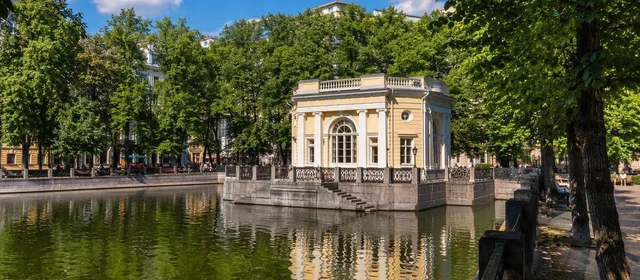
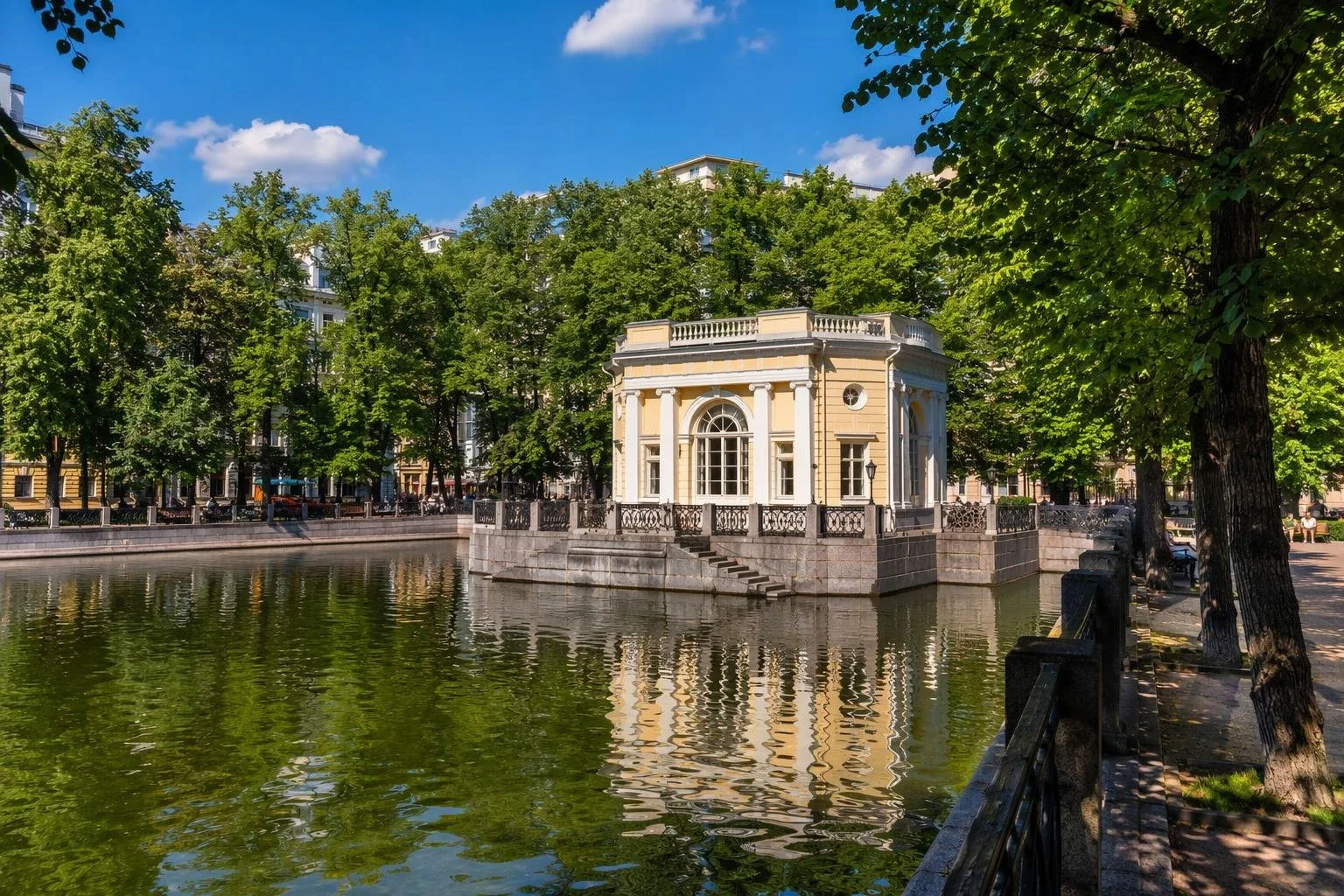
The pond is small—about one hectare—but it is an effective pause in the tight street grid. A tree-lined path, benches and a cast-iron fence encircle the water; residential buildings stand close behind.
Why the name is plural
Before the 17th century, this was Goat Marsh, a name retained in Bolshoy and Maly Kozikhinsky Lanes. In the 1680s, three ponds were dug in the Patriarchal settlement. Only one remained after the rebuilding that followed the Fire of 1812, but the plural name survived; nearby Tryokhprudny Lane means Three-Pond Lane.
The surviving pond was cleaned and given its surrounding square in the 19th century. It was renamed Pioneers’ Ponds in the Soviet period, then regained its historic name in 1992. The pond-and-garden ensemble is protected cultural heritage.
Bulgakov’s starting point
The opening chapter of The Master and Margarita takes place here. That association is the area’s central literary reference, but manage expectations: there is no official Woland bench, no Bulgakov statue and no tramline beside the pond. Bulgakov used the setting in fiction; the tram is part of the novel’s altered geography.
For the clearest sense of the scene, walk the side parallel to Malaya Bronnaya and look across the water. Bulgakov lived nearby at Bolshaya Sadovaya 10 in the early 1920s; the museum there makes a logical next stop, but it is not at the pond.
What to notice
- Ivan Krylov monument: installed in 1976, with sculptural reliefs of characters from the fabulist’s work.
- The pond itself: the name is plural, the water is not. A slow circuit is enough to understand the layout.
- Stone pavilion: built in the 1980s on the site of an earlier wooden pavilion; it is a strong visual marker on the bank.
Getting there and using the area
Mayakovskaya, Pushkinskaya and Tverskaya metro stations are all practical approaches; allow roughly 10–15 minutes on foot. Arrive from Mayakovskaya via Bolshaya Sadovaya and Yermolayevsky Lane, or from the Tverskaya/Pushkinskaya side through the smaller lanes.
The garden is a public outdoor space with free access. Treat it as a short walking stop rather than a destination requiring hours. The surrounding lanes are best explored on foot; driving adds little on narrow central streets.
From the magazine
Stories about Patriarch’s Ponds
Editorial stories linked directly to Patriarch’s Ponds.
No stories about Patriarch’s Ponds have been published yet.
Routes from our editors
Travel through Patriarch’s Ponds
Editorial routes connecting Patriarch’s Ponds with other countries, cities and hotspots.
No routes through Patriarch’s Ponds have been published yet.
More in Russia
Related hotspots
Other cities, nature areas and places within Russia.