City · Russia
Moscow
Moscow is Russia’s capital on the Moskva River, built around the Kremlin and Red Square. Its historic core, major museums and monumental Metro make the city navigable in distinct, productive districts.
Start with the historic core
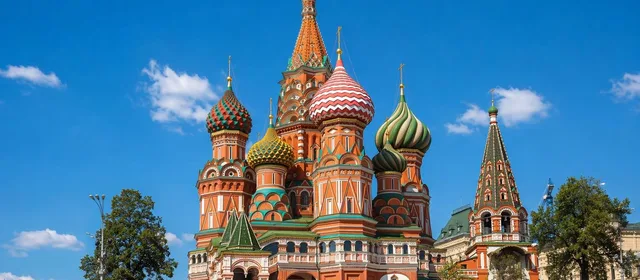
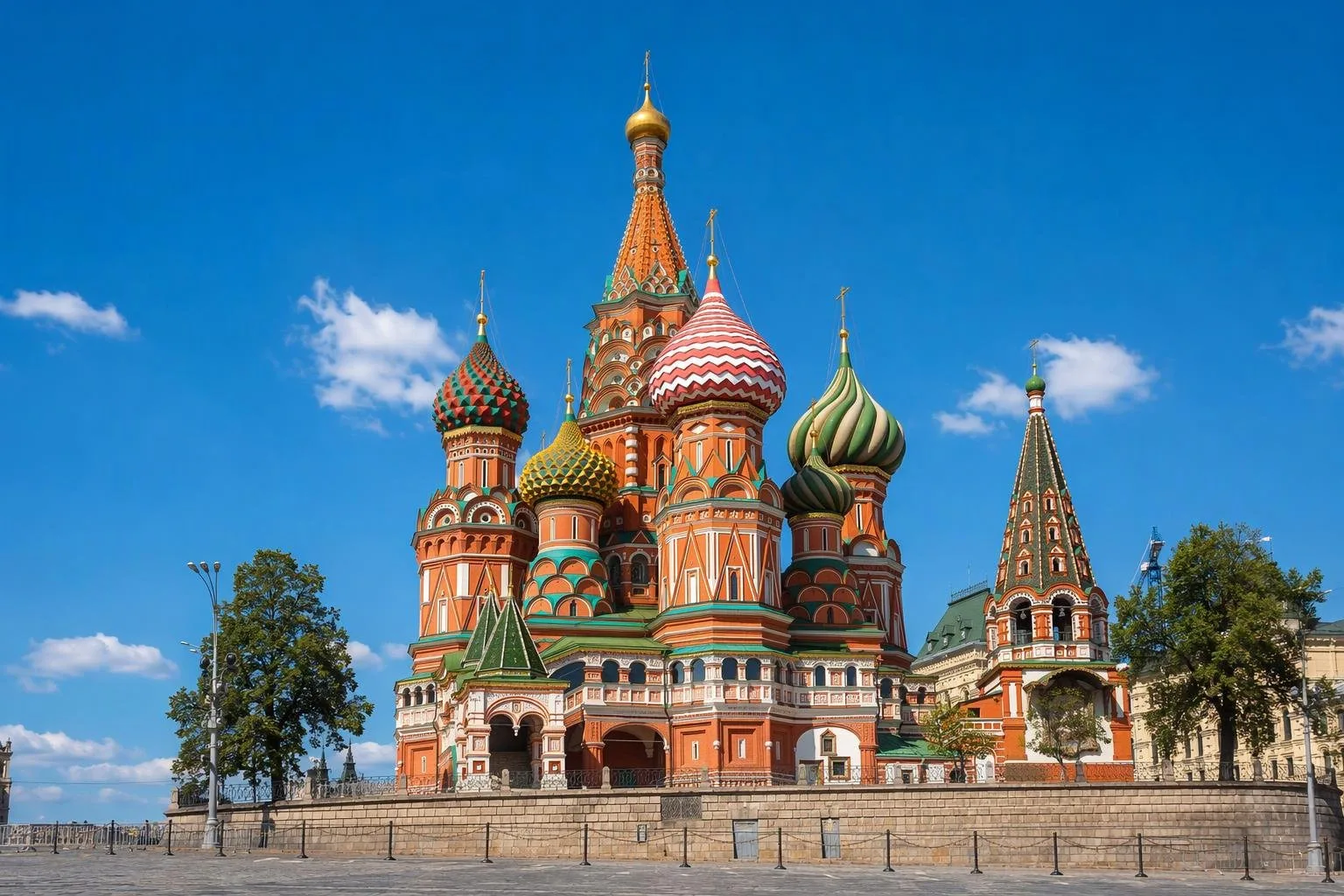
The Kremlin, Red Square and Saint Basil’s Cathedral are Moscow’s essential first orientation. The Kremlin and Red Square form a UNESCO World Heritage site: the fortress developed between the 14th and 17th centuries, while Saint Basil’s stands at the foot of its walls.
Treat the core as a sequence rather than a checklist. Walk Red Square, then use Alexander Garden as the approach to the Kremlin. The red-brick walls, towers and cathedrals explain why this compact area remains the city’s visual and political centre.
Kremlin: plan the visit properly
The Kremlin is a working state precinct as well as a museum complex. Cathedral Square and the Armoury Chamber require separate tickets and use different entrances; access to the grounds is through Kutafya Tower, while the Armoury is entered via Borovitsky Gate.
Allow time for security. The Kremlin museums are normally closed on Thursdays, and individual buildings or routes can close at short notice. Do not arrive with large luggage.
Choose one focus:
- Cathedral Square for the Assumption, Archangel and Annunciation cathedrals.
- Armoury Chamber for ceremonial objects, arms and court collections; entry is timed.
- The exterior circuit—Red Square, Alexander Garden and the Kremlin embankment—for the fortress at its most legible.
Build days by district
Moscow is too large to cover by hopping randomly between landmarks. Pair nearby places.
- Kitay-gorod and Red Square: the historic centre, GUM and Zaryadye Park.
- Zamoskvorechye: cross the river for the Tretyakov Gallery and older merchant streets.
- Theatre Square: the Bolshoi Theatre and central shopping streets.
- VDNKh: a separate northern outing for the vast exhibition grounds and its fountains.
Give major museums or a performance their own block rather than squeezing them between central sights.
Use the Metro as transport and architecture
The Metro is the practical way to cross Moscow and worth using deliberately. Several stations are protected cultural-heritage sites, so a short ride can double as an architectural stop. A Troika card is available at Metro ticket offices and ticket machines; it can be loaded for city travel.
Stations generally open from about 05:30 until 01:00, though first-train times vary. Metro maps use line colours, names and numbers; follow the destination shown for the train, not only the line colour.
Timing and practical limits
Central Moscow works well on foot, but distances beyond the centre are substantial. Use the Metro for district changes and save long walks for the Boulevard Ring, Arbat or riverside sections.
Winter daylight is short and temperatures can be severe; summer gives longer outdoor hours but brings heavier crowds around Red Square. Red Square and Kremlin access can be restricted for state events, rehearsals or security operations. Keep the central day flexible and avoid making it your only chance to see the square.
From the magazine
Stories about Moscow
Editorial stories linked directly to Moscow.
No stories about Moscow have been published yet.
Routes from our editors
Travel through Moscow
Editorial routes connecting Moscow with other countries, cities and hotspots.
No routes through Moscow have been published yet.
More in Russia
Related hotspots
Other cities, nature areas and places within Russia.