Workshop doors on Abovyan Street
A short stretch of Abovyan Street in Gyumri runs from a ceramics workshop at number 182 to a creative workshop at 252 and a tailor at 258/2. Snow, dark tuff and low winter light frame work that continues behind wooden doors and iron gates.
Number 182: clay behind the stone façade
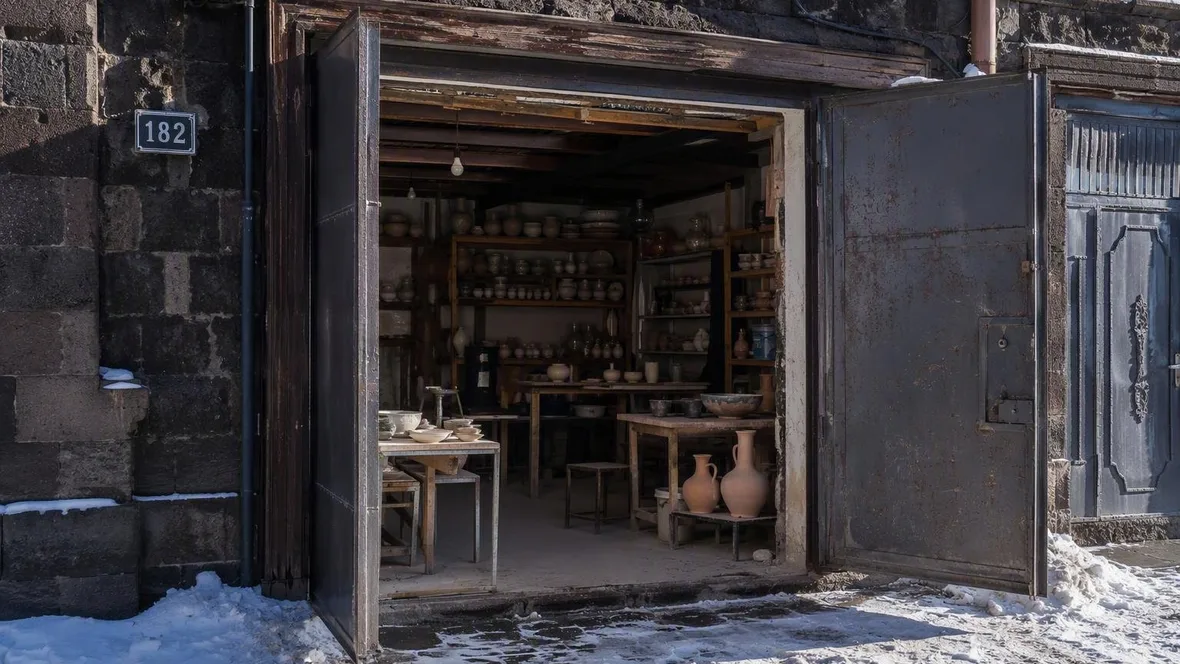
Family Care Ceramics works from number 182 on Abovyan Street, where ceramic production takes place daily and young makers receive training. That daily use gives this short route its starting point. A workshop opens into a street that has long made room for trade, services and small-scale work.
Abovyan took shape during the nineteenth-century expansion of Alexandropol, the name Gyumri carried at the time. Low buildings lined regular streets, and work, storage and domestic life often occupied different parts of the same one- or two-storey structure. The arrangement explains the modest scale of a working entrance here. It need not advertise much beyond the door.
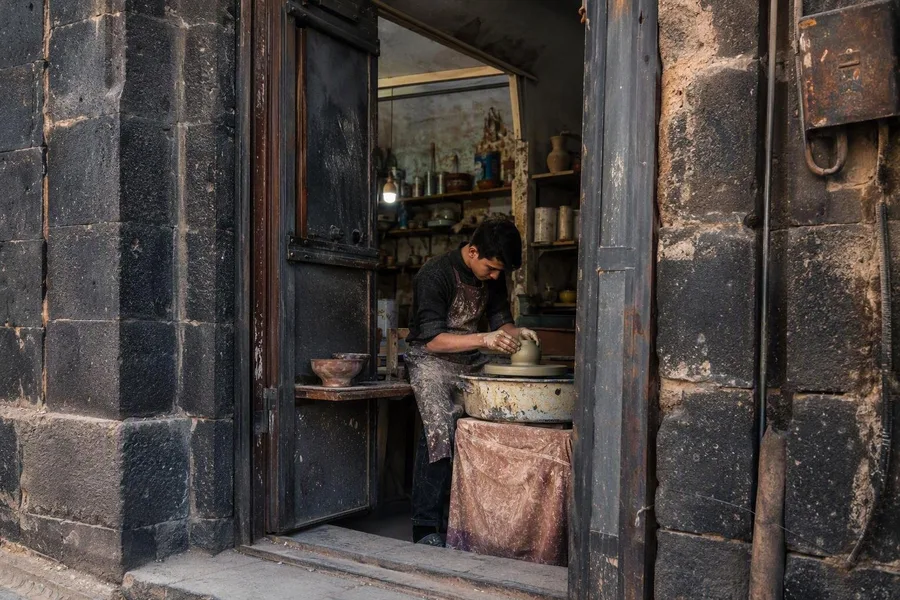 A young maker works with clay inside Family Care Ceramics on Abovyan Street.
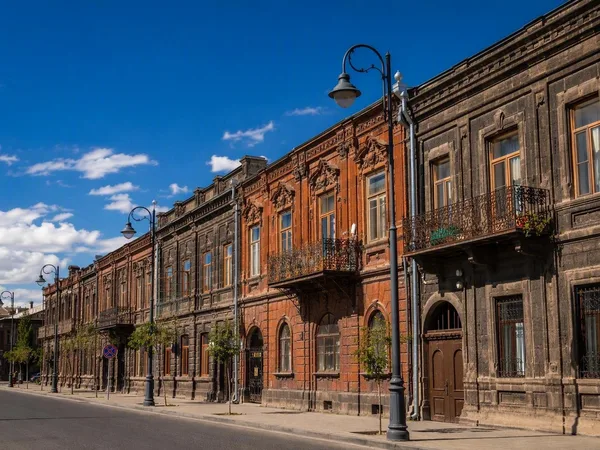
The façades along this part of Kumayri use local tuff in grey, black, orange and red. Stonemasons cut the volcanic material into regular, squared blocks and used restrained cornices, pilasters and bands around the walls and openings. The dark colour comes from the stone itself. Red tuff sometimes sharpens an edge or frames an opening.
Winter makes those materials easy to read. Gyumri has regular snowfall and severe January cold, so snow against black tuff belongs to the season rather than a special occasion. Low morning or afternoon light can pick out the grain of the black volcanic stone. On the paved street outside, the white surface and the dark blocks hold the eye while ceramic work continues indoors.
Doors, gates and repaired walls
From number 182, Abovyan leads through the historic fabric of Kumayri towards the corner addresses at 252 and 258/2. Wooden doors, timber windows and balconies form part of that older building vocabulary. Wrought-iron gates, grilles and balcony rails mark the passage from pavement to courtyard.
The street does not preserve one fixed moment. Some historic windows have been replaced with aluminium or plastic frames, partly in response to the hard winter climate. Later metal gates also stand at some entrances, with forms that differ from the original stone architecture. A black-tuff wall may therefore sit beside a new frame or a more recent metal door.
Repair has left its own visible marks. Broken roofs can send water into masonry joints, wooden floors and roof structures, while settlement cracks remain in parts of the historic district. Sound repair begins by keeping out water, restoring joints between tuff blocks and limiting stone replacement to material beyond repair.
Ironwork needs similar care. Gyumri’s blacksmiths make and restore gates, doors, window grilles, chandeliers and other iron objects for everyday use. Repairers clean rust, protect the metal and secure fittings where they meet the masonry, so water does not enter around loose fixings. The work explains why an iron gate matters here as more than a decorative remnant. It has a job at the threshold, and it can be repaired when that job continues.
The 1988 earthquake forms part of this maintenance history, but only part. Residents repaired many damaged houses and continued to use them, leaving joins between old and new masonry, replaced windows and rebuilt sections. Other buildings fell vacant amid the closure of major production systems and the economic decline that followed. Along Abovyan, repair, alteration and reuse sit beside one another without turning the street into either a museum set or a ruin.
Number 252: a workshop and shop
B612 operates at Abovyan 252 as a creative workshop and shop. Its opening adds another working room to the same short stretch of street, rather than sending the route into a separate arts district. The address remains part of a residential historic quarter, where not every wooden door or iron gate leads to a business.
That distinction keeps the street legible. A shopfront or open workshop identifies a public function; neighbouring entrances may lead to homes and inner courtyards. The old street plan accommodates both. Kumayri grew with regular streets and mostly low buildings during Alexandropol’s nineteenth-century expansion, and its architecture combines Armenian stonework with Russian urban forms in arches, entrances, courtyards and tuff façades.
The work at B612 does not have to imitate the trades associated with old Gyumri. The ceramics workshop at 182, the creative workshop at 252 and the tailor farther along all use small rooms on a street that developed around commerce and services. Their doors open for different kinds of work, but the street-facing threshold remains the same practical line between a low stone façade and the room behind it.
Number 258/2: the tailor’s entrance
A tailor works at Abovyan 258/2, a short walk from B612. The available record does not describe the room or its tools, but the address confirms a small working place at the end of this compact route. Tailoring also belongs to the service economy that has shaped Abovyan since its nineteenth-century development.
 An iron fixing meets black tuff beside the tailor’s doorway on Abovyan Street.
In winter, the entrance draws together the materials that recur along the street: paving, snow, dark and reddish tuff, wood and iron. The contrast is plain. Snow lies against the black stone; a wooden door or iron gate separates the cold street from a room in use.
At the foot of the wall, a thin edge of snow meets the paving. Low light catches the coarse surface of the squared black tuff beside the tailor’s doorway.
Keep exploring