What Paramaribo Cooks Begins at the Centrale Markt
Boats and trucks bring fruit, leaves, roots, fish and spices to the Centrale Markt beside the Suriname River. Inside, those ingredients lead towards roti and pom, saoto and peprewatra, and towards the histories that shaped Paramaribo’s kitchens.
The Centrale Markt stands where Paramaribo has long received food from the districts and the river. Goods once reached the Waterkant by boat, and morning deliveries still arrive by boat and truck before moving into home kitchens and nearby food stalls.
This is not a display of one fixed national cuisine. Cassava can become Indigenous cassava bread, Javanese-Surinamese telo or cassava grains in Maroon afingi; kousenband can accompany roti, go into nasi or meet the heat of a wok.
The river and the market hall
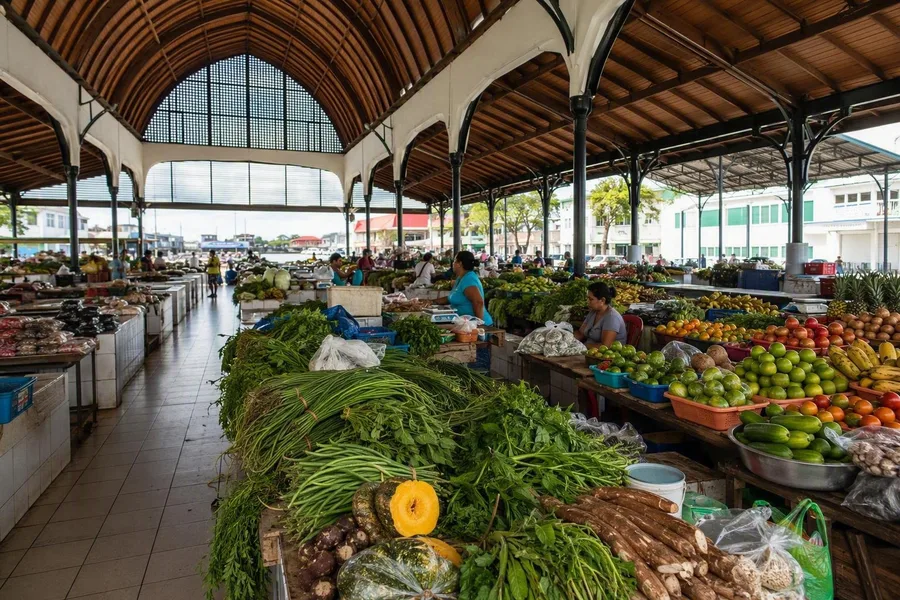 Produce stalls fill the ground floor beneath the Centrale Markt’s curved wooden roof in Paramaribo.
The Waterkant was Paramaribo’s first street and, for centuries, an arrival point for ships, people and goods. Warehouses and trading premises stood along the water, and colonial commerce there included the trade in enslaved people. That history remains close to the market’s everyday work of buying food, eating and catching a bus or boat.
The market moved from Heiligenweg to the Waterkant around 1933. Architect Peter Nagel received the commission for the present hall in 1959, and the building officially opened in 1970 after workers strengthened the riverbank against the Suriname River’s strong tides and currents.
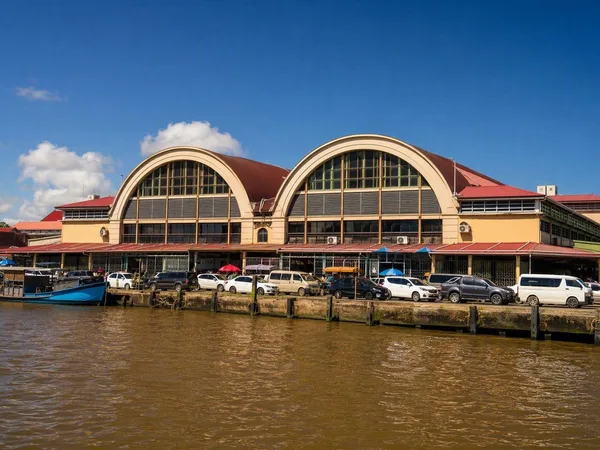
Nagel gave the two-storey hall a high curved roof. Laminated wooden beams span the broad interior, while its open construction lets air circulate in the tropical climate. Vegetables, fruit, herbs, meat and fish occupy the ground floor. Clothing and other dry goods fill much of the floor above, while food stalls work in and around the building.
Nearby buses depart and riverboats use the landing place. Shoppers, commuters, boat passengers and food sellers use the same stretch of Waterkant, where river traffic and road deliveries become the ingredients of daily meals.
Long beans, bitter leaves and grated roots
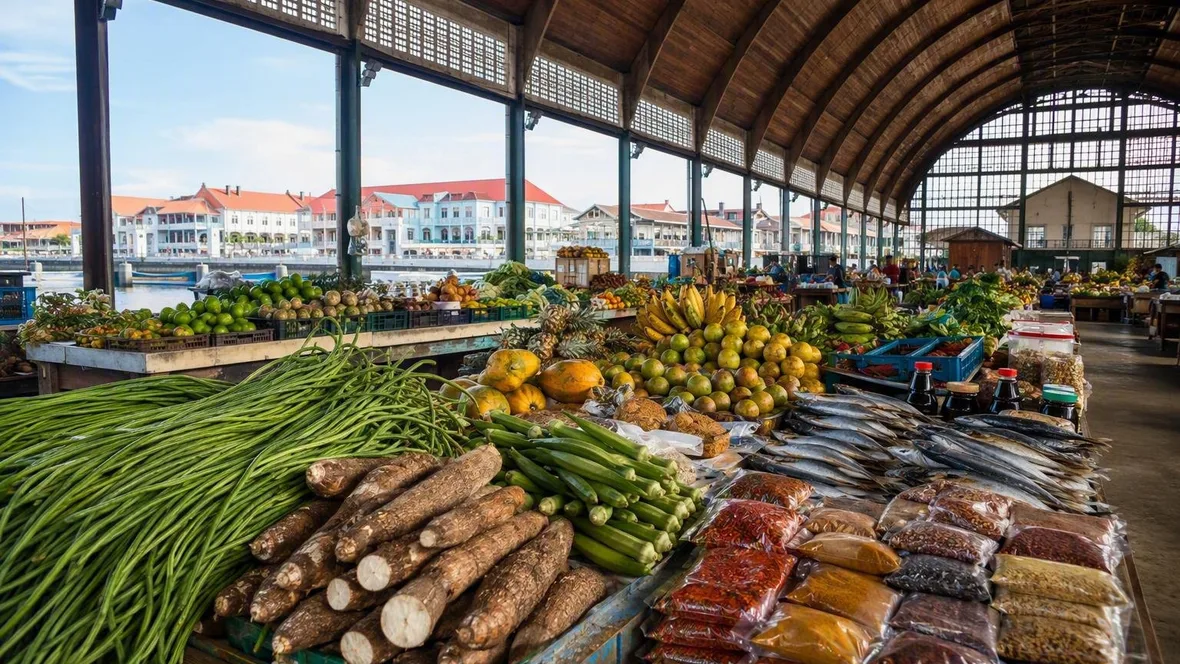
Kousenband makes a useful place to begin. These firm yardlong beans rank among the market’s recognisable vegetables, but they have no single culinary address. A cook may stew them with potato, masala and pepper for a curry with roti or rice. Another may add them to nasi or bami, while Chinese-Surinamese cooking also uses vegetables such as kousenband in wok dishes.
Other greens and roots have equally distinct uses. Okra releases a natural thickening liquid when cut. Bitawiri, or bitter leaf, is a somewhat tough green leaf that cooks quickly in a stir-fry or stew; it can sit beside rice or go into moksi alesi. Cooks grate pomtajer for pom, the baked chicken dish that combines a local root with a history shaped by Sephardic Jewish and Creole kitchens.
Pineapple, papaya, watermelon, pomerak, soursop and awara appear in the market’s food section. Cassava and plantain sit closer to the everyday foundations of a meal. Neither belongs to one community or one recipe.
Masala, sambal and soy sauce
Cinnamon, nutmeg, cloves and masala bring dry, aromatic notes among the fresh produce. Masala gives Hindoestani-Surinamese curries their character. Roti commonly comes with such curries, dhal, potato and vegetables such as kousenband; chicken, egg, aubergine, tempeh, lamb or prawns may also appear.
Roti serves as more than an accompaniment. Diners commonly tear the soft flatbread by hand and use it to gather curry.
The ingredients also carry a history of coercion and adaptation. After slavery was abolished, the colonial administration recruited Chinese workers from 1853, British Indian labourers from 1873 and Javanese labourers from 1890 for plantation work under restrictive contracts. Cooking knowledge from South Asia, Java and China took root in Surinamese households and changed there.
Java is visible in nasi, bami, saoto and sambal; Chinese traditions contributed soy sauce and wok cookery. Saoto places rice or noodles, egg, bean sprouts, fried onions, celery and sambal in clear chicken broth. Surinamese nasi can include beans, dried prawns, coconut and chicken.
The distinctions matter, but they are not fences. Javanese bami and Chinese-Surinamese tjauw min both use fried noodles, with different lineages and preparations. Kousenband crosses between them, just as rice, pepper and soy sauce appear well beyond a single culinary tradition.
Cassava beside fish
Cassava carries an older body of knowledge. Indigenous cooks peel and grate the root, press it to remove cyanide, then roast it into thin cassava bread. They also process cassava into dry grains and kasiri. The bread can accompany peprewatra, a spicy fish soup made with herbs and Madame Jeanette pepper; kwikwi or piranha can supply the fish.
Maroon communities also eat cassava bread with soup. In afingi, cassava grains cook with locally caught fish or meat. These preparations connect food to rivers and forested areas, while their overlap with Indigenous and Creole cooking prevents any neat ownership claim.
The same root appears in telo, fried cassava often served with bakkeljauw. Cooks soak this dried, salted cod to remove excess salt, then fry and stew it with ingredients such as tomato, kousenband and trassi. Rice, bread or telo can complete the plate.
Heri heri brings cassava together with other roots, plantain and salted fish. The dish grew from food practices developed by enslaved Africans, who combined produce from provision grounds with preserved fish under violent plantation conditions. Tayer leaves or kousenband may now accompany it.
Lunch at the market
Prepared food turns raw provisions into a short guide to Paramaribo’s cooking. Market stalls sell roti with curry, nasi goreng, moksi alesi, saoto and bojo. Each plate rearranges ingredients found downstairs: rice with greens, cassava with salt fish, or masala through potato and vegetables.
Moksi alesi combines rice with meat or fish and vegetables. Pom takes grated pomtajer and chicken into the oven, while tjap tjoy relies on stir-fried vegetables. Trade, forced displacement, contract labour and daily contact carried ingredients and cooking techniques between communities; cooks then adapted them again in Suriname.
Practical: The Centrale Markt is listed as open Monday to Saturday from 6am to 4pm and closed on Sunday. Early morning generally brings more room and a wider choice of fresh goods, while weekends are usually busiest. Bring Surinamese dollars in cash, as many sellers do not accept cards; bargaining is customary, and it is courteous to ask before photographing a stall, goods or seller.
Arrival from the Waterkant
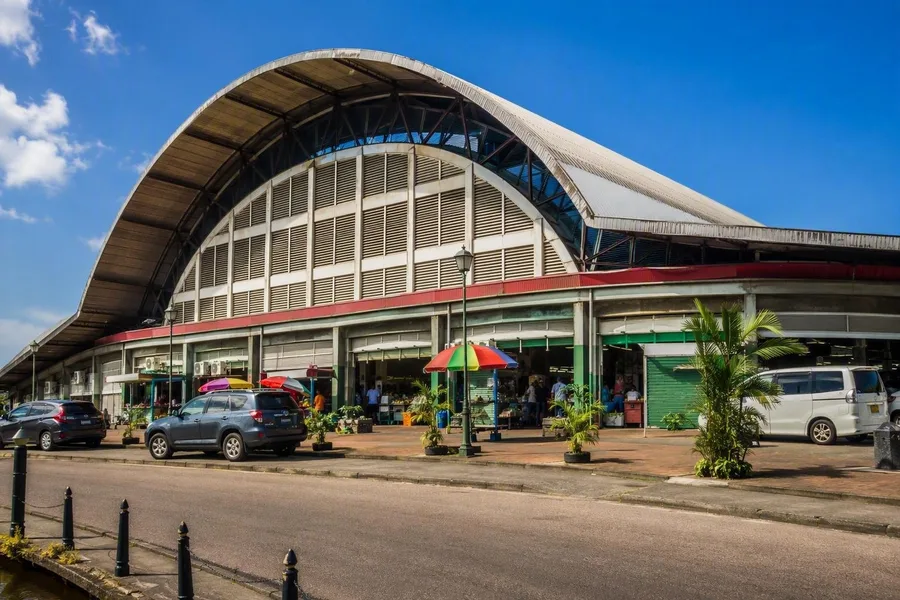 The Centrale Markt’s broad hall rises along Paramaribo’s Waterkant beneath its curved roof.
The Waterkant passes old merchant houses, the Waag, the Lutheran Church, kiosks and places to eat before it reaches the market. At the market hall, the broad building blocks the river view from the street. Under the curved wooden roof, long kousenband, green okra, cassava roots, fruit, fish and packets of dry spices occupy the ground floor.
Keep exploring