What Comuna 13’s escalators changed on Medellín’s hillside
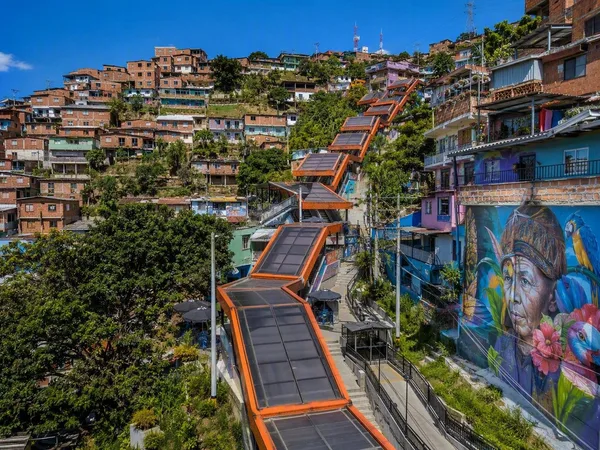
In Las Independencias, six pairs of public outdoor escalators cut through one of Comuna 13’s steepest residential slopes. They eased the climb home for people carrying groceries, heading to school or returning from work, then became part of a crowded route of murals, guides, music and small businesses.
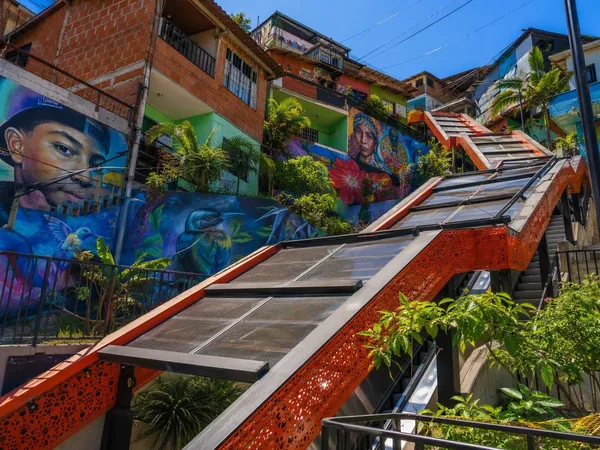
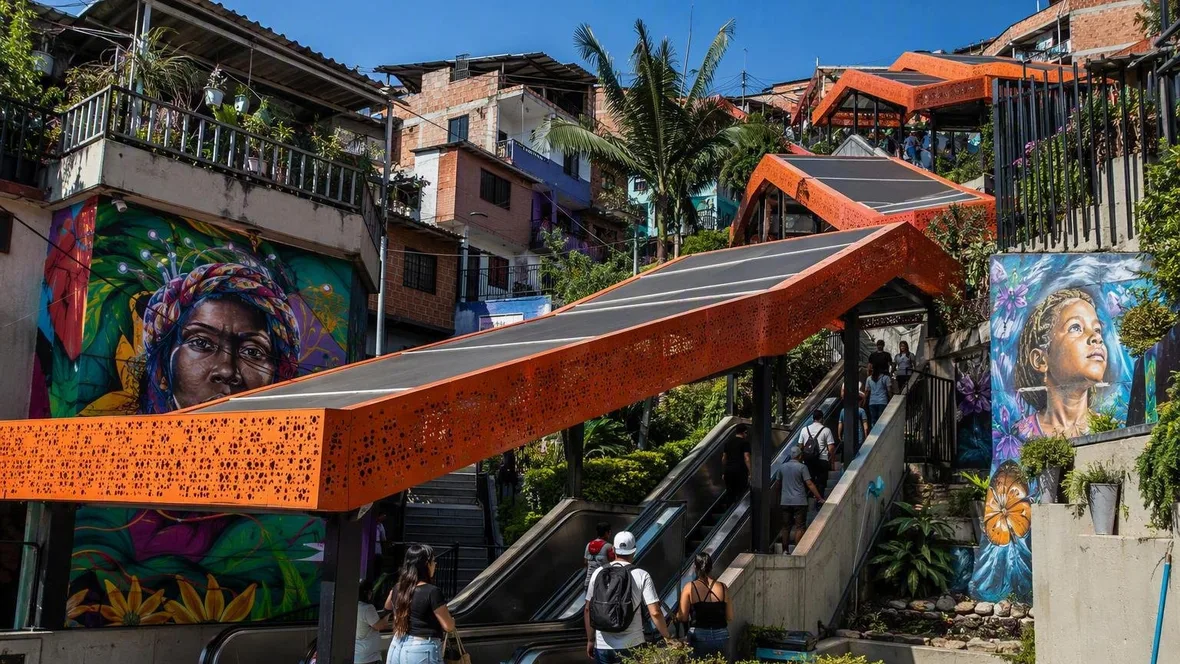
Orange acrylic roofs cover moving steps between close-built houses, fixed stairways and small landings. People can enter and leave the escalators at several levels instead of travelling from the foot of the hill to its upper edge in one long climb.
Medellín opened the escalators in late December 2011 in Las Independencias I, a neighbourhood within Comuna 13-San Javier. The project, Senderos de Conexión Independencias I, began as everyday pedestrian infrastructure rather than a visitor attraction.
A climb built into the hillside
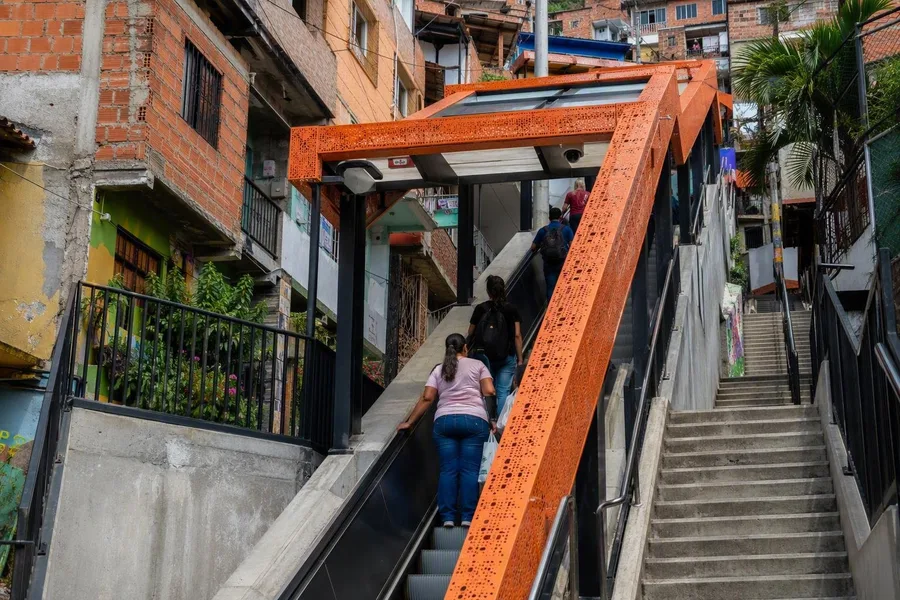 Residents use a covered outdoor escalator beside fixed stairs in Las Independencias I, Medellín.
Comuna 13 is a group of neighbourhoods on Medellín’s western slopes, not a single uniform district. Migration, social exclusion and displacement during Colombia’s armed conflict drove much of the area’s growth, as households built on steep, densely occupied land with weak connections to the rest of the city.
That terrain made a trip home physically demanding. The six double escalator sections replace the hardest part of a route that had roughly 350 concrete steps; depending on the path, the climb ran from 200 to 380 uneven steps. The escalators follow a 35-degree slope.
The machines did not abolish climbing. Fixed stairs remain beside the escalators and between their sections, and the system serves one hillside route rather than all of Comuna 13.
Still, the difference is plain in the ordinary work of getting home. Residents had carried groceries and household possessions up the old staircase, while older people and people with limited mobility faced particular difficulty on the slope. The escalators made higher homes easier to reach and shortened routes to work, school, medical care and other services.
The benefit also depends on maintenance. When sections stopped during repairs in 2023, residents again used the fixed stairs alongside them. Shopping bags, laundry and furniture do not become lighter when a motor is out of action.
The original works included footpaths, public space, street furniture, two public buildings and a viewing terrace. Cultural initiatives, street art, later connections and changing security conditions also shaped the area around the route. The escalators changed a strenuous daily passage, but they did not explain every change in the comuna.
A public route after years of armed control
A moving stairway carries a different weight in a neighbourhood where movement once came under armed control. In Comuna 13, militias, guerrillas and paramilitaries exercised control over territory and daily life in an area where state protection and services had often been scarce. Going to school, walking a street or using a park could take place under surveillance and threat.
Residents were not simply bystanders in that conflict. Many suffered displacement and bereavement; others organised forms of resistance. Fighting between militias, guerrillas, paramilitaries and state forces intensified between 2001 and 2003, forcing exceptional levels of displacement within Medellín.
Operation Orión began on 16 October 2002. More than 1,500 security and judicial personnel entered Comuna 13 with armoured vehicles, armed helicopters and masked informants, targeting alleged guerrilla supporters; reports recorded civilian deaths, injuries and disappearances.
The operation drove guerrilla forces from their strategic positions, but it did not end the conflict or illegal territorial control. The paramilitary Bloque Cacique Nutibara occupied the space left behind and committed human-rights abuses until its demobilisation at the end of 2003.
That history explains why public space cannot be reduced to a tourism success story. The escalators lowered a physical barrier on this slope, but they did not erase loss, end violence or settle struggles over who controls local income. Reporting has documented extortion of businesses, artists and guides by armed groups seeking a share of tourism revenue.
Murals, guides and front doors
The Graffitour began around 2010, before the escalators opened, as local artists used murals to tell stories of violence, loss and resistance. Hiphop, rap and breakdance also grew through local cultural work that gave young people public roles beyond those assigned by conflict.
The escalators made this steep section easier for outsiders to reach. Guides explain the paintings, while dancers and musicians perform nearby; residents sell food, drinks, prints and souvenirs along the route. Houses and ground-floor rooms on the access streets have also become cafés, galleries, shops and bases for guide services.
The same corridor remains a residential route. Residents, visitors, guides and vendors share narrow streets, and music from speakers, street sales and tour groups add noise and congestion near people’s front doors. Some neighbours turned early worries about privacy into small businesses. Others still report less quiet and less privacy, including people whose jobs depend on tourism.
The pressure reaches beyond noise. Research in Las Independencias and Veinte de Julio has recorded higher rents and food costs, more difficult everyday movement and the gradual displacement of older residents. Commercial stalls have also obscured murals that were made to preserve local memory.
Tourism supplies work, but it does not spread money, space or inconvenience evenly. A guide from the neighbourhood can explain what a painted wall records, while a direct purchase from an artist or small local business keeps visitor spending closer to the people working on the route.
Practical details
Metro Line B terminates at San Javier, where buses 221i and 225i run towards the escalators in Las Independencias. The escalators and neighbourhood have no entry fee, and usual daily operating hours are 06:00 to 18:00. Tours are optional; tip-based walks and paid group tours are available, with paid tours generally costing about COP 40,000–60,000 per person.
The upper landing
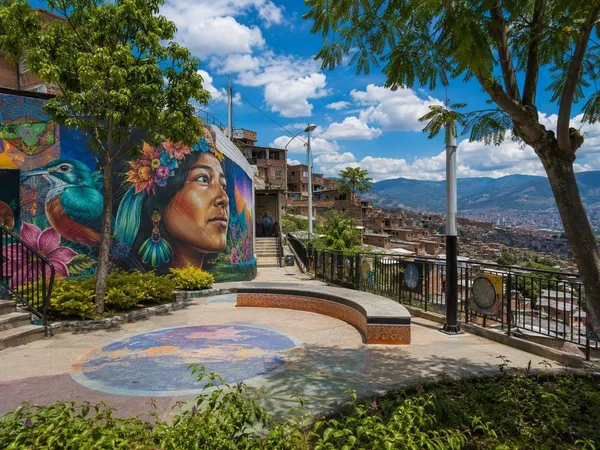
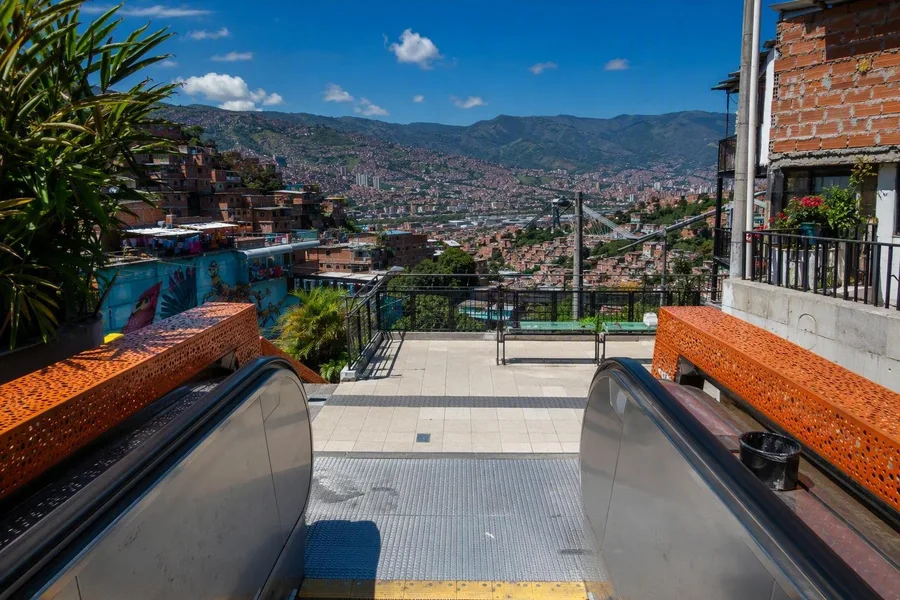 The final escalator steps reach the public landing at the Media Ladera viaduct in Las Independencias.
At the top, the escalators meet the Media Ladera viaduct and the Balcón de la 13. Terraces and viewpoints look across Medellín, beyond the tightly packed houses and painted walls. The last moving steps level out onto a public landing above the climb.