Water and Stone at Antigua’s Tanque La Unión
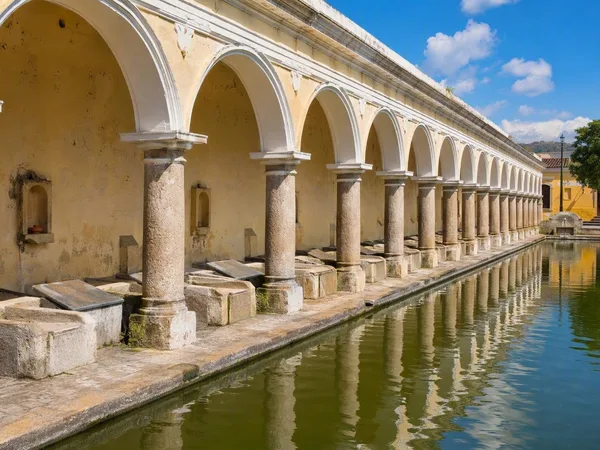
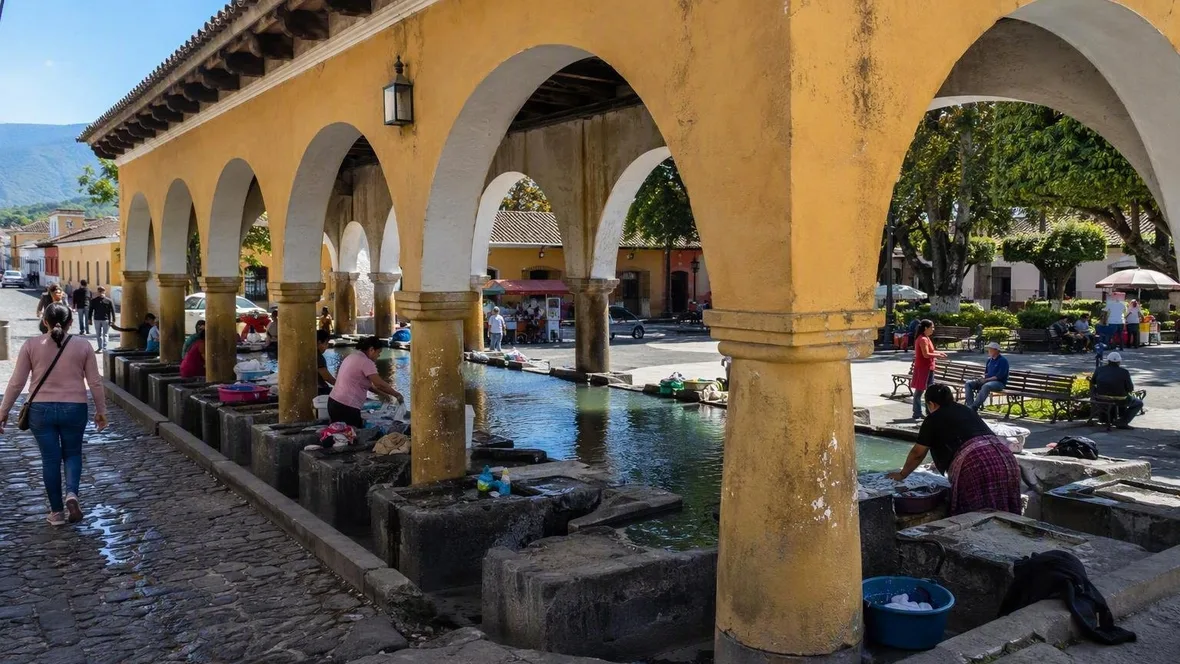
Twenty-two stone washing stations stand beneath the arches of Tanque La Unión in Antigua Guatemala. Water still fills the central tank, while the corner around it serves more often as a place to sit, walk, eat and pass through than as a guaranteed daily laundry yard.
Tanque La Unión stands at the corner of 2a Avenida Sur and 6a Calle Oriente, beside Plaza La Unión and across a narrow street from Santa Clara church. The washhouse does not hide behind a gate or at the end of a ceremonial route. Its stone basins stand at street level, under an arcade, with the plaza opening alongside them.
Twenty-two individual lavaderos run in a line beneath the neoclassical arches. Each station has a small place for soap and a recess below for the washer’s feet. Those modest cuts in the stone explain the building better than its arches do. Someone could stand in one position, set down soap, keep cloth close to the water and work at a defined edge of the shared tank.
Stone basins beside 6a Calle Oriente
The present-day washhouse keeps the shape of a tool. A long central basin holds the water, and the stations face it from beneath the arcade. Interior benches run within the structure. The arrangement gave separate working places to people using one public water point, rather than treating the basin as a fountain to admire from a distance.
Some people still wash clothes by hand here. Sources report that groups of women sometimes gather at the tanque on particular days, while another account notes women using the stone basins. That evidence supports an occasional use, not a fixed daily scene. No source establishes set washing hours, a regular number of users or the certainty of finding someone at work on a particular visit.
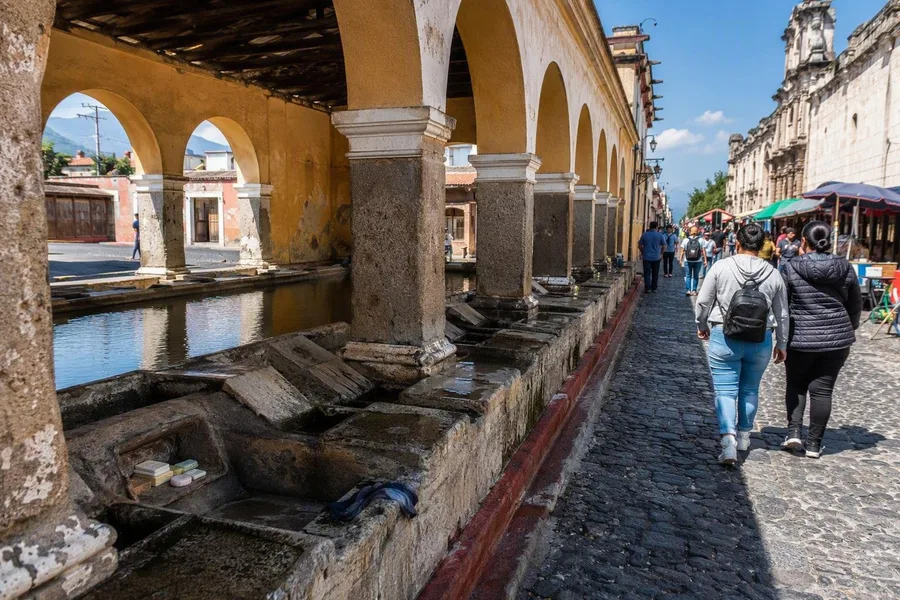 Pedestrians pass Tanque La Unión’s stone washing stations beside Plaza La Unión.
That limit matters. A person who sets soap beside a basin or handles wet cloth over its edge is carrying out a household task in public. The action does not turn that person into evidence of an untouched past, or into an attraction for passers-by. The washhouse itself supplies the relevant context: stone stations, shared water, footholds and soap niches record the physical requirements of hand washing.
The available evidence does not document clotheslines, drying racks or fabric hung from trees, walls or the arcade at Tanque La Unión. It is tempting to supply those details because they fit a familiar image of a public washhouse. This corner needs no such embroidery. The documented movement is simpler: water at the basin, cloth handled at the stone edge, then laundry taken away from the site to dry elsewhere.
From an animal trough to a public washhouse
Before the larger tank was built, Plaza de San José had a smaller spring or basin that also served as a drinking place for animals. In 1850, corregidor José María Palomo y Montúfar ordered a larger basin. Tanque La Unión opened on 3 February 1853. Its later name referred to the Central American union, and the site formally became Parque y Tanque de la Unión in 1925.
The washhouse formed part of a wider urban practice, not an isolated curiosity. Water from sources around Las Cañas, Pamputic and Santa Ana reached Antigua through collection points, aqueducts and clay pipes, supplying fountains and public spaces. Public pilas served for drawing water, washing clothes and other domestic work. The sources do not establish which particular source fed Tanque La Unión, or where its historical wastewater went.
The 1976 earthquake badly damaged the complex. Restoration retained its neoclassical form, including the arches and line of basins. Work completed in 2018 added waterproofing, clay tiles inside the tank and a pump that recirculates its water. The water now visible in the central basin therefore does not prove that the old supply system still works in its nineteenth-century form.
This repair changed the mechanics without erasing the work surface. The tiled tank still lies behind the arches. The soap niches and footholds still make the old use legible.
Benches, food stalls and the narrow street
Plaza La Unión extends beside the washhouse with grass, tall palms and benches. People use the benches and grass for sitting, talking and eating, while pedestrians move between the park, the arcade and the surrounding streets. The plaza carries much of the corner’s documented everyday use now.
Street food is sold and eaten around the park. At weekends, vendors appear near the plaza with snacks, including peanuts. These are small, ordinary transactions, but they give the washhouse an active neighbour: people pause at benches while the repeated stone workstations remain visible a few steps away.
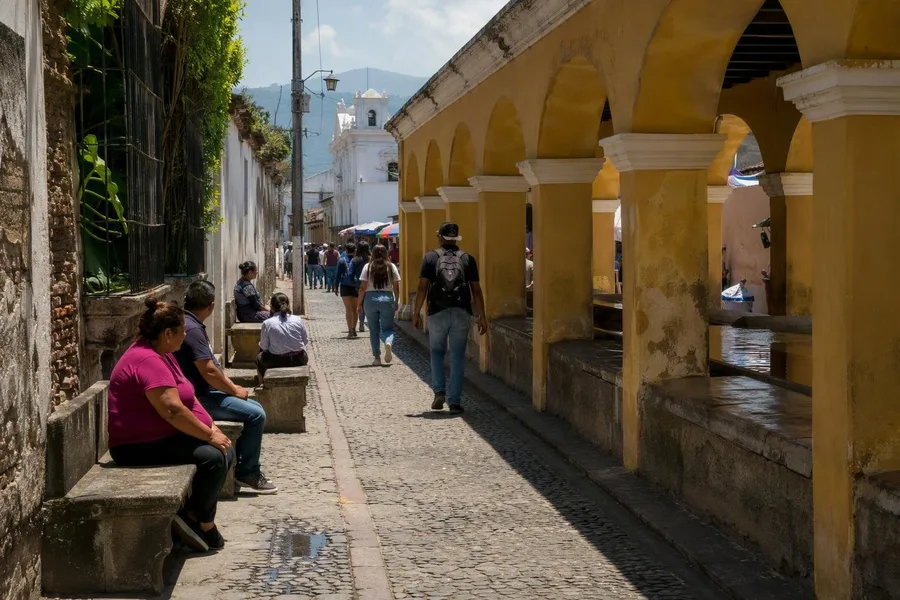 Pedestrians pass Tanque La Unión beside Plaza La Unión and the narrow street by Santa Clara.
Santa Clara forms the opposite built edge across the narrow street. The street separates church and washhouse rather than sealing either one off. 6a Calle Oriente continues past the arcade, and the plaza holds the slower activities of sitting and eating beside that passage. The sources do not provide a reliable account of vehicle flows, buses or tuk-tuks at this exact corner, so the clearest documented movement remains on foot.
Tanque La Unión is thus neither a sealed monument nor a permanently occupied laundry. Its current public role combines a restored washhouse with a park used for short stays, conversation and food. Washing remains possible and sometimes reported, but it should not be promised as a performance.
Practical note
Tanque La Unión is at 2a Avenida Sur and 6a Calle Oriente, beside Plaza La Unión and opposite Santa Clara. Visitor reports describe the site as accessible day and night, though those reports do not guarantee active washing at any given time.
The tank’s water circulates behind the arcade. When washing takes place, hands bring wet textile up from the stone edge and carry it beyond the plaza; no documented line or rack remains at the washhouse to show where that cloth dries.
Keep exploring