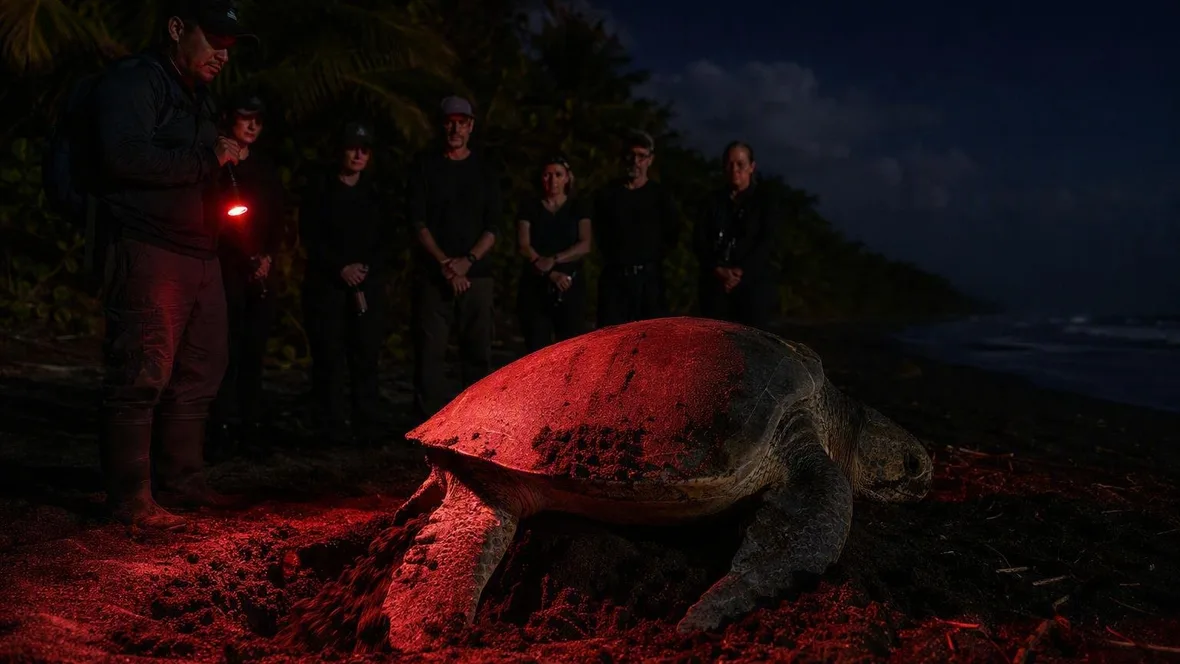
Tortuguero, from the canals to the nesting beach
Boats, not cars, carry visitors into Tortuguero, through lowland rainforest cut by lagoons and narrow channels. Beyond the village, the same protected landscape reaches a Caribbean beach where green, leatherback and hawksbill turtles nest.
At La Pavona, passengers leave the road and board a shared boat for Tortuguero. The route crosses a wet Caribbean lowland where rivers, lagoons, marshes and flooded forest cover ground that roads cross elsewhere.
Water has shaped both the park and the village. Tortuguero National Park holds sea, beach, freshwater and rainforest in one protected area, while the canals link residents, guides, researchers and visitors with an otherwise isolated coast.
Along the canals of Tortuguero National Park
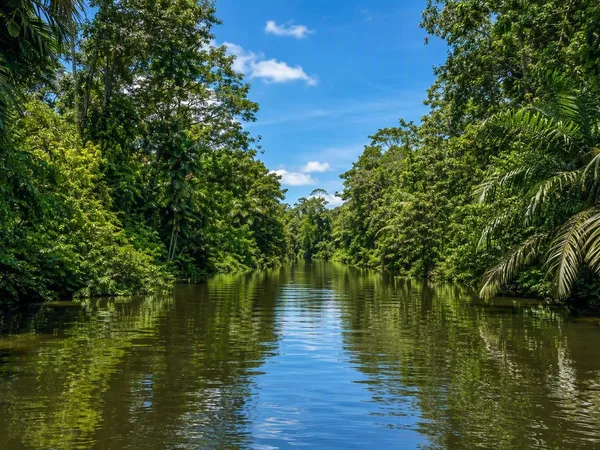
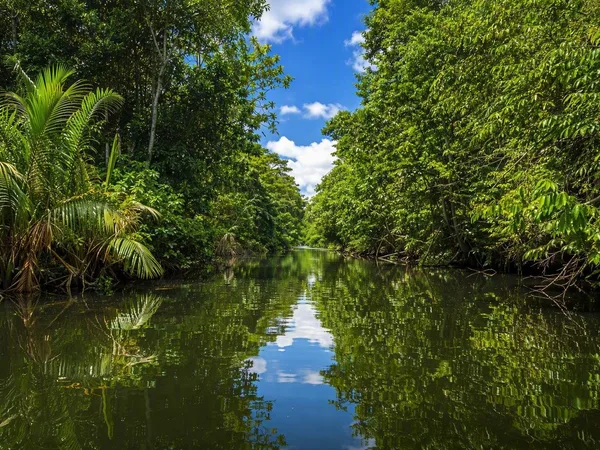
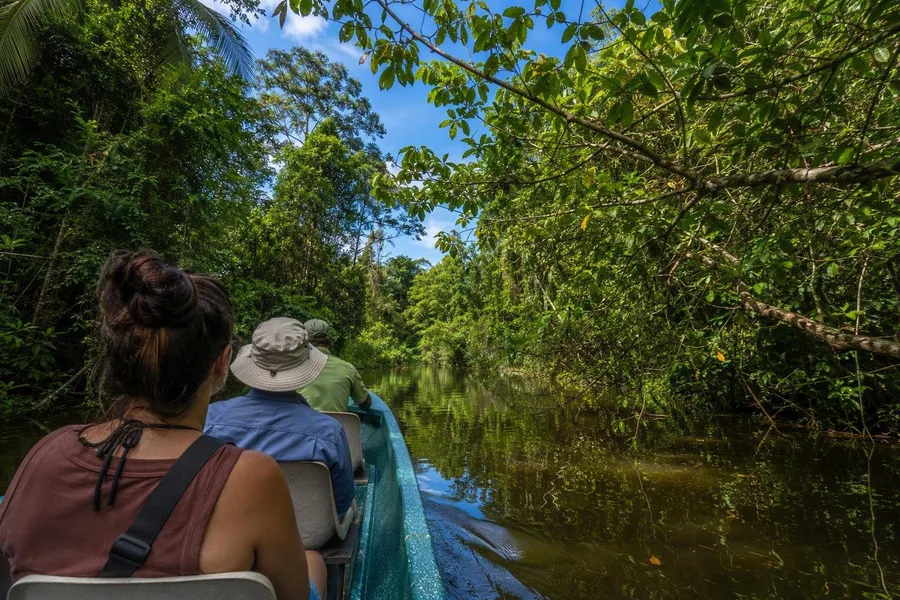 Passengers travel by boat through a narrow canal in Tortuguero National Park.
The canals are transport routes, but they also make the forest easier to read. Dense vegetation can close off views from the ground; from a boat, passengers can scan muddy banks, low branches, palms, secondary forest and fallen trunks along the waterline.
Small animals often show themselves before large ones do. Spectacled caimans may rest on muddy banks or sit half-hidden among waterside plants. Freshwater turtles bask on logs, while iguanas, basilisks, jacanas, anhingas, kingfishers and herons use the channel margins.
Broad, quiet stretches give a guide time to pick out movement in the vegetation. On narrower caños, branches and waterside growth narrow the view ahead. West Indian manatees live in these waters, though their quiet behaviour and the turbid water mean that a ripple, back or snout is more likely than a full view of the animal.
Wildlife does not arrive to order. A guide may recognise a bird call or spot movement in leaves, but a shy animal remains a possibility, not a promise.
Rainforest on foot
Tortuguero National Park includes tall rainforest, swamp forest, flooded woodland and yolillo-palm swamps. Heavy rain, warmth and humidity persist throughout the year, and paths run through dense, wet vegetation rather than open dry forest.
Mantled howler monkeys often give themselves away by calls that carry through the canopy. White-faced capuchins and spider monkeys move through the crowns of trees, while a sloth can remain high above as a motionless clump among leaves. On a forest walk, frogs, insects, reptiles and birds are more realistic finds than jaguars, tapirs or ocelots. Those larger mammals live in the protected area, but they are shy, scarce or active at night.
A guided evening walk can turn up red-eyed tree frogs, glass frogs or smoky jungle frogs, depending on rain and location. The useful habit here is simple: look slowly, listen carefully and accept that many rustles remain unseen.
Tortuguero village between waterways and sea
No road reaches Tortuguero village. Boats provide the usual connection, and bicycles and boats serve as practical local transport in settlements near the park.
The village stands on a narrow coastal strip between inland waterways and the Caribbean shore. That shore explains why Tortuguero became a national park: the beach forms a major nesting ground for green turtles and also supports nesting leatherbacks and hawksbills.
The canals and beach call for different expectations. A daytime boat trip focuses on forest edges and freshwater wildlife. Turtle watching takes place separately on the beach, under strict controls and usually after dark.
Three turtles, different seasons
Green turtles account for most nesting activity in Tortuguero. They come ashore from around mid-June to November; July to October gives visitors the most useful window, and nesting peaks from early August to mid-September.
Leatherbacks arrive earlier. Their season runs broadly from March through July, with the clearest activity in April and May. Hawksbills may nest at any time of year, but their numbers are small and unpredictable. May to October offers a better chance, not a dependable viewing season.
Arrival and egg-laying are part of the same night visit. A female leaves the sea, searches for a site, digs and lays her eggs, but visitors are not taken close during her arrival, site search or early digging. Hatchlings emerge roughly two months after the eggs are laid. September to November can therefore bring late-nesting green turtles and hatchlings from earlier nests; leatherback hatchlings appear earlier in the year.
April and May offer the strongest seasonal chance of a leatherback. August and September suit green-turtle nesting, while October and November favour green-turtle hatchlings. None of these periods guarantees a sighting, and young hawksbills remain a chance encounter.
Practical arrival and access
Shared boats run from La Pavona to Tortuguero in about an hour, with a typical one-way fare of ₡4,000; confirm the departure details shortly before travel and tell the boat crew which lodge or village stop you need. Small SANSA aircraft also fly daily from San José, taking about 30 minutes, with fares that vary by date. Foreign adults currently pay US$16.95, including tax, for park access booked online through SICORE. In nesting season, book a night tour in advance through a registered guide or authorised operator. Independent beach access after dark is not allowed.
Waiting for a turtle to lay
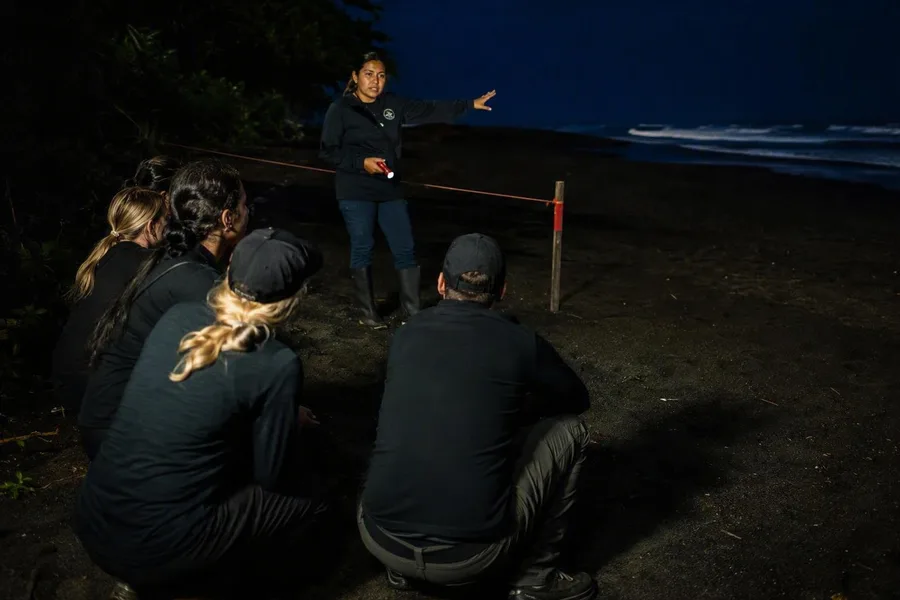 Visitors wait with an accredited guide before a turtle observation on Tortuguero’s beach.
During nesting season, the beach is not a place for an independent night walk. Accredited guides receive an assigned sector and time slot, while trackers search the sand and visitors wait away from the beach.
A tracker calls the guide only after a female has settled and started laying. The group does not watch her emerge from the surf, choose a site or begin to dig. This restraint has a plain purpose: white light or people approaching too early can disorient a turtle and send her back to sea before she lays.
A guide may lead no more than eleven people, including the guide. Visitors approach only on instruction, stay together, keep silent and leave the turtle's route to the water clear. Nobody touches the animal, the nest or the surrounding sand.
Dark, non-reflective clothing helps keep the group unobtrusive. Cameras, phones and video equipment are not allowed on the night beach, and visitors use no torches or screen light; a guide may use a red-filtered lamp when necessary. In daylight, nests must remain untouched and hatchlings must not be picked up.
When the guide gives the signal, the group crosses the dark sand without lights or screens. A red-filtered beam may briefly show the turtle's rear flippers drawing sand over the nest before she turns towards the Caribbean.
Keep exploring