La Merced’s Working Streets
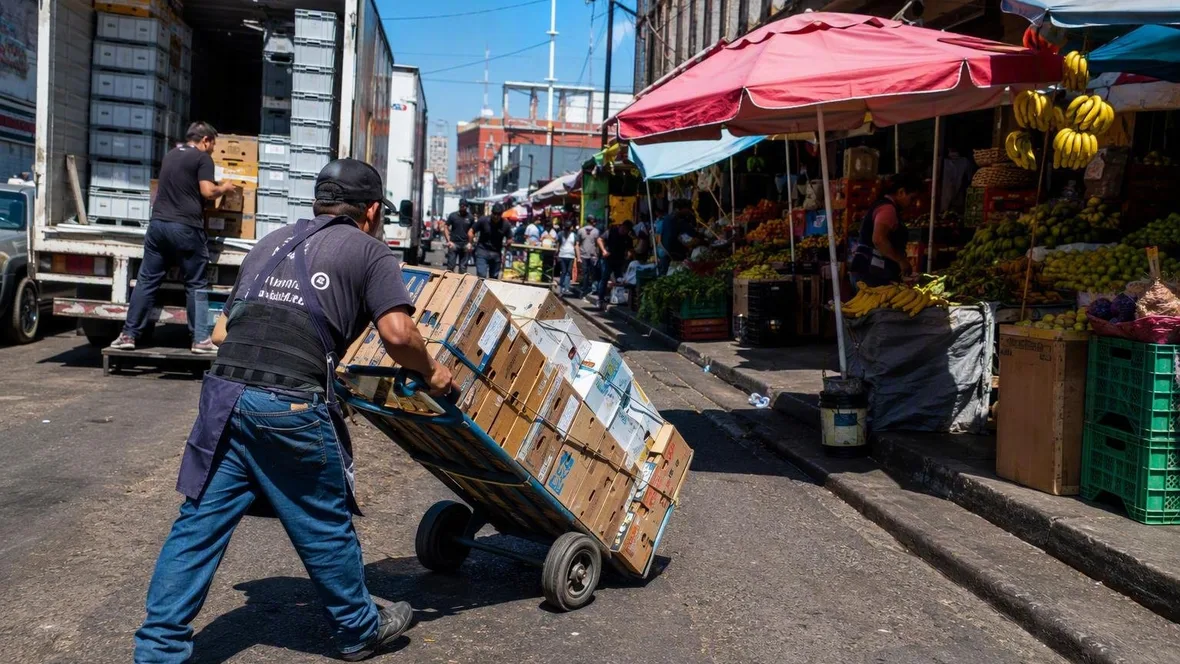
Drivers unload produce at the kerb. Diableros tilt boxes onto metal hand trucks and steer them towards stalls, while street vendors, shoppers and parked vehicles claim the same strip of pavement. In La Merced, the market reaches well beyond its doorways.
A market spread across the neighbourhood
La Merced fills much of the southeastern corner of Mexico City’s historic centre. It is not one market building but a district of covered halls, specialist markets, warehouses, fixed shops and street stalls.
Its position grew from transport by water. As the colonial city took shape and the former lagoon market at Tlatelolco ceased to function, landing places here connected the centre with farming areas to the east and south; goods then moved inland along Roldán Street. That older geography still explains the density of commerce in this part of the city.
The district takes its name from a Mercedarian monastery, established when four plots of land were joined here in the late 16th century. After the church was demolished in 1862, only the cloister remained. Plaza Alonso García Bravo now occupies the site of the old market building, immediately north of it.
Trade had already spread through the surrounding streets when an iron market hall opened on the former monastery grounds in 1880. Stalls soon gathered outside it again. In 1957, Mexico City opened the present complex farther east, designed by Enrique del Moral. The new buildings concentrated part of the trade, but they did not put a clean edge around it.
The banquetón, the broad pavement zone outside the halls, carries another layer of selling. Fixed shops face goods set out on the pavement. Semi-permanent stalls reduce the walking space, while parked vehicles, unloading crews and hand carts take up the rest; pedestrians sometimes step into the carriageway to get past them. The street serves as sales floor, storeroom route and workplace at once.
From truck to stall by diablito
Vans, pick-ups and larger trucks bring vegetables, fruit, meat, fish and dairy products into La Merced. Drivers unload on the street, beside a bodega, or on private parking land. Diableros and carretilleros then carry boxes and bales on two-wheeled metal hand trucks, the diablitos, to a shop, a stall or a storage room.
The name is playful. The work is exacting.
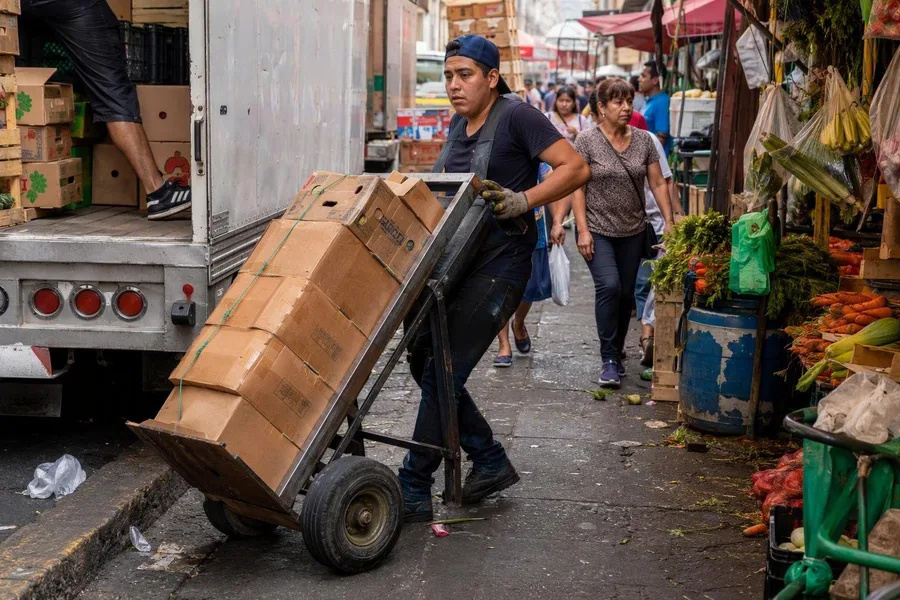 A diablero steers a loaded diablito from a delivery vehicle toward a La Merced stall.
A loaded cart has to clear customers, merchandise and other workers before it reaches its destination. Street sellers rely on hand carts particularly often, and more than three quarters of unloading recorded in a logistics study took place on public roads, where stalls and traffic already occupied space. The person at the handles must balance the load and find a passage through a moving crowd.
La Merced does not follow one reliable daily sequence. Deliveries, carrying, sales, cooking and cleaning overlap because different businesses use the same streets and halls at different times. Fruit and vegetable sellers may buy at the Central de Abasto in Iztapalapa or receive deliveries from specialist carriers. Meat reaches the Nave Menor through, among other sources, the 20 de Noviembre and San Juan Pantitlán markets.
Workers divide larger consignments for fixed shops, street stalls and storage. The buyers include households, restaurant operators, cooks and resellers; prepared-food stalls often buy ingredients within the market before turning them into meals. La Merced therefore works as a retail market and as a place for smaller wholesale transactions.
The Central de Abasto took over Mexico City’s leading wholesale role after it opened in 1982. La Merced nevertheless remained the city’s largest traditional market and a supply point for households and traders from the capital, the metropolitan area and other states. Its role now rests on that close-grained redistribution: goods arrive in volume, then leave by the bag, the box, the cart and the cooked plate.
Concrete roofs and working drains
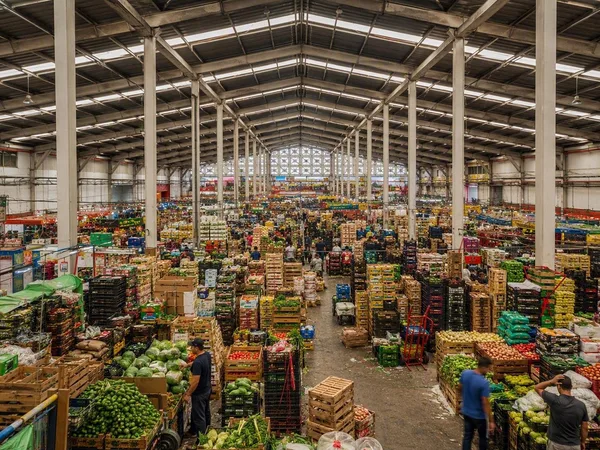
The Nave Mayor gives this dispersed trade its largest roof. The hall runs for about 400 metres beneath high reinforced-concrete shell vaults, whose staggered forms bring daylight and ventilation above rows of low stalls. It holds fruit, vegetables, pulses, seeds and dried chillies. The Nave Menor handles meat, fish, dairy goods and groceries, while other halls and annexes serve prepared food, flowers and household articles.
Those divisions matter because the market contains different kinds of labour, not a single general bustle. The 1957 complex included loading platforms for vehicle movements and facilities for washing and disinfecting food before sale. At its edges, however, hand carts still connect vehicles, warehouses, shops and temporary stalls. Street trading also occupies parts of the space originally intended for loading.
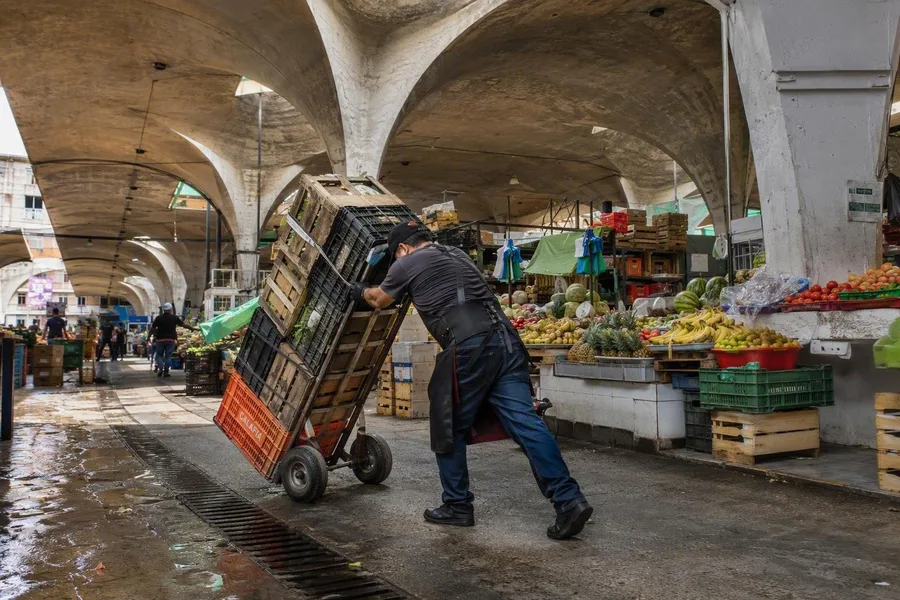 A diablero pushes a loaded hand truck through produce stalls in La Merced’s Nave Mayor.
Cleaning belongs to that same chain of work. Meat preparation produces fat and organic waste, and stallholders in the second Nave Menor have cleaned and unblocked drains themselves to prevent blockages. Elsewhere, sellers report that daily rubbish collection does not remove all the waste generated in the district. Bags and piles remain near collection points, drains and corners; when drains clog, water can stand in the street.
That is not an after-hours detail. Refuse takes space from the same pavement used for selling, carrying and walking. A cart, a crate, a stall counter and a rubbish bag can all determine where a person puts a foot.
Older streets beside the market halls
Anillo de Circunvalación cut a broad traffic route through the older urban fabric in the 20th century. Functional buildings along the avenue combine ground-floor shops and storage with housing above, while narrower streets behind them retain irregular blocks and former vecindades around long courtyards.
Talavera offers a precise counterpoint to the concrete halls. A Baroque niche stands opposite Art Deco balconies, and the surviving Mercedarian cloister has carved cantera columns, relief arches and Corinthian capitals. Nearby, Casa Talavera preserves an 18th-century red-tezontle façade, timber beams, a stone floor and a well.
These structures do not belong to a sealed heritage enclave. They remain beside warehouses, loading lanes and stalls because commerce has used the neighbourhood’s streets and squares for centuries. The contrast is physical rather than nostalgic: volcanic stone and courtyard buildings stand close to concrete shell roofs, vehicle lanes and counters extended onto the pavement.
Arriving at La Merced
Metro La Merced offers a direct arrival, with an entrance inside the Nave Mayor. Plaza Alonso García Bravo, Anillo de Circunvalación, Rosario, Adolfo Gurrión and General Anaya help mark the wider market district beyond the hall.
The Metro stairs rise into the Nave Mayor rather than onto a formal forecourt. At the top step, filtered daylight falls through the concrete shells onto the low rows of produce stalls.
Keep exploring