Jaffna, from Palmyra Palm to Curry Pot
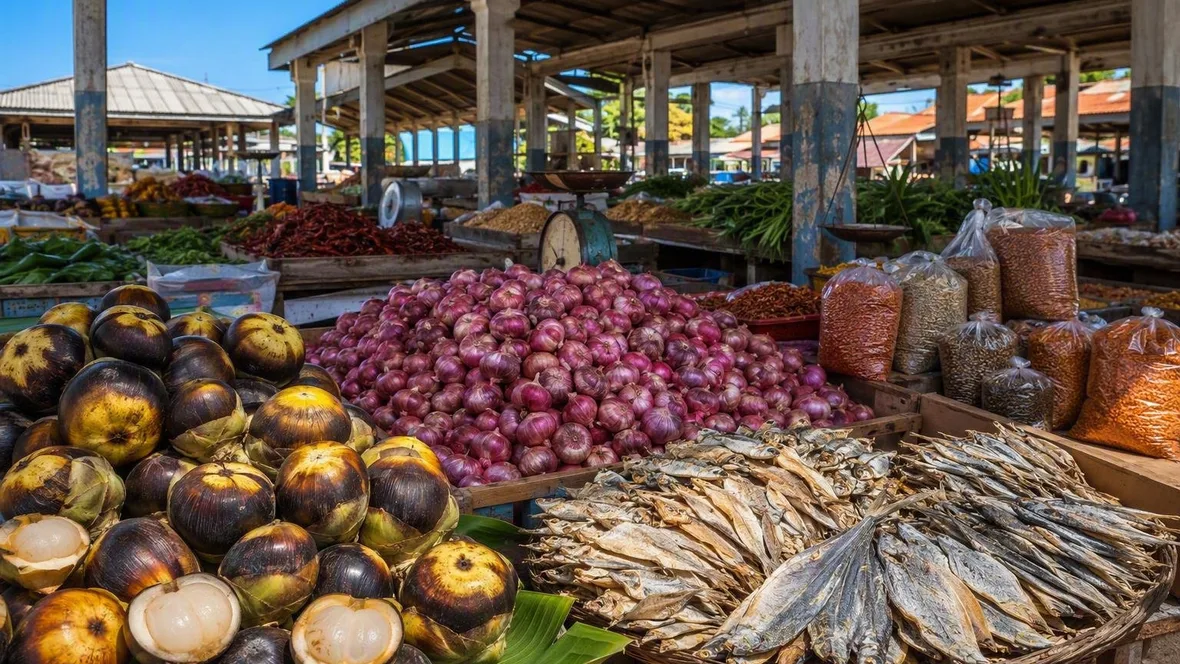
At Jaffna’s municipal market, palmyra tubers sit near lagoon crabs, dried chillies and bunches of moringa leaves. These ingredients trace the dry northern peninsula and lead straight into its Tamil kitchens.
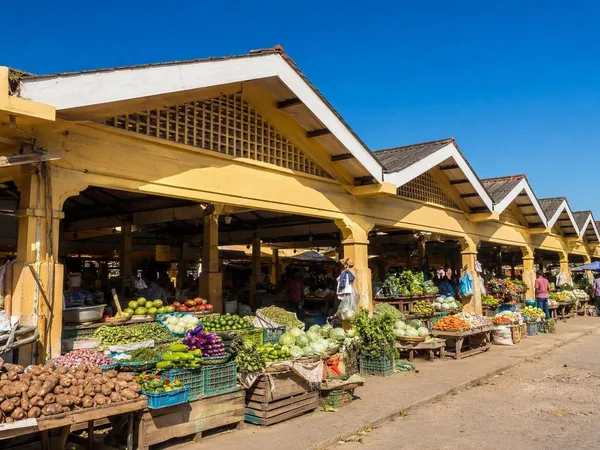
Jaffna Municipal Market, between Hospital Road and Stanley Road, serves as the city’s daily pantry.
Under open pavilions, traders weigh beans, pumpkins, tomatoes, jackfruit and the local Karthacolomban mango on hanging scales; some wrap purchases in banana leaf. Fish and meat sellers occupy another part of the market, while coconuts, leafy vegetables, dried fish and nungu, the translucent flesh of young palmyra fruit, appear around its edges.
Wholesalers arrive early. Households follow to buy ingredients for the day, and another flow of customers passes through in the late afternoon on the way home. The stalls bring peninsula growers, coastal fishers and city kitchens into the same daily circuit.
Dry land, salt water and the market
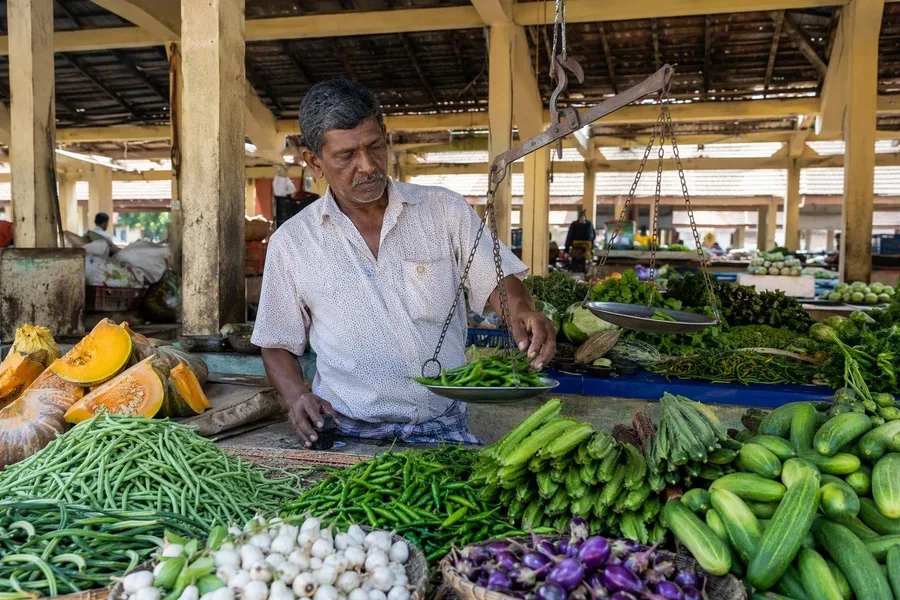 A trader weighs vegetables beneath the open pavilions of Jaffna Municipal Market.
The Jaffna Peninsula lies in Sri Lanka’s dry zone, where most rain falls during the northeast monsoon. The land is low and flat, with limestone beneath it, a lens of rainwater below ground and saline soils near the coast. Farmers grow red onions, chillies, potatoes, pulses, vegetables, bananas and grapes; irrigated plots can produce vegetables beyond the main rains, while rice cultivation follows the wetter season more closely.
That geography shows up in the market’s working ingredients. Onions, dried chillies and pulses keep well, while seasonal fruit and fresh vegetables fill the day’s cooking baskets. Palmyra palms grow naturally between fields and compounds across the peninsula, their fan-shaped leaves standing above the open ground.
The coast supplies the other half of the kitchen. Sea and lagoon surround Jaffna District, and fishing remains a major occupation. Before sunrise, boats unload at the Gurunagar and Pasaiyoor fish market; restaurateurs and other buyers purchase seer fish, mackerel, reef fish, prawns, crab, squid and cuttlefish in the auction hall. Fresh catch, along with dried and salted fish, then reaches cooking pots across the city.
Spice stalls turn these supplies into Jaffna’s recognisable curries. Their stock includes fennel, fenugreek, coriander, cumin, turmeric and cinnamon, as well as dried chillies and mor milagai, chillies soaked in buttermilk and dried in the sun. Traders also sell Jaffna curry powder, a roasted and ground spice blend used in the region’s dark, robust fish dishes.
One palm, many foods
The palmyra provides Jaffna with much more than its familiar silhouette. A tapper scrapes the ends of flower clusters and fixes an earthenware pot underneath to catch the sap. Fresh, unfermented sap is called pathaneer. It is clear and sweet, but wild yeasts quickly turn its sugars into alcohol. The result is toddy, a cloudy, lightly sparkling palm wine.
Producers clarify and filter unfermented sap, then boil it down and pour the brown concentrate into moulds to make jaggery. They also keep it as treacle, while fermented sap can become vinegar. The same tree therefore provides a drink, a sweetener and a preserved condiment.
The fruit changes with age. A seller cuts through the dark shell of young fruit to release jelly-like nungu, mild and lightly sweet with a soft, watery bite. Ripe fruit yields deep yellow-orange pulp with a more assertive, sometimes bitter flavour; producers turn it into drinks, jam, sweets and ice cream.
Below ground, a germinating seed produces the edible shoot or tuber called odiyal. Cooks peel and roast it over an open fire, while vendors also sell hard dried pieces that are nibbled rather than bitten. A fried version, boiled and dried before it meets hot oil, chilli and salt, becomes crisp.
For flour, processors clean and boil the tubers, strip away the outer fibres, cut the flesh into thin pieces, dry it and grind it. The resulting odiyal flour thickens one of Jaffna’s best-known shared dishes.
Odiyal kool in the cooking pot
In Jaffna, kool means a substantial soup, and odiyal kool names the version thickened with palmyra flour. A large pot may contain fish, crab, prawns and squid alongside rice, cassava, long beans, jackfruit seeds, chilli and tamarind. Cooks first mix the flour with water, then stir the paste into the pot near the end so the broth turns thick and glossy.
The dish sits between soup and porridge. Chilli supplies heat, tamarind brings sourness, seafood deepens the broth, and palmyra adds an earthy note. Pieces of coconut can be eaten alongside it.
Families and friends have traditionally cooked kool in quantity and shared it, sometimes from coconut-shell bowls or folded palmyra leaves. The preparation involves cleaning seafood, balancing tamarind and chilli, and stirring in flour without clumps. Large extended-family lunches became less common after displacement during the civil war, which ended in 2009, and households now often reserve this labour-intensive dish for gatherings.
The pot also carries a longer local history. From the early fourteenth century, the peninsula formed the centre of an autonomous Tamil-speaking kingdom. Its rulers maintained links with South Indian dynasties and trading networks while developing distinct Tamil and Saivite Hindu institutions. Odiyal kool combines a Tamil cooking tradition with a pantry built from palmyra, coastal catch and dry-land crops.
Pittu, crab curry and palmyra sweets
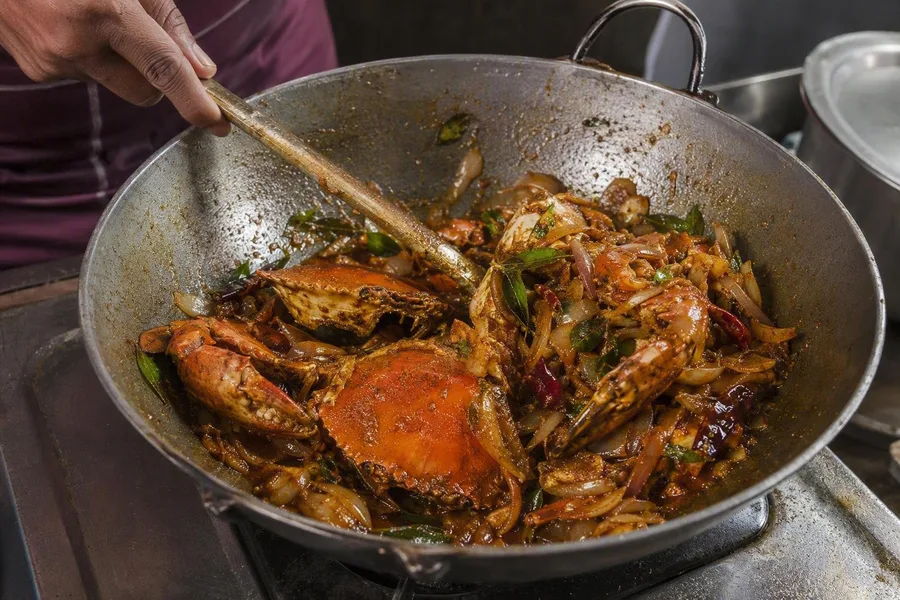 A cook fries whole mud crab with spices for Jaffna crab curry.
Pittu, also called puttu, shows the South Indian connection in everyday form. Cooks moisten rice flour or finger-millet flour, layer it loosely with grated coconut, and steam it in a cylinder. The finished pittu is soft, lightly granular and mild enough for spiced dhal, coconut milk or curry gravy. It is common in Tamil households across northern Sri Lanka rather than exclusive to Jaffna.
Jaffna crab curry belongs firmly to the coast. Cooks grind roasted cumin, pepper and coconut into a paste, then fry whole mud crab with onion, mustard seed, fennel, curry leaves, chilli and Jaffna curry powder. Coconut milk and tamarind simmer around the shells until the sauce thickens, producing sweet-salty crab meat in a hot, peppery, sour gravy. Families may serve it as a shared celebratory meal.
The palm returns at the sweet end of the table. For panangai paniyaram, cooks combine ripe palmyra pulp with flour, coconut, cardamom and jaggery or sugar, then fry small portions until golden. Roasted pulp gives the fruit cakes a smokier taste and firmer texture. The snack is associated with Jaffna Tamil cooking and uses two products from the same palm: ripe fruit pulp and jaggery.
Back at the market, adjoining stalls can hold woven palmyra baskets, blocks of brown jaggery, yellow bundles of dried shoot and dark fruits cut open to expose pale nungu. Nearby, crab, tamarind and chilli wait for the cooking pot. A spoon drawn through odiyal kool leaves a thick, steaming trail in the broth.
Keep exploring