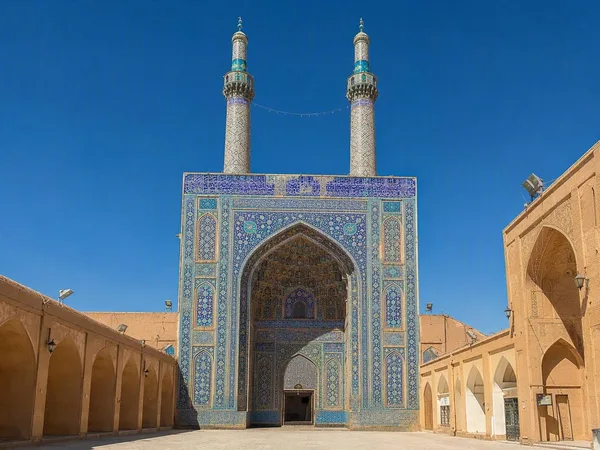
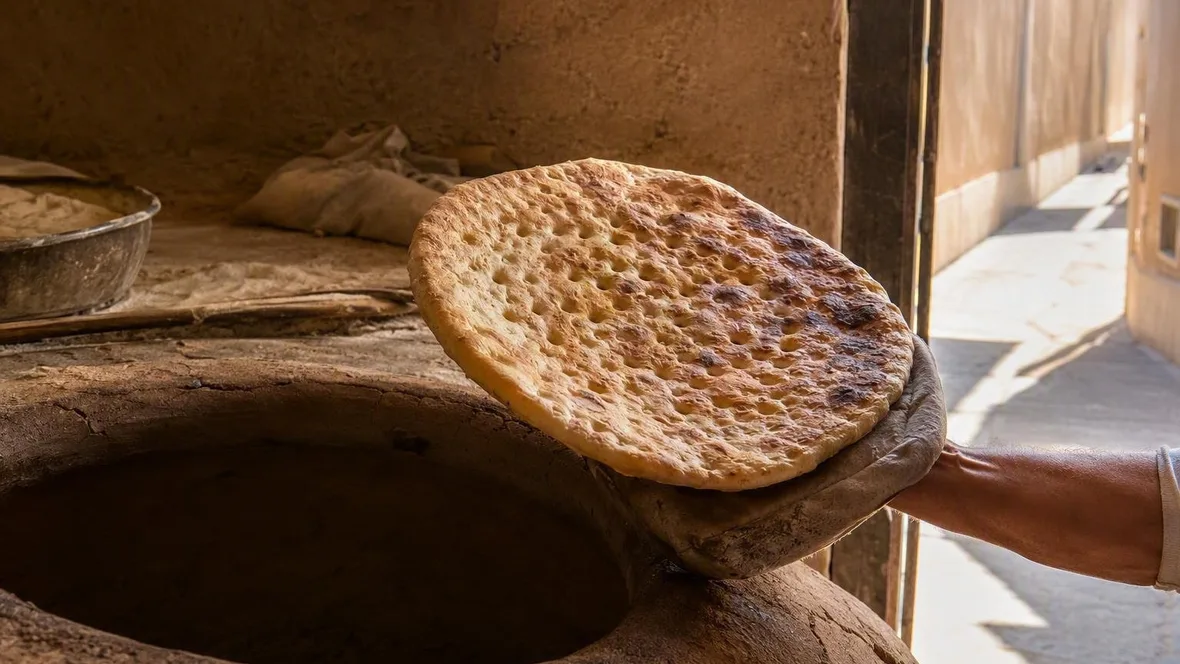
Flour, Clay and First Light in a Yazd Bakery
Morning bread work in a Yazd neighbourhood bakery moves from soft dough to a hot clay wall. Outside, high mud-plastered walls keep the narrow lane shaded while broken light gathers at the doorway.
Before the lane brightens
A neighbourhood bakery belongs to the daily fabric of Yazd rather than a display of old crafts. The historic city consists of dense, inhabited quarters with their own everyday centres, where small workshops stood alongside water points, bathhouses and bazaars. Hundreds of bakeries still serve the city, and morning production forms part of its everyday bread supply.
The street outside provides the first frame for the work. High adjoining earthen walls and narrow passages were arranged to cast shade; some lanes pass beneath a sabat, a room built across the street between two houses. Windows in these covered passages can throw alternating strips of light and shadow below.
Earth gives Yazd’s built fabric its weight and muted surface. Builders used it widely for walls, vaults and domes because timber was scarce, while kahgel, a mud-and-straw plaster, protects and insulates older brickwork as well as earthen walls. That heavy construction explains a compact, shaded room at street level. The oven supplies its own fierce heat.
Among traditional breads recorded in Yazd bakeries, nan-e taftoon tanuri is the strongest focus for this kind of morning work: it was the most common traditional bread in one survey and its name identifies it as taftoon baked in a tanur.
Flour becomes taftoon
Flour and water begin the process. Yeast and salt make the dough rise; some versions also use oil or sugar, but neither belongs to every taftoon dough.
The dough is kneaded and left to rest. A baker then divides it into round pieces and rolls each one into a flat, nearly circular sheet. The work stays close to the surface of the bench: a soft portion becomes a thin round that can take the heat of the wall.
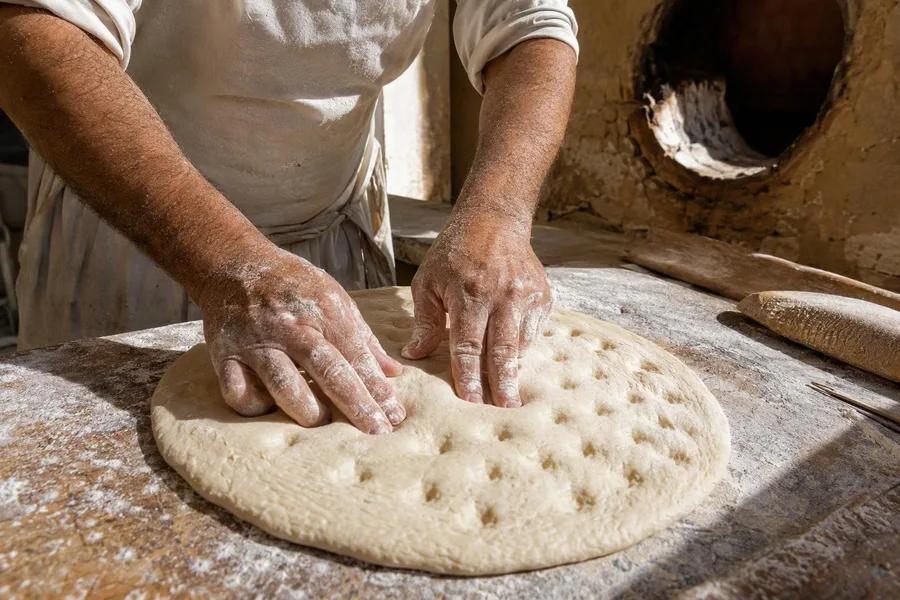 Flour-dusted hands press dimples into taftoon dough in a Yazd neighbourhood bakery.
Fingers and a fork press small hollows and holes across the dough. Those marks prevent the bread from blowing up into a few large bubbles in the oven. They also leave the practical, dimpled surface associated with taftoon.
Daylight does not need to fill the room to register the hour. Yazd’s narrow lanes, high walls and partial coverings limit direct sun, so light can enter a street-side workspace in interrupted bands rather than across the whole interior. Flour, dough and hands remain nearest the oven opening.
Dough at the oven wall
The tanur dictates the next movement. It is a round, cylindrical or slightly tapering clay oven, traditionally fired with wood. Its upper opening receives fuel and dough, while a lower opening admits air and allows ash to be removed.
A local Yazd account describes dough spread on a non-bandeh, a bread cushion or support, then placed against the oven one piece at a time. The support carries the soft round to the opening. A quick sideways press fixes it to the smooth, hot inner wall instead of letting it fall towards the fire.
The wall is the baking surface. Flames and glowing fuel heat the clay from within, and the stored heat cooks the dough attached above the fire. This is why the bread remains flat and why the baker works with a direct, controlled motion rather than laying it on a tray.
The available evidence does not identify a wooden tool for this Yazdi wall-oven action. A long wooden peel belongs to the separate practice of baking sangak on hot pebbles, not to the vertical clay wall used for taftoon. In the documented wall-oven method, hands and the cloth-covered bread support bring the dough to the clay.
Moisture helps the dough hold. Experimental work with tannur baking found that lightly wetted fingers could give dough enough adhesion to stay on clay and still release cleanly after baking; too much water left residue behind. The baker must therefore keep the dough moist enough to cling, but not so wet that it marks the wall.
Clay, heat and release
The dough changes quickly against the heated clay. Its surface firms as the crust sets, and the bread gradually loses the grip that held it to the wall. A long hook or spatula can free a stubborn edge.
The sequence repeats without machinery. One round can be shaped while another bakes, then the next piece waits on its support as a finished bread comes away. Taftoon’s prevalence in Yazd makes this a routine neighbourhood task, not an occasional heritage performance.
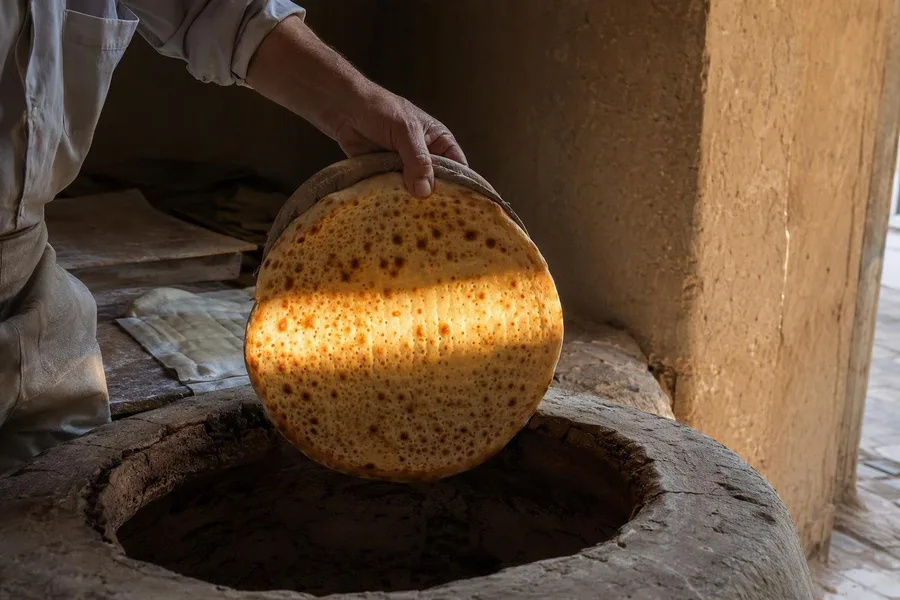 A hand lifts fresh taftoon from the tanur into filtered light at the Yazd bakery doorway.
Other local breads follow a different timetable. Yazdi nan-e khoshk, or dry bread, first bakes against the wall, then continues drying on a metal tray in a closed oven. Taftoon keeps the action direct: dough is flattened, marked, pressed to the wall and lifted away.
Outside, the street remains shaped by shade even as the morning grows brighter. The earthen façades and covered passages break up the sun before it reaches the doorway. Inside, the clay wall still holds the oven’s stored heat.
The baker loosens a finished taftoon from the inner wall. Its broad, almost circular shape holds, and the small holes pressed into the dough have kept its surface from ballooning.
The fresh round rises clear of the oven opening. Filtered light from the narrow lane crosses the bread as it moves from the clay wall towards the doorway.
Keep exploring