Dhaka’s painted rickshaws put pictures into traffic
A film star, a tiger or two peacocks can travel through Dhaka on the back of a cycle rickshaw. Painters turn the vehicle’s working parts into public pictures, even as cheaper printed panels replace much of their handwork.
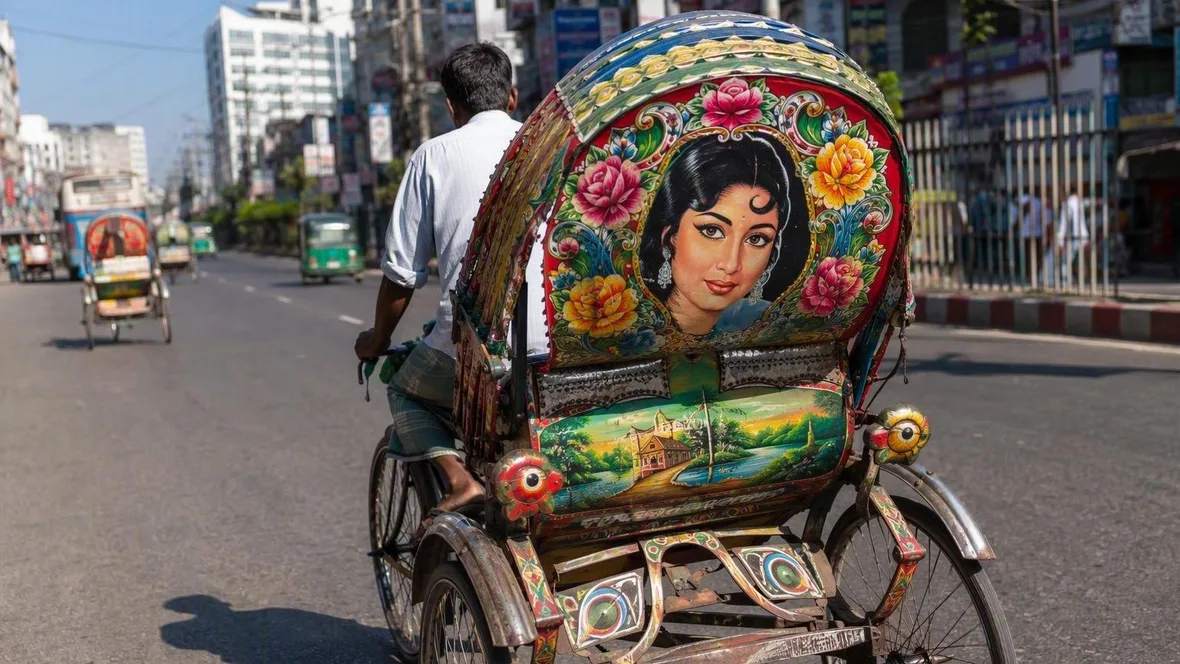
The picture sits above the chain and gears. As a driver pedals, the painted rear panel moves slowly enough for people nearby to make out flowers, faces and lettering.
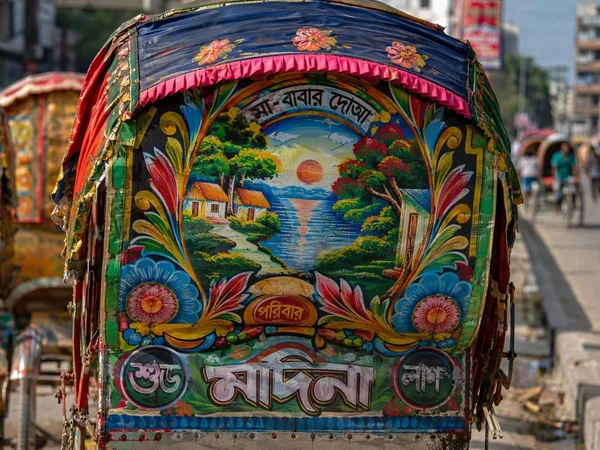
Dhaka’s rickshaw painters work across the vehicle rather than on a single detachable panel. Paint and ornament can cover the tin rear plate, hood, seat, footrests and iron frame; tassels, plastic flowers and glittering trim fill the gaps around those surfaces. A passenger vehicle carries popular imagery on the same small structure that carries its rider.
Paint on the working rickshaw
Cycle rickshaws reached Dhaka in 1938. During the 1950s, owners and makers decorated them more richly as they competed with the horse-drawn tomtom. Floral ornament came first, then spread across almost every available part of the vehicle.
The rectangular tin sheet at the rear became the main picture surface. It also covers the chain and gear assembly. Painters use enamel paint on metal, though sources also document oil paint on reused, previously enamelled tin. Some painters draw freehand; others work with stencils. Neon yellow, vermilion red, emerald green and cobalt blue all appear in documented contemporary work.
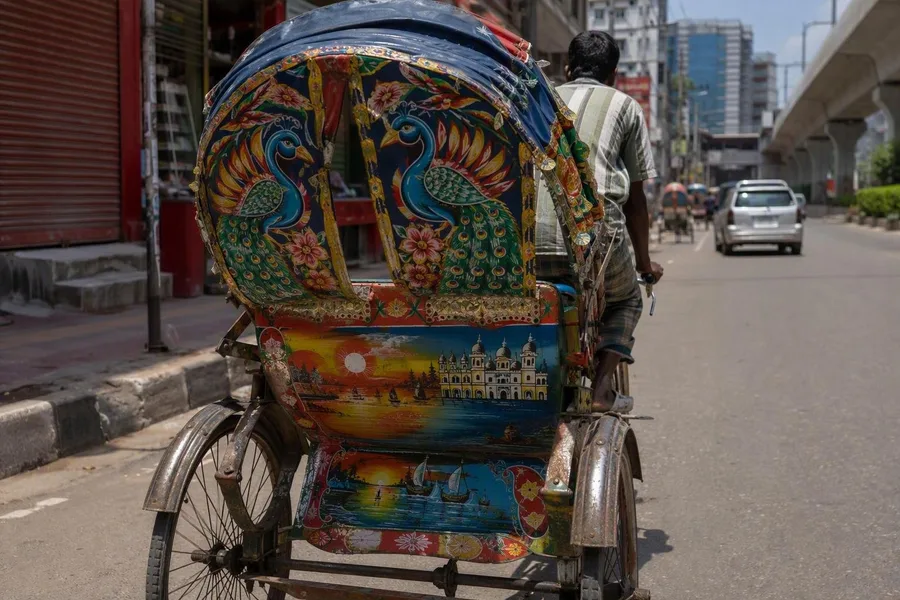 A driver pedals a Dhaka cycle rickshaw with a painted tin panel over its chain.
Paint is only one part of the finish. Makers cut coloured plastic with cardboard templates, fit decorative metalwork, and add tassels or small brass vases filled with plastic flowers. Rexine backrests and plastic hood sections can also carry images. The result combines brushwork, cut plastic, metal and upholstery on a vehicle built for daily use.
Flowers, leaves and curling vines form the underlying vocabulary. Research links those patterns to decorative practices known to rural migrants, including alpana, village ornament and painted household objects. Birds, tigers, peacocks, boats, forests and river landscapes extend that vocabulary into scenes that fit a narrow metal panel.
Religion and public history appear there too. Painters have depicted mosques, horses and the winged Buraq, as well as Kali and Durga; other works show the 1971 Liberation War, national figures and historic events. Names and slogans add another layer, while some words serve as protection. On a small panel from the 1980s, Allah appears between two peacocks for that protective purpose.
Cinema faces in the street
Film supplied bold faces and action scenes that read from a distance. Stars and dramatic scenes became popular subjects in the 1960s, and later painters drew on Indian and Pakistani cinema, television and international heroes. Posters and cinema billboards gave painters working references.
Painters did not simply copy a single poster. They combined people and incidents from different advertisements into new compositions. A large face could fill the centre of the rear panel, with flowers, leaves and lettering around it. The paint carried a cinema image beyond the billboard and into ordinary traffic.
Cinema also led documented makers into rickshaw art. Mohammad Hanif Pappu painted film posters for decades before he turned to rickshaws, after learning from his maternal uncle. In 2024, he worked from a studio on Hossaini Dalan Road in Old Dhaka and had taught the craft to others.
Md Monir Hossain began practising while still in primary school. He took a painting job on Nazimuddin Road in 1994 and later worked with Pappu, applying rickshaw imagery to household objects as well as vehicle panels.
Nobo Kumar Bhadra followed an older workshop route. He first ran errands for his ustad, then learned to sketch and paint small details of figures before becoming independent after five years. His later work continued to draw on reworked film-banner imagery, and he held a solo exhibition of rickshaw art in 2025.
Brushes still pass from hand to hand
Painters traditionally learn by watching, assisting and taking on parts of a picture step by step. Builders work together in workshops, while painters often complete commissions at home and pass skills to children or relatives. Men and women paint rickshaws, although the heritage record identifies the vehicle builders as men.
Pappu added a formal teaching space to that informal system in 2025. He opened Pappu’s Art School for All at 38 Hossaini Dalan Road in Chawkbazar, where Monir and veteran rickshaw and cinema-banner painters joined him as mentors. The school provides firm evidence of active teaching in Old Dhaka. It does not prove that the district still has a large network of workshops producing new hand-painted rickshaws.
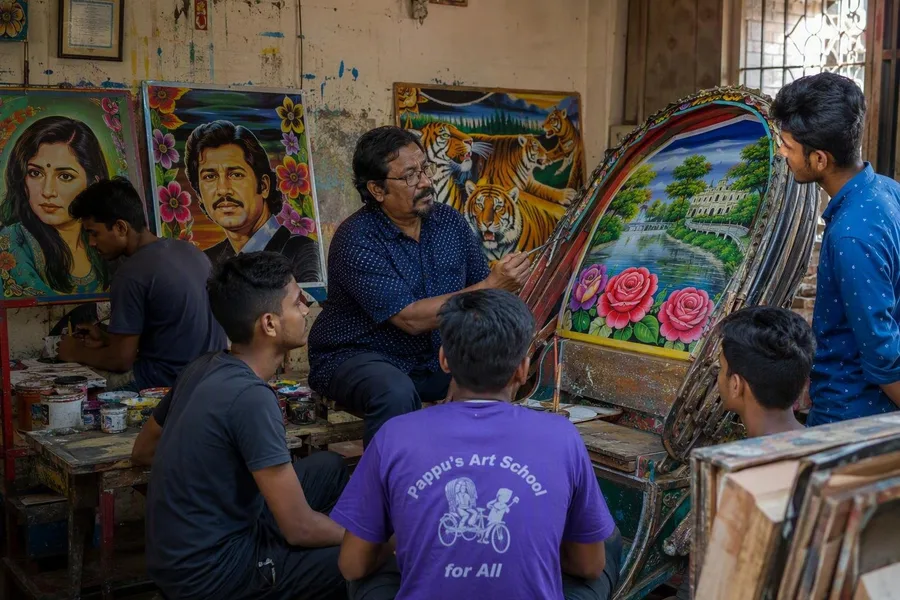 Mohammad Hanif Pappu and fellow mentors teach rickshaw painting in Chawkbazar, Old Dhaka.
Syed Ahmed Hossain was also working from a home studio near Hossaini Dalan in 2024. He traced one line of painters to RK Das, whose family continued the work across generations. Sources document that family connection, but do not identify a current public workshop run by Das’s descendants.
Ready-made and digitally reproduced panels cost owners less than a newly commissioned painting. Motorised vehicles also offer less room for the traditional metal picture. Active artists, teaching and exhibitions remain documented, but the available evidence does not establish a broad production scene across Old Dhaka.
A rickshaw in a museum, a rickshaw on the road
The British Museum holds a complete painted rickshaw from Dhaka, acquired in 1987 after it was commissioned for the exhibition Traffic Art: Rickshaw Paintings from Bangladesh. Plastic, wood, tin and rubber make up the vehicle, while painted and cut decoration covers much of its structure.
The collection also holds separate parts. Alongside the panel with Allah and two peacocks, it preserves a painted plastic seat section with buildings, a road, cars and a bus beneath a lotus and a border of flowers and leaves. Another catalogued object is an oil-painted tin panel from Dhaka. These pieces show how painters fitted devotion, city traffic and ornament onto small working surfaces.
In 2023, UNESCO placed Dhaka’s rickshaws and rickshaw painting on its Representative List of the Intangible Cultural Heritage of Humanity. The inscription covers building, painting, commissioned work and the transfer of skills, not only finished objects. It identifies painters and builders as the people who sustain the practice.
The recognition came as hand-painted panels lost ground to cheaper substitutes. Collections and exhibitions preserve images once made chiefly for working vehicles, but a panel in a gallery no longer covers a moving chain or follows a passenger through the city.
On the street, the passenger sits in front of the image. The driver presses the pedals, the chain turns beneath its painted cover, and a film face framed by bright flowers rolls forward between the rear wheels.
Keep exploring