Before the Mahjong Tiles Click: Opening Heming Teahouse
Before seven, staff sweep the stone paving at Heming Teahouse in Chengdu’s People’s Park. Bamboo chairs and low tables stand under trees beside the water; soon, hot water will fill porcelain gaiwans and mahjong tiles will begin to click.
Before seven at Heming Teahouse
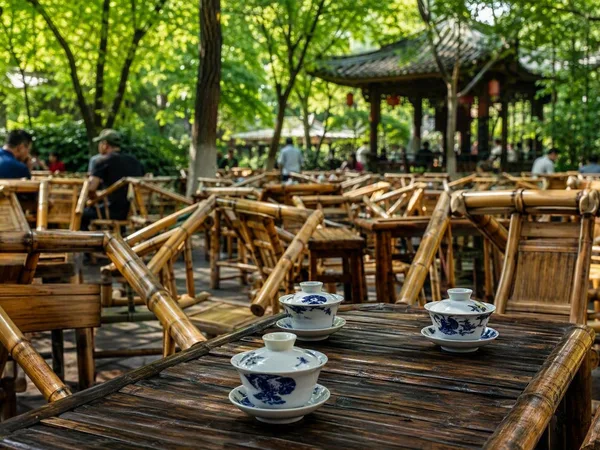
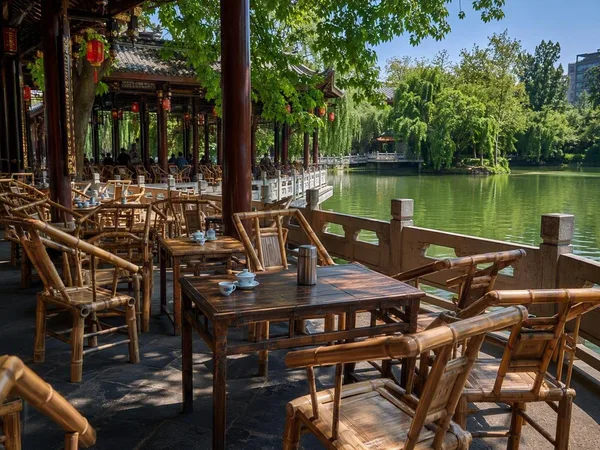
Heming Teahouse opens onto the park rather than closing itself off from it. Its outdoor seating spreads across blue-grey stone paving, where bamboo chairs face low wooden tables beneath the trees near the lake. Before seven, staff sweep between the tables and chairs.
The historic building stands at the edge of this open-air seating. Red-painted columns hold up a West Sichuan-style pavilion, with timber brackets under deep eaves that turn up at their ends. Heming dates from 1923, and repairs have retained and refurbished the old structure.
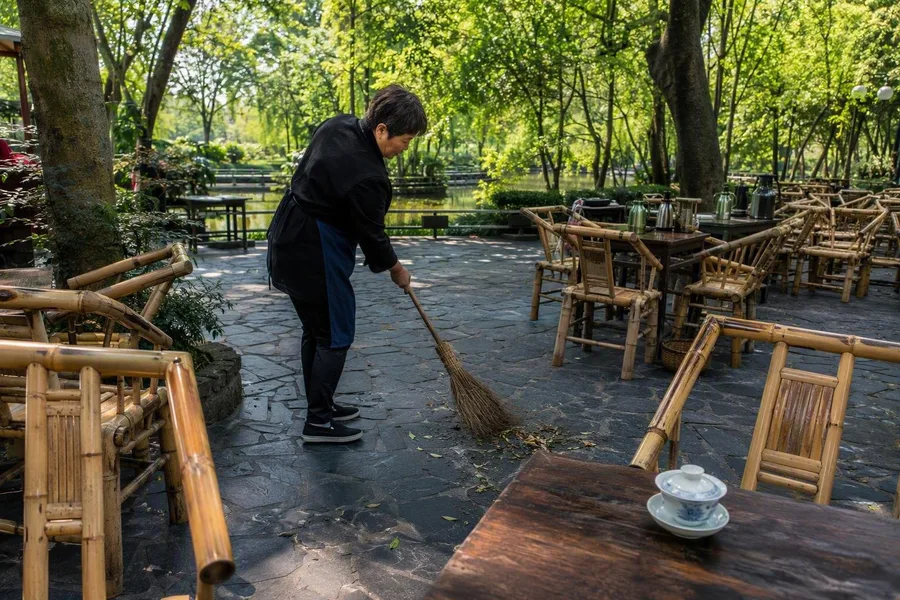 Staff sweep between bamboo chairs and low tables at Heming Teahouse in People’s Park.
The first early-tea period begins at 6.30am. That early hour matters less as a spectacle than as the start of ordinary use: chairs, tables and a supply of hot water ready for people who may remain for some time. One tea order includes repeated refills, so a table can hold a gaiwan long after its first pour.
People’s Park supplies the setting, but it is no ornamental backdrop. The park began in 1911 as Shaocheng Park, in Chengdu’s former Manchu quarter, and became the city’s first modern public park. After residents of the Eight Banners lost their rice allowance, some received permission to make a living inside the grounds. Trade and recreation therefore shared the park from its early years.
Heming’s site was originally chosen where a stream met dense greenery. The Jinshui Stream still runs through the park, past banks with willow, bamboo and flowering shrubs. Water, trees and paths also frame a daily public space used for leisure and seasonal flower festivals, alongside monuments and historic buildings.
The tiger stove and the first pour
A coal-fired laohuzao, or tiger stove, keeps the kettles hot at Heming. The arrangement is practical. The teahouse needs a continuing supply of water because each order can be topped up again and again.
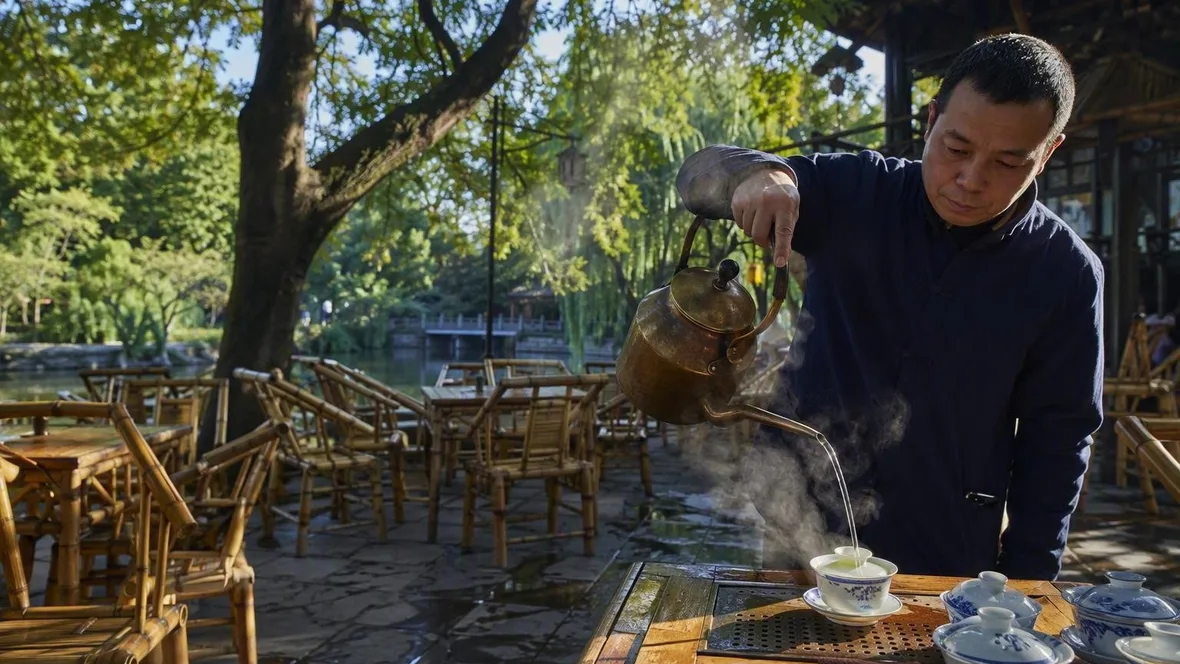
Boiling water gives a soft hiss. Porcelain answers with a light tap. A server takes a long-spouted kettle to the table and pours hot water into a gaiwan, sending steam above the cup.
The first order involves no elaborate ritual. A guest chooses tea; the server sets down a gaiwan with leaves already in the bowl, then adds hot water. The gaiwan consists of three porcelain pieces: a bowl, a lid and a saucer. The saucer carries the hot bowl. The lid holds back leaves and leaves a narrow opening for drinking.
Some leaves float on the surface. The drinker can use the lid to move them from the rim, then drink through the gap between lid and bowl. Later, a lid propped at an angle against the bowl signals that more water is wanted.
The objects suit the place because they are made for long, repeated use. Hemingway’s bamboo chairs include locally used hard-yellow and patterned bamboo, while the porcelain gaiwan has traditionally come from Jingdezhen or specialist makers. The porcelain sits on the table. The kettle returns when the lid tilts.
Tea as a reason to stay
Chengdu’s public teahouses have long served as more than places for a quick drink. People have sat in them to talk, exchange information, conduct everyday business and spend time together. Teahouses shifted from private businesses to collective ownership during the twentieth century, and their public role narrowed sharply in the Maoist period before reviving in the reform era.
That history helps explain the scale of Heming’s outdoor room. The tables do not belong only to the pavilion. They extend under the trees, beside the water, where tea, conversation and games can occupy neighbouring tables.
People’s Park has carried similar layers of public use for more than a century. In 1913, the park received a memorial column for people killed in the Railway Protection Movement of 1911. Buildings used for public education in the 1920s now serve, among other roles, as meeting space and a museum about that movement. After 1949, Shaocheng Park became People’s Park.
Heming remained in business after 1949, unlike many other park businesses, and the building is protected as a historic structure. Its red columns and upturned eaves stand beside a working tea service, not behind a barrier.
Practical note. Early tea starts at 6.30am. One order includes repeated hot-water refills.
The first mahjong tables
Mahjong does not have a documented ceremonial first move at Heming each morning. It belongs instead to the teahouse’s daily use, alongside cards, conversation and long sessions over tea. Mahjong spread far beyond Chengdu, but the city’s public teahouses give the game a conspicuous place outside the home.
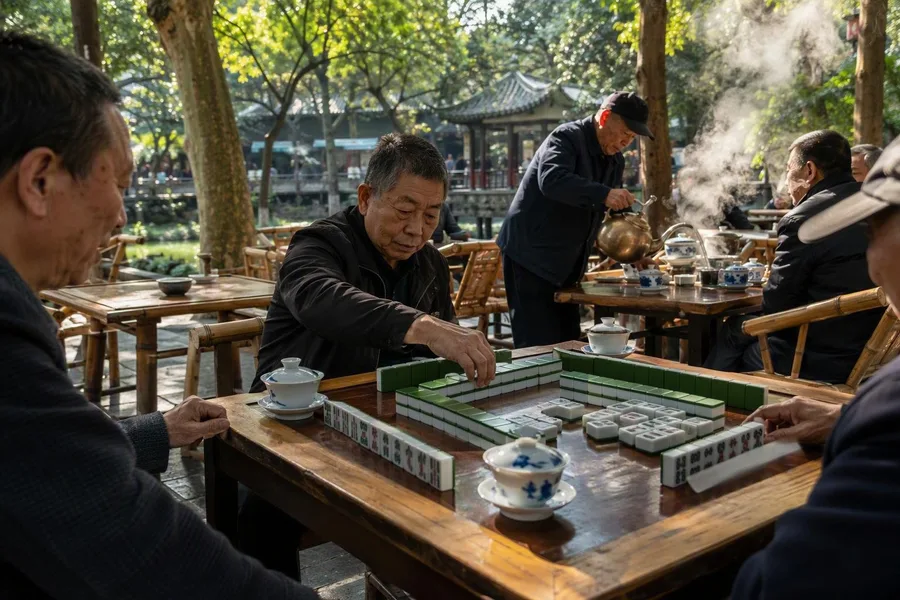 Mahjong players arrange tiles beside steaming gaiwans at Heming Teahouse in People’s Park.
As the tables fill, the soundscape changes in small, hard notes. Sources describe the continuing click of mahjong tiles in Chengdu teahouses and the meeting of tiles, conversation and kettle sounds at Heming. The game gives a table an activity that can last longer than a single cup of tea.
A gaiwan remains on its saucer. Leaves float beneath the lid. At the next table, mahjong tiles strike the wood while a long-spouted kettle sends another line of hot water through the steam.
Keep exploring