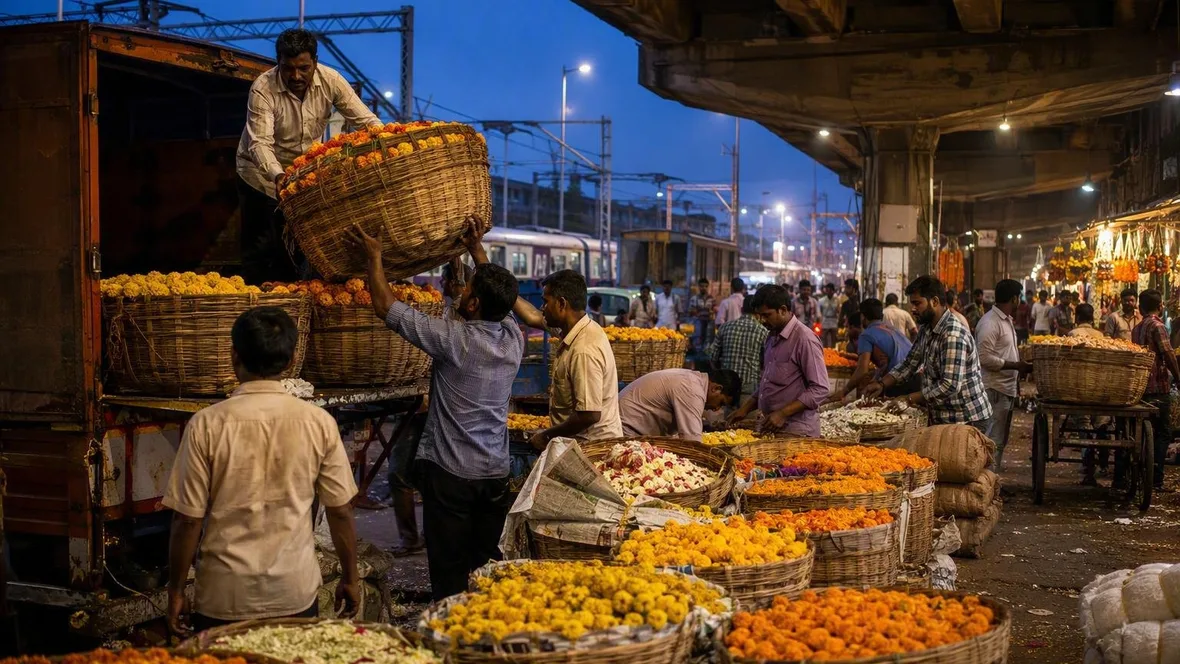
Before Sunrise, Mumbai’s Flowers Change Hands in Dadar
Before sunrise, trucks reach Dadar with marigolds and chrysanthemums from farms across Maharashtra. Within hours, traders divide those loads among florists, decorators and street sellers who carry flowers into neighbourhoods across Mumbai.
A wholesale market beneath the flyover
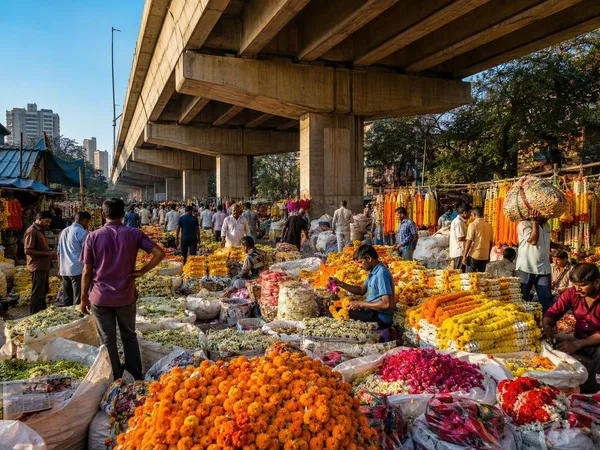
Dadar’s flower market occupies a narrow strip along Senapati Bapat Marg in Dadar West, beside Dadar station and under or near the flyover. Its names include Phool Gully and the Maasaheb Meenatai Thackeray Flower Market.
This is not a neat hall with one entrance. Fixed shops stand beside kiosks, stalls and wooden boards, while baskets and handcarts fill the remaining street space. The trade grew around the railway and the later flyover: flower sellers used the space beneath the elevated road, alongside earlier street trades that included pottery and animal stalls.
Flower sellers had worked around Dadar station since at least 1950. In 1985, the city moved 634 vendors into the Meenatai Thackeray market, while another cluster of flower trading remained near the station. The formal market now sits beside the narrow lanes where baskets, carts and smaller sellers continue the trade.
The location explains Dadar’s role. The station brings growers, collectors, buyers and portable bundles close to the stalls, while Senapati Bapat Marg gives trucks and delivery vehicles access to the wholesale trade. Rail passengers and flower cargo cross the same crowded ground.
Farms send their harvest into Dadar
Most large consignments come from Maharashtra. Trucks and smaller goods vehicles carry marigolds and chrysanthemums from Nashik, Pune, Satara, Sangli and Kolhapur to Dadar during the night. Festival supplies also include roses from Tasgaon and cut flowers from Maval.
Farmers or commission agents dispatch the larger loads by road. Wholesalers in Dadar sell them on to smaller traders, florists, decorators and other buyers working across Mumbai. The flowers have already spent the night in transit, so traders unload and offer them quickly; perishability leaves little time to hold a consignment.
Not every consignment arrives by truck. Growers from the Vasai-Virar belt have long brought mogra and other fragrant flowers to Dadar themselves for early sales. Individual collectors also travel by train with smaller bundles of leaves and flowers, then sell them on the pavement between the station and the main market.
Flowers from farther away add another stream. Dadar sellers identify Bengaluru, Madurai, Coimbatore, Chennai, Indore, Ujjain, Lucknow, Kashmir and Jaipur as supply points reached by train or air cargo. Maharashtra’s farms remain the main hinterland, but traders have sought supplies in other states after disrupted production in Sangli, Satara and Pune.
Baskets become smaller orders
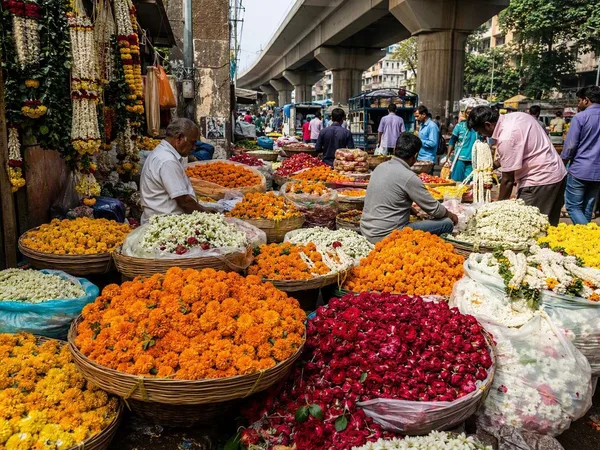
Workers unload flowers into large baskets or spread them across flat woven trays. They sort yellow marigolds for garlands and orange ones for offerings, string mogra buds into gajras and keep roses moist until buyers arrive. These actions break a truckload into goods that smaller Mumbai businesses can carry and sell.
Some flowers leave loose. Others become malas, gajras, doorway torans, petals for decoration or bouquets made to order. Sellers hang finished garlands where buyers can inspect them, call out prices and bargain in the cramped passage.
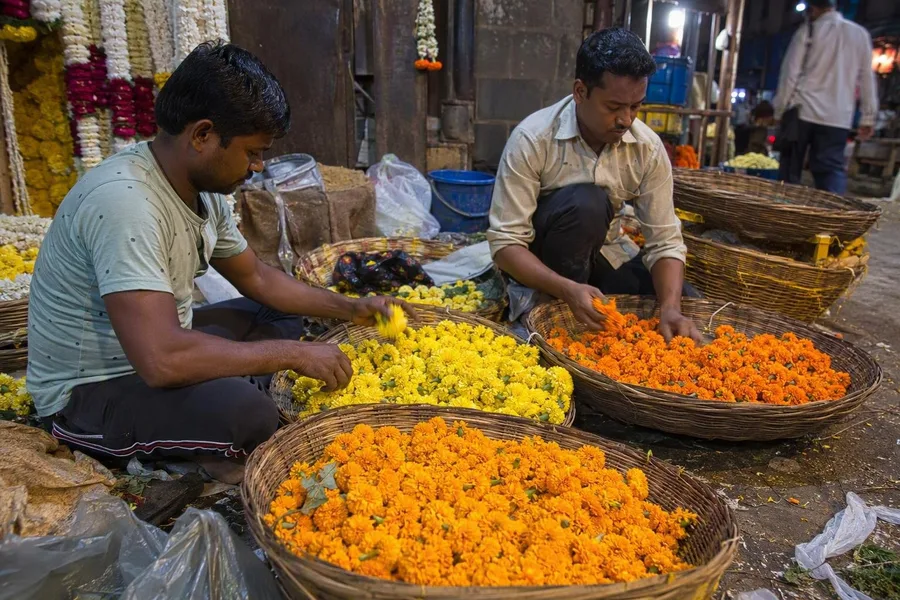 Sellers sort yellow and orange marigolds from baskets in Dadar’s flower market.
Small flower merchants from Mumbai and its suburbs buy stock early, while wedding and ceremony decorators negotiate directly for larger quantities. Private customers can also buy here, but bulk orders dominate the early trade.
Vendors may lay out loose petals again, while smaller sellers buy leftover flowers cheaply and take them elsewhere. Traders also carry heavy baskets on their heads or shoulders towards the local trains, taking loose flowers and finished garlands to street stalls and smaller markets.
Flowers for homes, weddings and gifts
Dadar supplies everyday commerce as well as ceremonies. Women who sell mogra and marigold garlands have made the market a permanent workplace, turning wholesale flowers into small, portable purchases. Decorators buy loose flowers and completed strings for houses, venues and ceremonial settings.
Specialist makers also buy here. A Mumbai floral studio sourced fresh flowers from Dadar for a wedding dupatta, necklaces and wrist ornaments made from flowers. Around Valentine’s Day, roses pass through the wholesale market before retailers sell them as single stems, bouquets and arrangements.
Demand rises around major festivals. During Diwali, traders repeatedly unload lotuses and marigold garlands for buyers seeking fresh bulk stock. Ganesh Chaturthi also brings large orders for decoration and ceremonial use. A household purchase, a florist’s morning stock and a maker’s short-lived wedding ornament can all begin in the same Dadar lane.
Too many claims on one narrow street
The same position that supports the trade also produces conflict. Residents have complained about double-parked delivery vehicles, baskets, flower waste and stalls occupying roads and pavements around the market. The traders’ association disputes responsibility for some obstructions and says authorised supply vehicles unload inside the market during the night.
Discarded flowers make the pressure plain. The market generates an estimated 10 tonnes of floral waste each day, and the city has examined local processing into products such as compost and incense sticks. During the monsoon, residents have reported that crushed flowers make the road surface slippery.
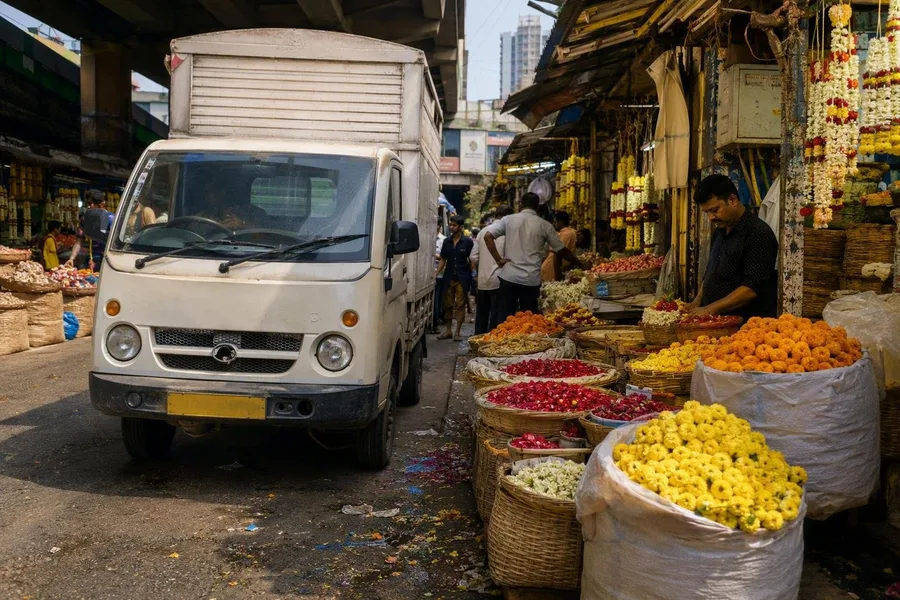 A delivery vehicle, baskets and flower stalls crowd the street around Dadar market.
A municipal redevelopment plan remained under preparation after an architect was appointed. Residents opposed it in 2025 because they feared more traffic and greater pressure on public space. Some called for the market to move outside the city, but no relocation decision followed. In February 2026, authorities stated that the market should remain open.
Enforcement has also affected sellers. Growers from Vasai reported that municipal action had obstructed their early trade in March 2026; officials were then instructed to support their sales. A cut-flower traders’ association later announced a four-day closure to protest a shorter selling window and unauthorised vendors. The association said perishable stock could not be unloaded and sold fast enough.
Visiting the market
Dadar station provides the simplest access, and wholesale activity is busiest before sunrise and in the early morning. Keep clear of porters, baskets and working vehicles: Phool Gully remains a functioning distribution market, not a staged attraction.
Before daylight, the lane outside Dadar station holds fixed shops, makeshift counters and woven baskets beneath the flyover. Under 100-watt bulbs, sellers call prices while fresh garlands hang above loads that have arrived from Maharashtra’s farms.
Keep exploring