Sight · Armenia
Matenadaran
At 53 Mashtots Avenue in Yerevan, the Matenadaran is Armenia’s manuscript museum, archive and research institute. Its galleries reveal Armenian book culture through illuminated Gospels, maps, medical works and manuscripts in many languages.
Orientation
The Matenadaran stands at the northern end of Mashtots Avenue, where the city rises toward the Kanaker heights. It is officially the Mesrop Mashtots Research Institute of Ancient Manuscripts: a museum for visitors, but also a working centre for cataloguing, conserving and studying manuscripts.
The core collection developed from the manuscript repository at Etchmiadzin and was transferred to Yerevan in 1939. The institute took up its current role in 1959 and has carried Mesrop Mashtots’s name since 1962. Its ancient manuscript collection has been on UNESCO’s Memory of the World Register since 1997.
Read the building first
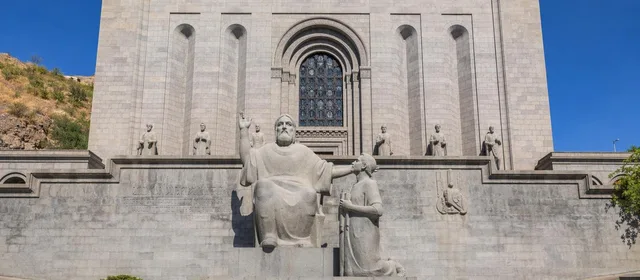
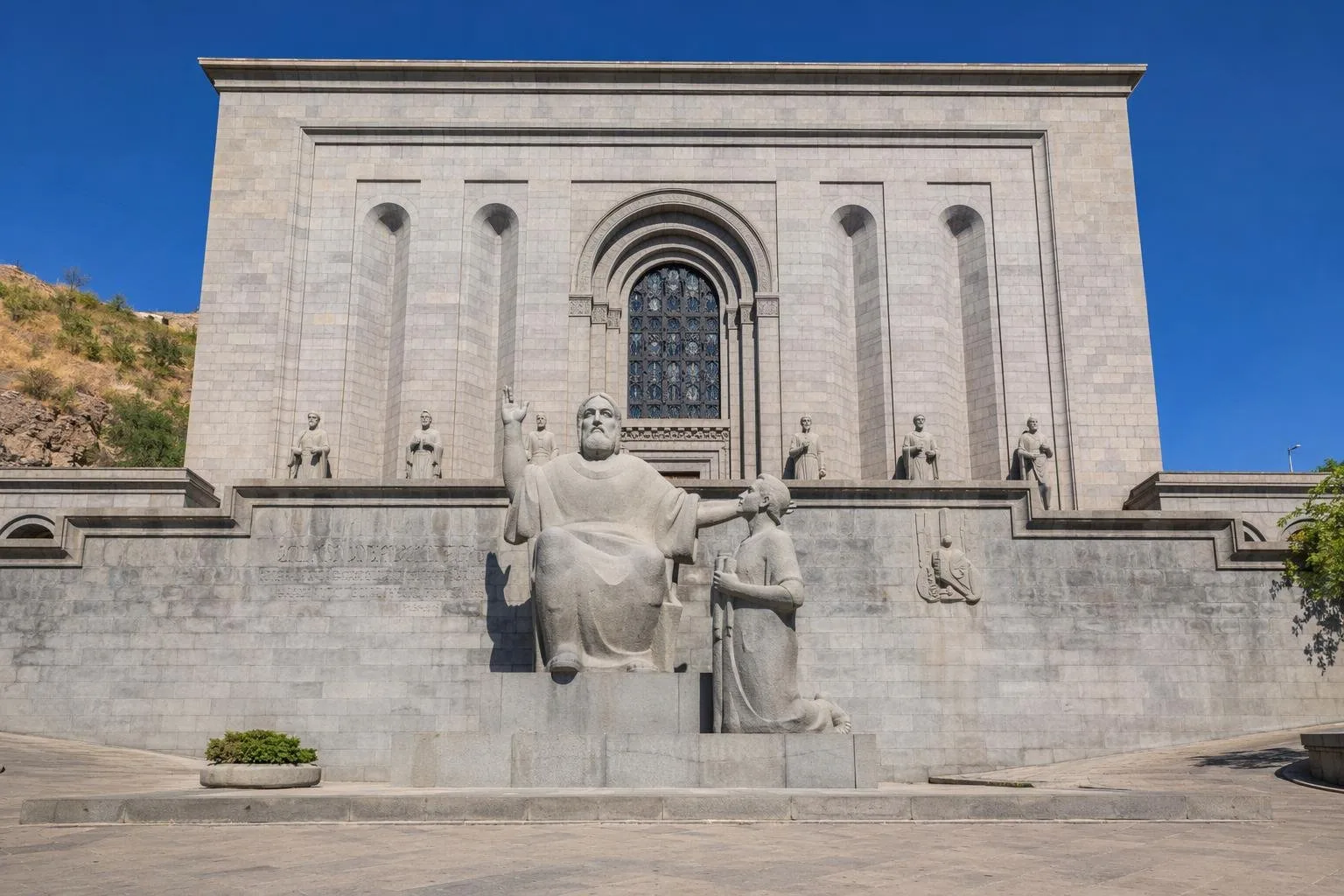
Architect Mark Grigoryan’s four-storey main building, completed in 1957, makes a deliberate break from central Yerevan’s pink tuff. Its hard grey-basalt façade, tall central arch and interior vaults draw on medieval Armenian architecture.
Approach via the staircase and pause at the statue group of Mesrop Mashtots and Koryun. Mashtots, credited with creating the Armenian alphabet in the early fifth century, sits beside his pupil. Six further statues of medieval Armenian cultural figures line the façade. The arcaded areas beside the building also hold an outdoor display of stone monuments, including khachkars.
What is on display
The museum shows a selection from a much larger holding of roughly 23,000 manuscripts and about 300,000 archival documents. Do not treat it as a gallery of religious books alone. The permanent displays range across:
- illuminated Gospels and miniature painting;
- history, philosophy, law, medicine, mathematics and cosmology;
- maps and geographical material relating to Armenia and the region;
- manuscripts in Armenian as well as Arabic, Persian, Greek, Latin, Syriac and other languages.
The point is breadth as much as age. Medieval Armenian translations preserve some works whose originals no longer survive in their source languages. Look closely at the parchment, pigments, scripts and bindings: the manuscript was both a text and a made object.
Visiting practicalities
Address: 53 Mashtots Avenue, Yerevan. The museum is open Tuesday to Saturday, 10:00–17:50; it is closed Sunday, Monday, public holidays and remembrance days. The ticket office closes at 16:50.
Allow at least an hour for the permanent galleries; more if you want to read the labels and spend time in the maps and foreign-language manuscript sections. The building is uphill from central Yerevan, so the final approach on foot includes a climb.
Groups of more than five people must arrange their visit in advance. Tactile display cases make parts of the collection more accessible to visitors with visual impairments. The library and reading room are separate research facilities with their own hours; they are not part of a standard museum visit.
From the magazine
Stories about Matenadaran
Editorial stories linked directly to Matenadaran.
No stories about Matenadaran have been published yet.
Routes from our editors
Travel through Matenadaran
Editorial routes connecting Matenadaran with other countries, cities and hotspots.
No routes through Matenadaran have been published yet.
More in Armenia
Related hotspots
Other cities, nature areas and places within Armenia.