
When Lunch Takes the Counter at San Telmo Market
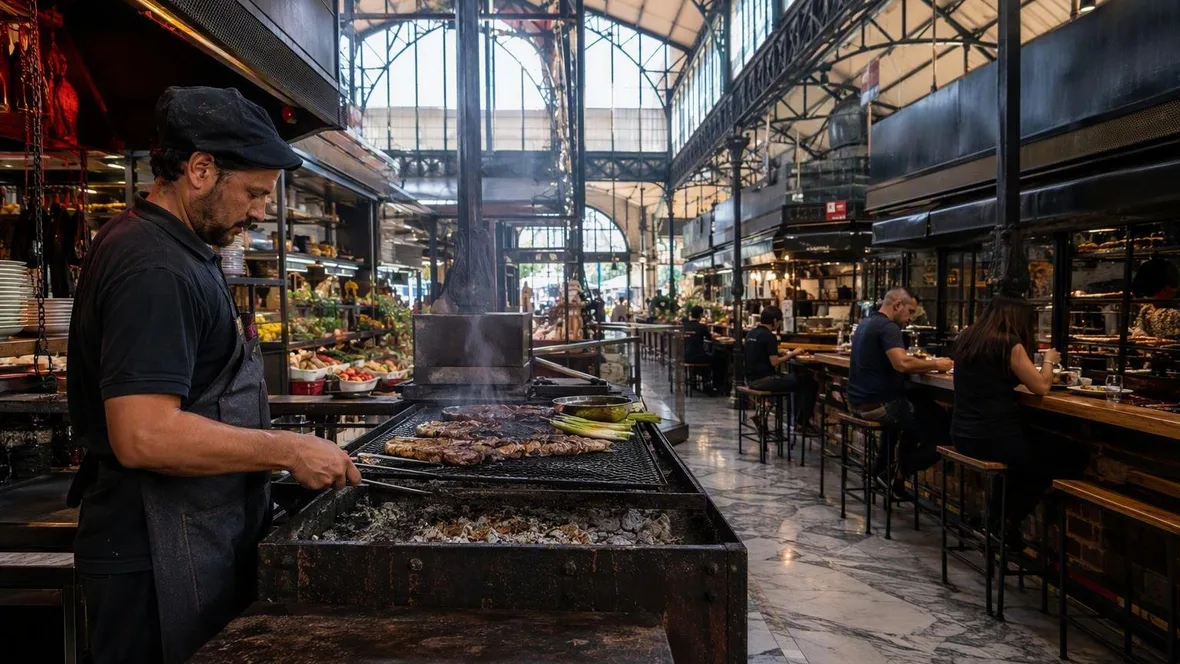
At Mercado de San Telmo, daylight falls through glass above iron arches and Carrara-marble floors. Fruit and vegetable stalls, butchers, bread sellers and lunch counters work under the same nineteenth-century roof; by midday, the open grill becomes one of the hall’s clearest signs of the day changing.
Nine o’clock, behind the brick façade
Mercado de San Telmo opens at nine on the corner of Defensa and Carlos Calvo. Its brick façade runs along a building that fills almost an entire block, with further entrances on Bolívar and Carlos Calvo. Round arches and Tuscan-style portals mark the way in.
Inside, the materials change quickly. Cast-iron pillars, beams and arches carry a roof of corrugated metal and glass. A central dome brings more daylight into the hall, and Carrara marble covers the main passageways. The roof was built to give the market light and ventilation. It still sets the conditions for the working day below.
The market opened in 1897, when the south of Buenos Aires was growing and local fruit and vegetable sellers needed a permanent place to trade. That original purpose has not vanished behind the cafés and counters. Traditional fruit, vegetable and butcher’s stalls remain in the passages, alongside antique dealers and newer food businesses.
San Telmo often gets reduced to a handful of familiar images: tango, antiques, old façades and the Sunday crowd around Plaza Dorrego. The market shows a less polished daily fact. People still come here for food to take home, while others stop at a counter for lunch.
Food work under the same roof
The morning does not divide neatly between shopping and eating. Produce stalls, antiques stands and food counters face onto the same routes through the hall. Their hours overlap, as do their customers.
Fruit and vegetables remain part of the market’s regular trade. By the Carlos Calvo entrance, a bakery sells sourdough baguettes and croissants. Bread passes through the market as an ordinary provision, not as a decorative flourish beside the older stalls.
The clearest record of work sits at the counters. Around midday, a 2023 report found men in white aprons preparing chorizo at a butcher’s metal counter. At a poultry stall nearby, workers breaded chicken for milanesas. Those tasks belong to the same hour as lunch orders. Hands keep working while customers choose between ingredients for later and food for now.
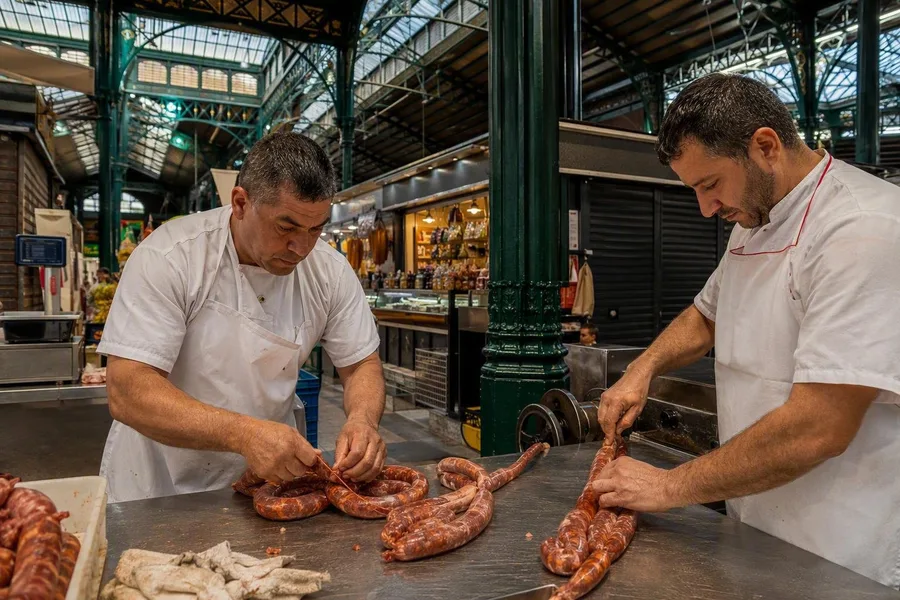 Men in white aprons prepare chorizo at a metal counter in Mercado de San Telmo.
Iron holds up the roof and shapes the space at eye level. Metal also appears at the butcher’s worktop. Marble takes the weight of people crossing the hall. The market has protected its historic fabric, but nobody treats the building like a silent exhibit. Sellers prepare food. Customers queue, sit, carry bags, and move on.
At noon, the old stalls do not always attract the largest crowd. The same 2023 report found some of the traditional food traders relatively quiet while more people ordered meals from the market’s restaurants. Lunch shifts the centre of attention, though it does not clear the vegetables or butchers from the hall.
Defensa after midday
The street outside follows its own timetable. On Sundays, the antiques fair around nearby Plaza Dorrego turns Defensa into a pedestrian street. More people fill the pavement and the market’s shared bars and terrace tables can draw queues.
A weekday gives a different view. One Wednesday report described the hall after midday as full of people, smells and noise, with produce sellers still trading beside gastronomic businesses. The market holds both uses in plain sight. A shopper can stop beside a lunch counter; an antiques browser can pass a butcher’s stall on the way to the exit.
The sound changes as orders multiply. At Hierro Parrilla, inside the market, the grill stays open to the counter. Food sizzles over fire within sight of the people waiting or sitting at the bar. That short, sharp sound cuts through the general movement of the hall.
Charcoal smoke reaches the market corridor around the open kitchen. The fire does not sit behind a closed restaurant door. It stands in the working passage, where the cook moves between grill and counter and finished dishes go out to the bar and shared tables.
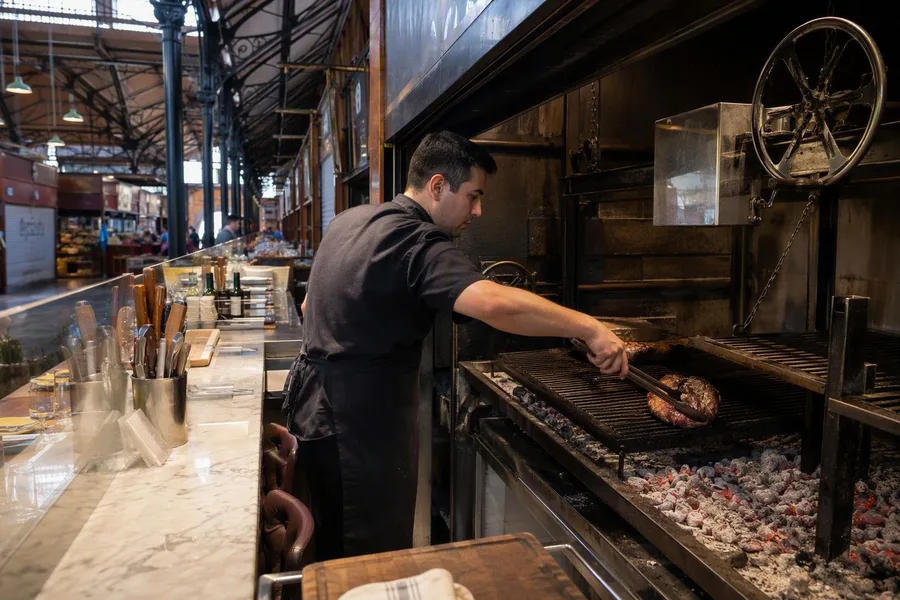 At Hierro Parrilla, a cook returns a cooled portion to the charcoal grill.
The parrilla at eye level
Hierro Parrilla puts the basic labour of lunch in view. The kitchen prepares food in front of the counter, and diners can watch the parrilla while they sit. Heat, smoke and the hiss of the grill give the meal its tempo.
That visibility matters because it keeps the fire tied to the rest of the market. A butcher works at a metal counter. A bakery sells bread near the entrance. The grill cook stays beside the wood-fired parrilla as plates leave for the bar. Each task has a different pace, but all of them take place under the same iron-and-glass roof.
The market has changed since 1897. Its central passages now contain more places to eat, while the original fresh-food stalls continue to trade. That change can be seen without turning the building into a symbol of either loss or revival. The older stalls and the newer counters simply share the floor, the light and the passing trade.
At the parrilla, lunch stays close to the work that produces it. A cook tends the heat. Food crosses the counter. People take seats at the bar or at shared tables. Nothing needs to be staged beyond the open fire and the work it makes visible.
Practical details
Mercado de San Telmo opens daily from 9am to 8pm. There is no listed admission charge or market reservation requirement. Hierro Parrilla is at stall 123; it opens Monday to Wednesday from noon to 5pm, Thursday and Friday from noon to 8pm, and Saturday and Sunday from 11am to 8pm. It does not take reservations and accepts major credit cards and digital payments.
Back to the grill
A portion that cools can go back over the parrilla. The cook returns it to the fire, and the grill answers with a hiss.
Keep exploring