Newlyn, from the Old Quay to the Street Above
Before sunrise, engines turn over beneath Newlyn’s granite walls. From the Old Quay, a short walk past warm pasties and up into the cottages shows the harbour changing level by level as the water returns.
The first light reaches Newlyn before the sun does. A pale glow settles on the Old Harbour, where small boats lie at the Old Quay and larger working vessels sit in the wider basin beyond. Engines sound below the gulls. The ice machine adds a hard mechanical chatter, and fish crates scrape across the quay.
Salt hangs in the air with the direct smell of fish. The ground does not offer a smooth promenade. Elvan stone, cobbles and flat granite blocks meet later patches of asphalt and tar, each surface catching the damp in a different shade.
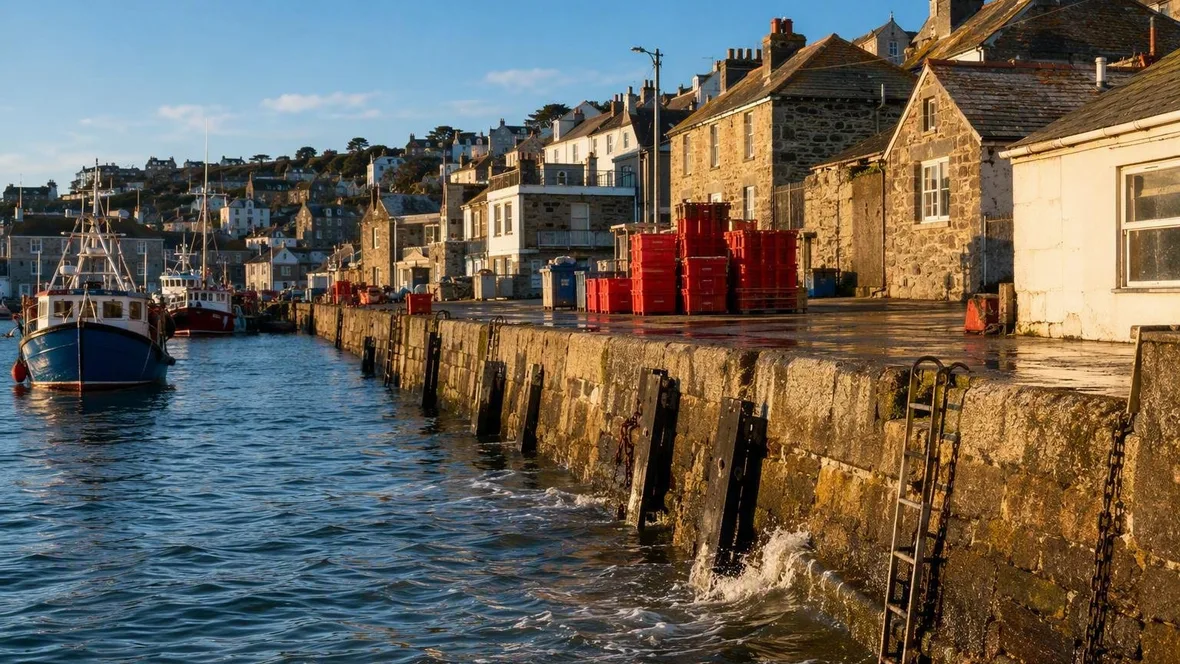
The old pier curves low beside the water. Dry-laid granite forms its body; a heavier retaining wall carries the street and houses above it, while a sloping parapet sheds rain from its top. Ten granite bollards mark the quay. Wrought-iron mooring eyes sit in the stone edge, and ropes hang down the old wall.
At first, the water sits low enough to show what lies beneath the quay. The central slipway runs down over granite and elvan cobbles. Higher up, compacted earth and small stones break the line; farther west, dressed granite blocks make a more regular path between stone edges. The boats lie below street level, separated from the quay by exposed stone and the long slope of the slips.
Barnabas and Silver Stream moor among the smaller historic vessels at the Old Quay. Their lines do not make a pretty arrangement. Some ropes lie loose against granite. Others pull straight from boat to iron eye, their twisted fibres tightened by the weight and motion of a hull. The working harbour has little use for decoration before breakfast.
Around the fish market, the morning takes shape in plain actions. Sorters separate landed fish by species and size. Buyers gather beside rows of red crates for the auction. Crates travel over the quay, and a crane lifts goods between boat and land. Nets and winches remain part of the fleet’s working equipment.
Near the harbour, shops stock oilskins, boots, paint, rope and lifejackets, and maintain the lifejackets too. Dark waterproof clothing stands out against wet granite and the pale harbour light. The red crates do the rest.
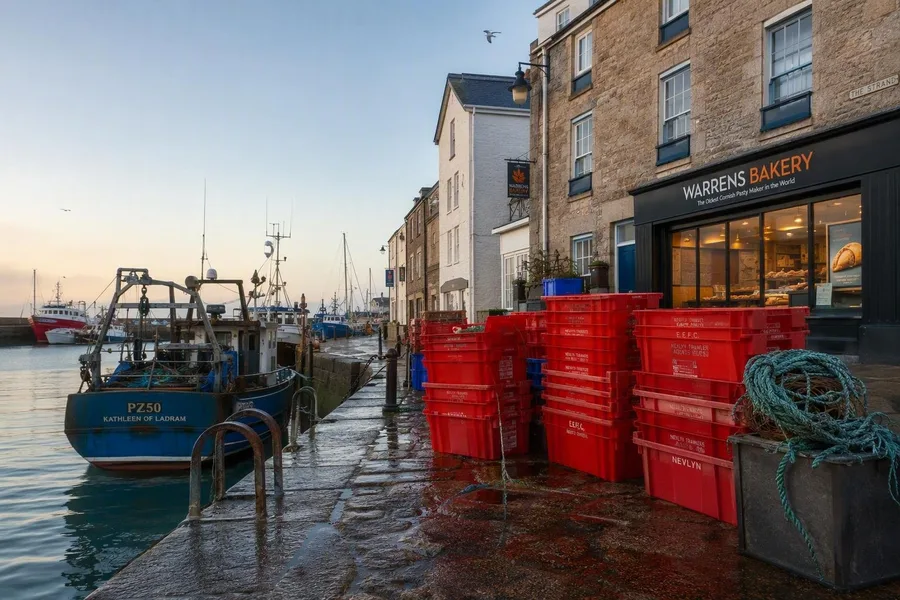 A view of Newlyn, from the Old Quay to the Street Above.
The tide changes without ceremony. Water covers the lowest stones, then narrows the strip at the foot of the slipway. Hulls rise. The granite wall that seemed to tower over the boats loses a little of its height as the waterline comes up.
From the Old Quay, The Strand leads towards Warrens Bakery at number 11. The shop sells Cornish pasties, sandwiches and sweet pastries. Warm pasties have sent their smell out into the street. That warmth sits briefly against the salt air and fish smell from the harbour, only a short walk behind.
The bakery marks a small change of trade, not a change of place. The red crates remain close by. So do the gulls and engine noise. Pastry, flour and warm filling replace the sharp harbour scents at the door, while the water continues to rise against the granite beyond.
Behind The Strand, the streets close in. The Fradgan, Gwavas Quay, Fradgan Place and Orchard Place stand on the ground behind the former inlet. Eighteenth- and nineteenth-century cottages sit beside former fish cellars and warehouses. Granite steps and surviving cobbled sections leave the street surface uneven underfoot.
Gwavas Quay slopes down towards The Strand along what was once a slipway. Fradgan Place narrows into a paved dead end lined with early eighteenth-century cottages. Orchard Place branches into short alleys and patches of cobbles. These are residential streets, but the harbour’s materials have followed the climb: granite under shoes, stone walls at shoulder height, and water still visible below where the streets open.
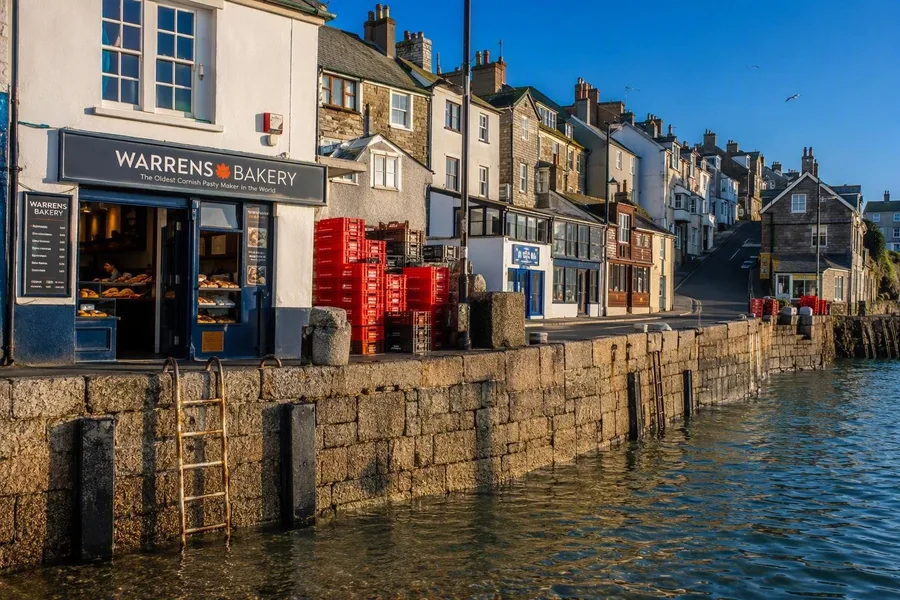 A view of Newlyn, from the Old Quay to the Street Above.
Rain makes the slope unmistakable. At the Old Quay access, asphalt and concrete once lay in a patchwork over worn stone. A deep central groove carried rain downhill from Fore Street; a drainage channel now takes the runoff towards the harbour. Wet asphalt darkens. Water runs along granite edges and down the incline, passing the low, tar-protected parts of cottage fronts before it reaches the quay.
Fore Street runs above the old harbour. The southern quay wall supports the houses at numbers 35 to 39, a fact written plainly into the masonry beneath them. A slope of granite setts and a flight of steps descend from the street to the western slipway. The passage gives the harbour a sudden vertical scale: houses above, street underfoot, wall below, then the water.
By this point, the tide has changed the view from the higher ground. The exposed slipways have shortened. The cobbles at their feet have disappeared. Boats now lie closer to the quay edge and the landing ladders, beside wooden fenders that keep hulls from rubbing directly against them.
Trewarveneth Street climbs from the former Newlyn Town slipway with a paved central gutter running through it. Farther uphill, the street looks towards Fore Street and the harbour. Rue des Beaux Arts, narrow as its name suggests, joins it to Boase Street, which rises steeply between cottages; the harbour remains visible in the other direction.
The quay has become a harder border now. Water reaches the granite beside the ladders. Below the houses, each small swell hits the stone wall, folds back, and knocks against the wet wooden fenders.
Keep exploring