
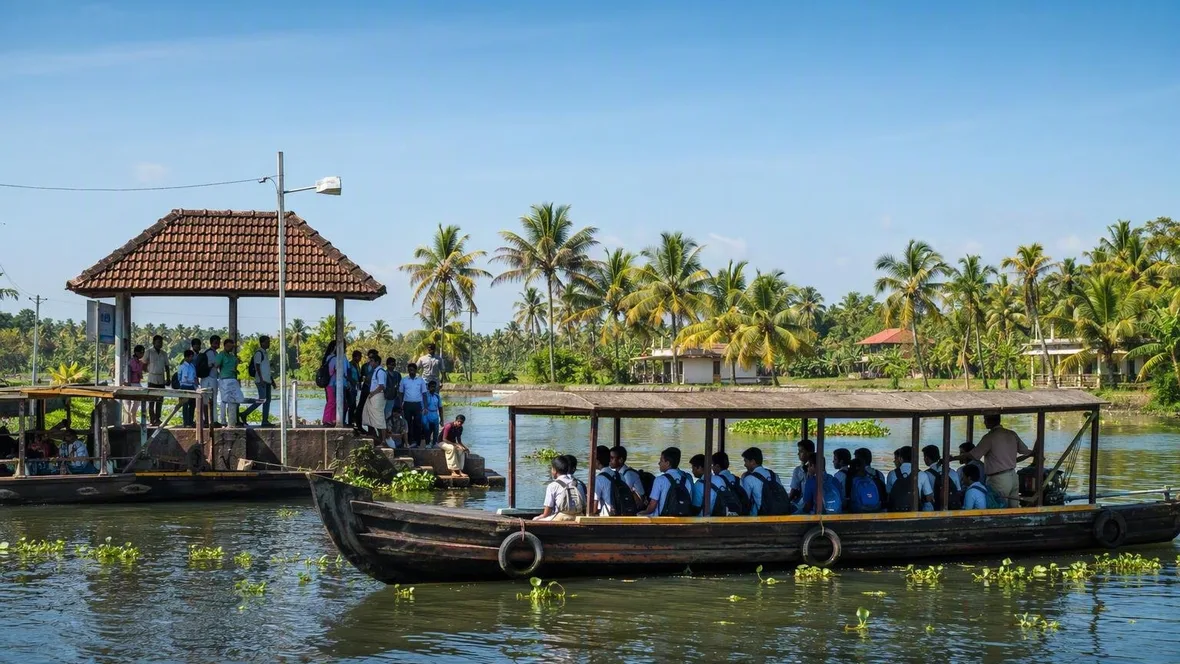
Morning Crossings in Kuttanad
Before school bells and market errands, the canals around Alappuzha carry the first small traffic of the day: tea glasses, cooking smoke, narrow boats, and children crossing the water between rice fields and home.
At first light, the canals of Kuttanad hold the pale sky between their banks. Water runs beside low rice plots, and coconut palms mark the field edges. Houses stand a little way back from the water, beyond narrow paths and strips of damp ground.
Some mornings bring a soft veil of mist. During the monsoon, moisture darkens the green of growing rice and rain can tap roof tiles, leaves and the canal surface; at other points in the farming year, one plot may lie brown after harvest while another turns gold before it.
The first movements barely disturb the water. A hand-rowed canoe cuts across a bright patch of canal. Near a house, a motor catches and a small school boat draws away from the bank. Kuttanad uses both kinds of craft: boats with engines and boats moved by oars.
Tea at the water’s edge
Small chayakkada, or tea shops, open before sunrise. Milk boils. A shopkeeper pours strong, sweet tea from height into a glass, and the falling stream gives a brief hiss. Puttu and chickpea curry sit ready for an early meal.
People on their way to school, work or the next landing stop here. Along Kuttanad’s raised paths, small shops sell drinks, food and household basics; larger markets lie farther away, across the water or on the mainland.
At a public landing in Alappuzha, the morning follows a plain, efficient order. Passengers wait under shelter. A boat noses in, people step off, and those bound for villages, markets or the city move down to the jetty and board. The crew casts off and heads on.
The public ferry is made for use, not display. Wooden floors meet narrow benches, with coconut-fibre cushions along the seating. Passengers shift their feet as the hull settles and lifts. Through the open sides, water and cultivated land sit close together, divided by thin embankments and canal banks.
School begins on the bank
Farther into Kuttanad, some children start the school day at the water beside their homes. They climb into small canoes, motorboats or public passenger boats and travel over the canal to class. Regular boat passengers include children younger than ten.
The sounds vary from one crossing to the next. An engine holds a steady note. An oar enters the water, pulls, and rises dripping. This is not the thunder of Punnamada’s snake-boat races, with their drums and hundreds of racing oars. On an ordinary school morning, the water carries smaller working boats.
Children share these routes with adults heading to work, shops and markets. Larger ferries stop at public jetties as buses stop along a road. Canoes and small passenger craft cover the shorter gaps between homes and nearby banks.
The crossing itself may be easy; reaching the boat is not always so. At Kapulapalli in Veliyanad, the old access steps sank into the river. Parents made a narrow temporary crossing from areca-palm trunks, and schoolchildren used it alongside commuters and hospital visitors.
Here, each passenger must judge the shifting distance between shore and hull. A foot finds the palm trunk, then the edge of the boat. There is no handrail.
Fields close to the channel
Beyond the landing, the banks tighten again. Coconut palms stand along the canals, while low dykes hold the shape of the fields. White egrets sometimes work the wet margins. Ducks float in quieter patches of water.
Light touches more than the rice. It lies on the channel between plots, on the slick edge of a bank, and on the palm leaves above. On wet mornings, the air carries the smell of soaked earth and dripping vegetation. That smell belongs to rain and the monsoon, not to every day of the year.
Daily work reaches the same waterline. Residents wash clothes and clean dishes at the bank, close to the channels used by school boats and ferries. A canoe may pass those tasks first. A larger passenger boat follows later, carrying shoppers towards Alappuzha.
No performance is needed. A schoolbag rests against a bench. An oar sheds a line of water. A passenger waits while a hull bumps once, then settles against the landing.
Coconut oil, pepper and a clay stove
Near Nedumudy, a low kitchen on wooden posts adds sharper notes to the morning. Shallots crackle in coconut oil. Someone pounds pepper on stone. Dried chillies hiss in hot oil on a clay stove.
A cook stirs duck stew in long, unhurried strokes while boatmen finish their early work and gather near the shop with other customers. Fermented palm toddy can add a mildly sweet, slightly sour scent here, at this kind of waterside establishment. It is not the smell of every Kuttanad kitchen.
Elsewhere, breakfast and morning cooking draw on rice, fish curry and vegetables prepared with coconut, chilli and cumin. Ladles strike pots. Hot oil spits. Beyond the kitchen walls, an engine passes, then the quieter pull of an oar.
Tea changes hands. Food stays warm. Boatmen end one stretch of work as children and commuters begin another. The shop’s customers arrive from the fields, banks and settlements linked by the canal.
The landing fills
By school time, the pauses between boats grow shorter. Ferries draw in to the jetties. Passengers wait for the last people to disembark. Small boats bring children from homes scattered among canals and rice plots.
One boat touches the landing. The hull still shifts under the final push of water. A child rises from the narrow bench, puts one foot on the edge, then steps onto the bank as morning light stretches across the flooded margins of the fields.
Keep exploring