From Wet Maize to the Comal in Oaxaca
Before sunrise in San Antonio de la Cal, near Oaxaca city, mill motors start and wheelbarrows carry wet nixtamal along the street. By afternoon, that maize has passed through palms, presses and comales, then into the stacks sold at city markets.
Before the mill opens its mouth
The morning’s maize does not arrive at the mill as a dry grain. Someone has already cooked it in water with food-grade lime, left it to rest, drained it and washed it. The kernels are now nixtamal: moist, treated maize with skins that loosen in the process.
That earlier work matters because it changes what the mill receives. A wheelbarrow holds prepared kernels, not a sack of raw corn. At the mill, the grain goes in recognisable as grain and comes out as masa, a damp, cohesive dough that can be divided, rolled and flattened.
In San Antonio de la Cal, mill motors run before daylight and wheelbarrows carry nixtamal through the streets. The sound belongs to a workday rather than a performance: maize must become masa before hands can shape tortillas and sellers can take stacks to market.
Molino Santa Lucía, a family business in Oaxaca city, uses a stone system to grind nixtamal for tortilla makers. Stone grinding remains part of the city’s everyday food economy, but it does not replace the work around it. People bring cooked maize, wait for the grind, then take masa back to kitchens, tortillerías and stalls. The mill serves as a shared hinge between home cooking and the businesses that sell tortillas through the day.
That is the first useful correction to the postcard version of Oaxaca. Maize does not become a tortilla by force of heritage. It takes water, lime, heat, rest, a mill and a person who knows what the resulting masa should do in the hand.
The dough has its own demands
At Tortillería Moneda in Barrio de la Noria, the sequence can take place under one roof. Workers inspect and wash maize, cook it with lime, grind it, and turn the resulting masa into tortillas and other forms. A metate works alongside more modern milling methods.
The work does not follow one rigid recipe. Different maize varieties absorb water differently and need different resting times or textures, so workers adjust the masa before they shape it. Blue and yellow bolita maize, and white and red olotillo, can appear side by side. Their colours carry through into the masa and the finished tortilla.
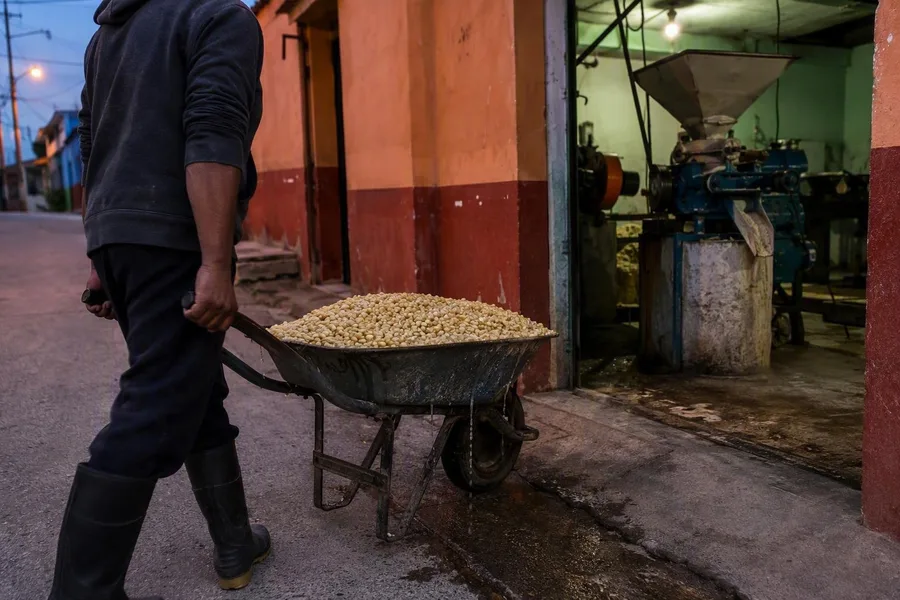 A wheelbarrow carries moist nixtamal to a mill in San Antonio de la Cal before sunrise.
The distinction is visible even without a lesson. Nixtamal still looks like maize. Masa holds together as one soft mass. A tortilla begins as a portion of masa made flat.
Makers cut the dough into pieces and roll each piece into a ball. Palms start the work. A press or further handwork spreads the ball into a round, a process known in Oaxaca as torteado. The gestures repeat quickly: portion, roll, flatten, lift. Nearby, the mill may still be turning; the dough taps against hands as the next round takes shape.
Much of the knowledge sits in these small decisions. A maker judges whether the masa needs more water, whether it should rest, and whether a thin round will survive the lift to the comal. Women have often passed this knowledge between generations, together with the ability to select and handle different kinds of maize.
The result is not a single standard Oaxacan tortilla. The same masa can become a smaller, soft blanda, or a broader tortilla left longer over heat for a firmer tlayuda. At Moneda, makers also fold masa into triangular tetelas and form thicker tlacoyos.
The comal decides the finish
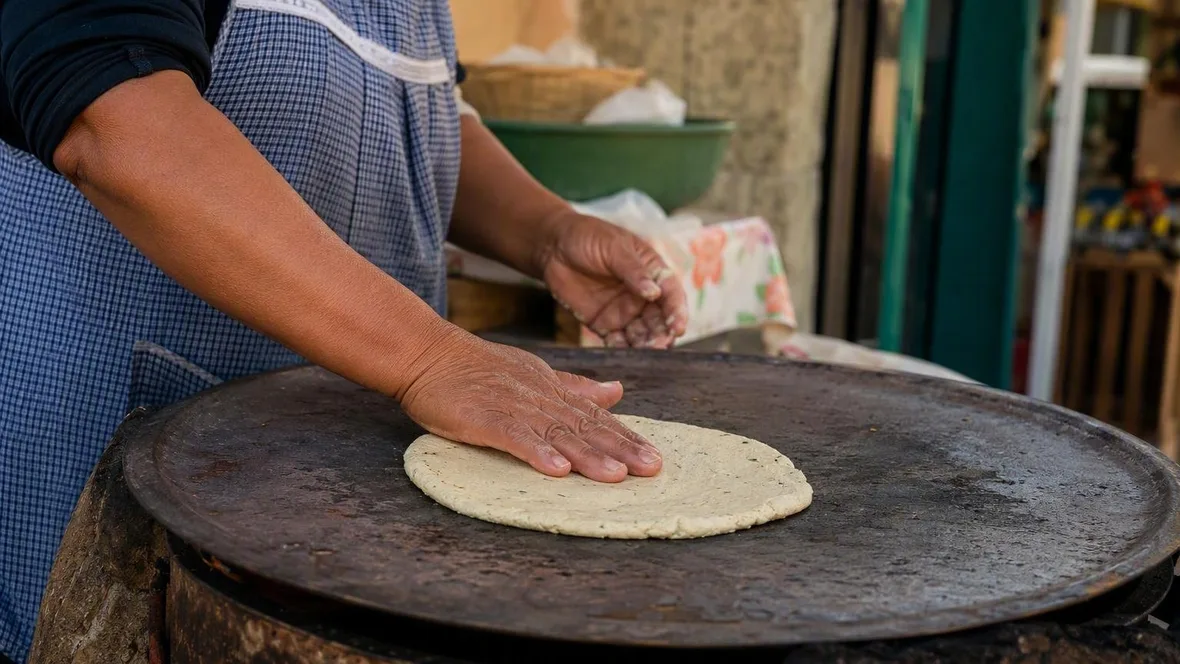
A raw disc of masa reaches the comal as a pale, pliable round. Dry heat sets its surface. The maker lifts it, turns it carefully, and returns it to the metal so the tortilla cooks without tearing.
Nothing pauses at the comal. While one tortilla cooks, hands reach for the next portion of masa. A warm stack rises beside the heat. The work moves between the table and the comal in short, practised loops: flatten, lay down, turn, stack.
Tlayudas make that work easier to see. These broad tortillas can reach 50 centimetres across, and makers bake them on comales heated with firewood. Their size changes the gesture. A hand must lift and turn a wide, thin round without breaking it; the tortilla stays over the heat until it takes on the drier, crisper character expected of a tlayuda.
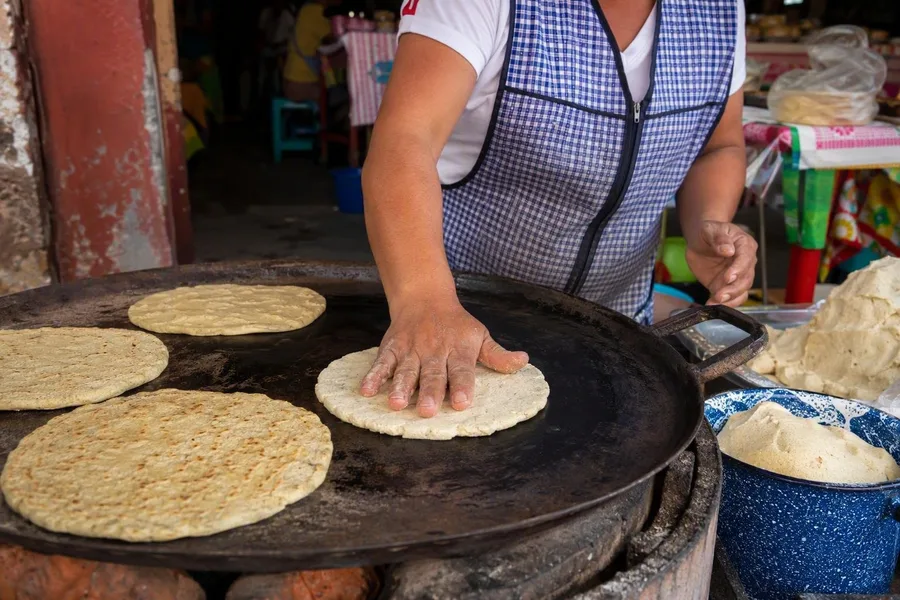 A vendor presses a thick memela from masa onto a hot comal at Mercado de la Merced.
Finished tlayudas go into stacks and then into palm baskets known as tenates. Sellers carry the baskets towards Oaxaca city on their backs or heads, steadying the load with a rebozo. The route from comal to market is physical work, measured in weight, balance and the need to keep selling.
Orders set the tempo as firmly as the fire. Cenadurías and tlayuderías buy tortillas by the dozen as well as one at a time. A maker can keep pressing and turning while finished rounds wait across the table for the next collection or sale. This is paid, repeated labour that supports households. Calling it a quaint survival of tradition obscures the pace and skill in plain view.
The stack becomes an order
Sellers from San Antonio de la Cal bake early, then bring blandas and tlayudas into Oaxaca city. Mercado Benito Juárez is among the places where those stacks are sold into the afternoon.
At a stall, the tortilla changes hands again. A customer may choose a single tlayuda or a dozen tortillas. Another tortilla may return to a comal around a filling, folded or rolled before its edge takes a light char. The stallholder counts, stacks and passes the order across the counter; the next customer steps forward.
Mercado de la Merced, east of the historic centre, puts the comal close to the entrance. Vendors form thick memelas by hand, cook them on the hot surface and add toppings among the market’s fondas and food stalls. Elsewhere in Oaxaca, some small taco stands use earthenware comales over smouldering oak charcoal. Roasting nixtamal gives off its distinctive aroma while smoke rises from the fuel.
Practical note. Go to Mercado de la Merced in the morning for the busiest comal work. Tortillería Moneda runs nixtamal and tortilla workshops by advance booking. Visits to producers in San Antonio de la Cal should also be arranged ahead of time; it is a working community, not an open-air display.
At La Merced, a vendor presses a piece of masa flat and lays it on the comal. Heat catches the underside. Two fingers pinch up the edge of the memela, then set it back on the hot surface.
Keep exploring