From Luang Prabang’s Morning Market to the Mekong
Before the souvenir market takes over the main street, Talad Sao handles the more ordinary business of food. In a narrow lane on the Mekong side of Luang Prabang’s historic centre, vendors sell vegetables, meat, rice, snacks and fresh fish to people shopping for the day.
Food on the ground at Talad Sao
Talad Sao, Luang Prabang’s Morning Market, sits in a slender side lane behind the tourist office. The lane runs parallel to Sisavangvong Road, close to the former Royal Palace and on the Mekong side of the old centre.
That position distinguishes it from two other well-known markets. Pho Si is the city’s larger market, on the road towards Kuang Si and outside walking distance of the main street. The evening market largely sells to visitors. Talad Sao serves a more basic daily purpose: residents come for household food and ready-made breakfast.
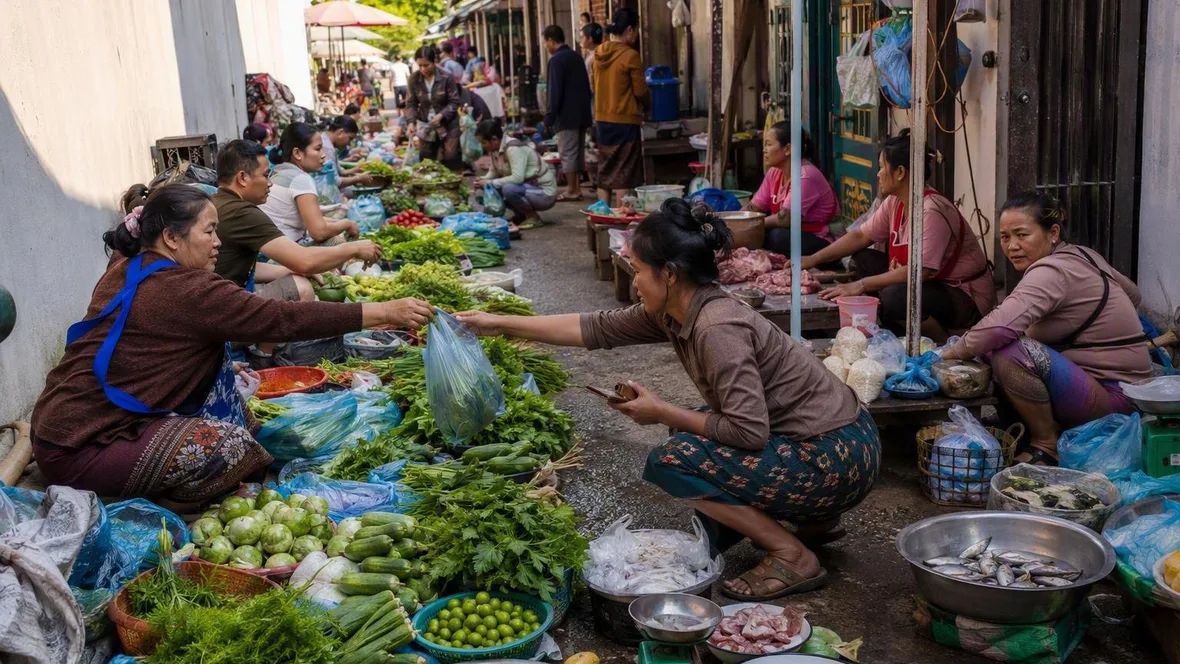
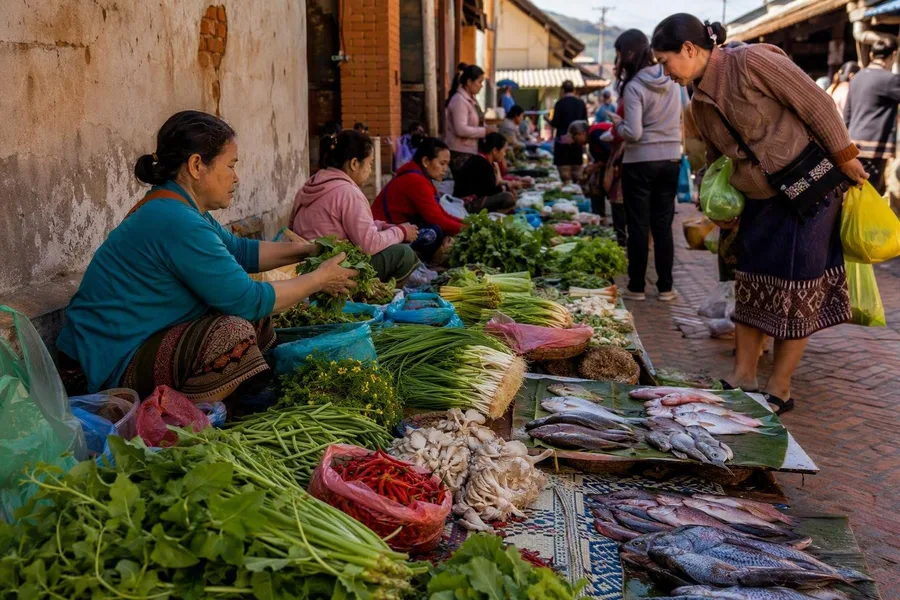 Vendors arrange vegetables and fresh Mekong fish as customers shop at Talad Sao.
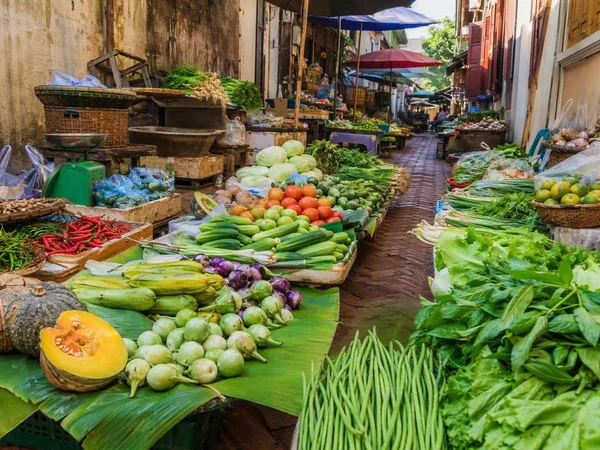
Vendors lay leafy vegetables, chillies, mushrooms and tropical fruit on mats or directly on the paving, often under umbrellas. Pork and chicken sit alongside rice, while vendors sell Mekong fish fresh or grilled. Sellers weigh produce and arrange fresh ingredients. Customers buy food for cooking later that day.
Several stalls cook as well as sell. Noodle soup, sticky rice, Lao sausage, and fried or grilled snacks turn the lane into a place for breakfast as well as provisions. The prepared food belongs to the same tight stretch of street as the raw ingredients.
The market brings products from beyond the town into the historic core. Small farms and surrounding villages supply vegetables, fruit, herbs and mushrooms; rice, meat and fish join them in the lane. The sources do not establish a fixed boat route from a particular Mekong landing to Talad Sao. They do show a more direct connection: fish from the river reaches the market as fresh and grilled food.
Practical: Talad Sao operates daily from about 06:00 to 10:30. Trading is busiest in the early morning and generally fades by late morning.
A lane behind the main street
Sisavangvong Road runs along the length of Luang Prabang’s historic peninsula. Side streets and lanes lead off it towards the Mekong on one side and the Nam Khan on the other. Talad Sao lies just behind this main axis, on the Mekong side. The route from market lane to riverbank therefore crosses a short section of the old city rather than linking a distant market to the waterfront.
Luang Prabang takes its shape from the land between those two rivers. Its historic core stands on the peninsula formed by the Mekong and the Nam Khan. Older village layouts, each traditionally organised around a temple, remained visible after colonial streets were laid across them. The result is a compact town of longer roads, narrow lanes and compounds held between riverbanks.
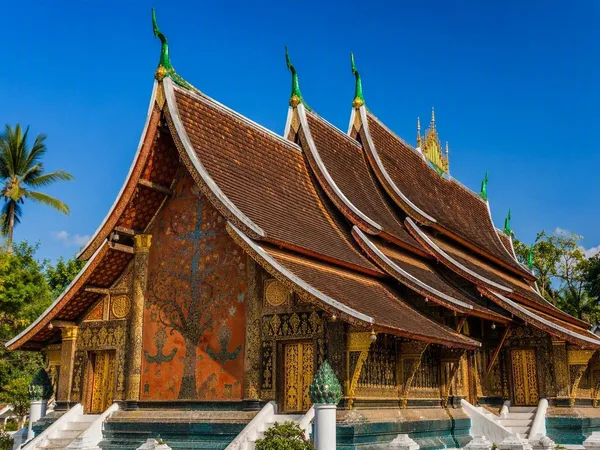
Its buildings show the same layering. Traditional wooden houses stand beside one- and two-storey colonial brick buildings. Some older houses use woven bamboo panels finished with clay. Brick buildings along the main street and the Mekong often have balconies and wooden details.
Talad Sao uses this inherited fabric without much ceremony. The market has no grand hall. Perishable food occupies an ordinary lane behind the former palace area, where sellers work close to the ground and customers pass through for breakfast or ingredients.
Trade in a royal town
Luang Prabang’s role as a trading town reaches back well beyond the market. The city, earlier known as Muang Sua and Xieng Thong, served as the capital of Lan Xang from the 14th to the 16th century. Its position on a major trade corridor contributed to its wealth and influence. Under the French protectorate, it remained a royal and religious centre; Vientiane became the administrative capital in 1946.
That history helps explain why trade still sits so visibly inside the old town. People buy vegetables and breakfast in a lane behind the former palace. Traders sell fresh food among wooden houses and colonial brickwork.
UNESCO added Luang Prabang to the World Heritage List in 1995 for its well-preserved combination of Lao urban traditions and European colonial architecture. The designation covers a living town rather than a sealed historic quarter. Food shopping continues in its lanes, and the Mekong remains part of local transport and work.
At the Mekong bank
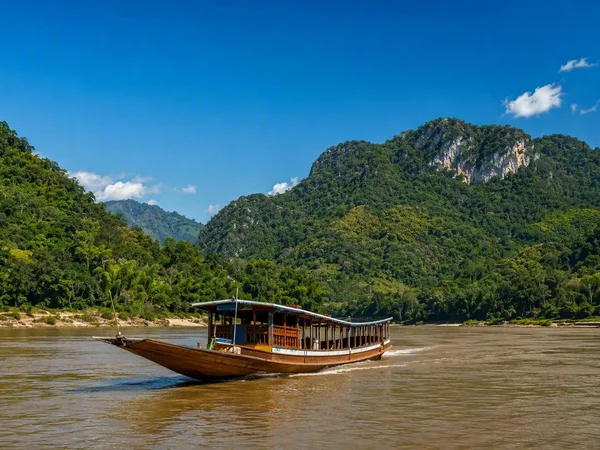
The market lane sits on the same side of the peninsula as the Mekong. Between Talad Sao and the bank, commercial buildings and homes have long stood alongside each other in the historic town. The river formed a transport and trading artery in Luang Prabang’s development, and boats still carry people, goods and visitors on its water.
Slow passenger boats provide one visible contemporary use of that river route. Services between Huay Xai and Luang Prabang travel over two days and stop at Pakbeng. That long-distance service does not prove a supply route to Talad Sao, but it confirms that the Mekong remains a working route beside the historic centre.
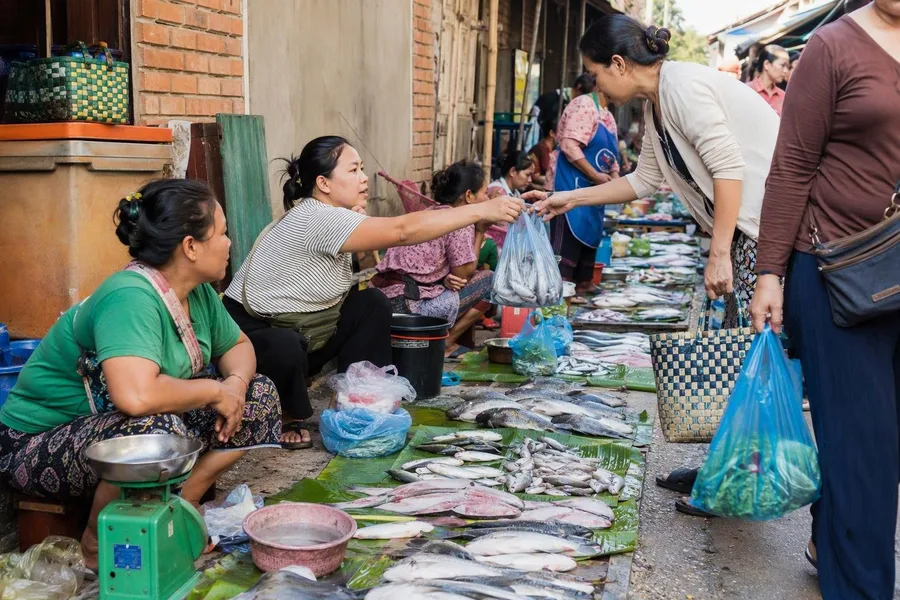 Vendors sell fresh Mekong fish on mats at Talad Sao in Luang Prabang.
The more immediate market link lies in what people buy and cook. Fresh Mekong fish appears beside regional vegetables, fruit, rice and meat. Vendors grill fish and prepare soup, sausage and snacks in the same market lane.
The riverbank forms part of Luang Prabang’s protected physical setting, along with natural spaces and urban ponds used for fish and vegetable cultivation. Brick colonial buildings, often with balconies and wooden ornament, line parts of the Mekong edge.
At the bank, the built edge of the peninsula meets the broad Mekong. Boats move along the river below the riverside buildings, while fresh Mekong fish remains for sale a few streets behind at Talad Sao.
Keep exploring