From Kond to Republic Square, as the Pink Stone Turns Gold
Late-afternoon light reaches Kond in fragments: a stair edge, a red wall, the rim of a courtyard. The walk from Surp Hovhannes down to Republic Square follows that broken light out of the hill’s narrow lanes and into Yerevan’s broad, rose-coloured centre.
Above Paronyan Street
Surp Hovhannes stands on Kond’s high edge, its red tuff façade and bell tower rising above the low houses around Paronyan Street. It gives the walk a useful first landmark. Beyond the church, straight lines become scarce.
Kond occupies a hill between Proshyan, Saryan, Paronyan and Leo streets. Its lanes follow the slope instead of the city grid. Kond Street, Simeon Yerevantsi Street and Rustaveli Street provide the main threads, while short side passages fold between them.
The sharp afternoon sun cannot settle evenly in this terrain. It reaches a strip of wall, the lip of a worn tread or the far side of a gateway; the next passage already lies in shadow. Underfoot, old paving gives way to uneven stone, then a run of steps, then patched ground again. The route needs no drama. It needs ordinary attention to where a shoe lands.
The walls refuse the neat pink uniformity of central Yerevan. Low houses and courtyard walls use tuff, but brick, clay, timber, repaired gates and later additions interrupt it from one doorway to the next. Tuff is volcanic ash compressed into stone. Its exposed edges in Kond can look porous, grainy and chipped, especially beside rough repairs and old joints.
Springs, benches, and shade
Simple communal springs stand at corners along Kond, Simeon Yerevantsi and Rustaveli streets. Water makes a clean, narrow sound against the quieter scrape of shoes on paving. Wooden doors, asymmetric brick walls and vine-covered houses close in around the lanes.
Stone seats stand beside houses rather than in tidy municipal rows. Residents use them for cards, backgammon, coffee and conversation; washing takes place at the springs. Children playing football or racing through the passages bring laughter and quick footfalls to the afternoon streets.
A shaded stretch beside a wall or gateway offers a brief break from the exposed slope. The coolness comes from the tight geometry of the place: high walls, narrow openings, and courtyards set behind gates. Those courtyards remain private. From the public lane, an open gate offers a glimpse of a plant pot, a chair or a length of washing; it does not provide a route through.
Near the remains of the Tapabashi mosque, rough brick walls interrupt the close line of homes. Pointed and rounded arches survive among the brickwork, with traces of blue decoration on the old surface. This is no grand clearing in the neighbourhood. The arches sit in the same dense weave of gates, walls and turning passages.
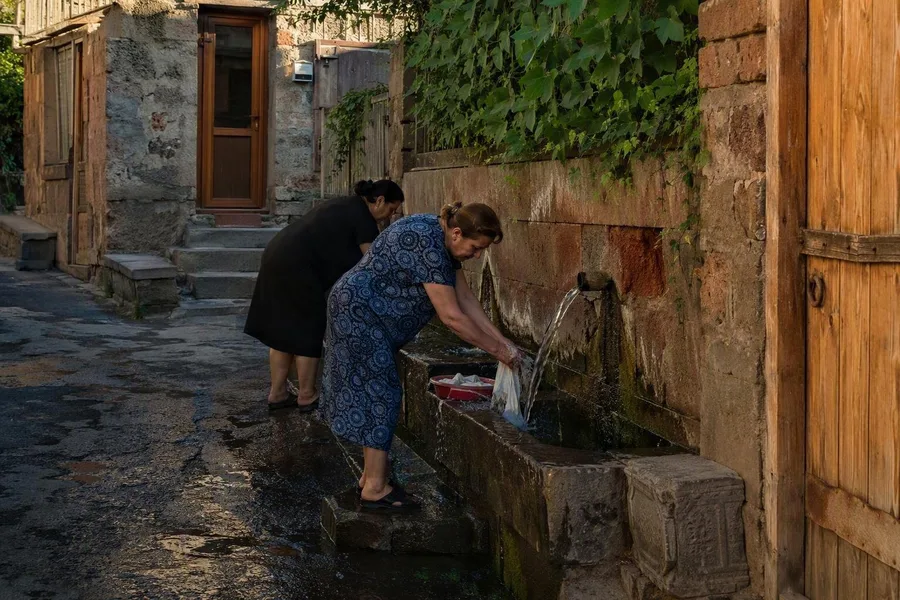 Residents wash at a communal spring beside stone seats in Kond’s narrow lanes.
Practical note: Kond has no single signed walking route. Use Kond, Simeon Yerevantsi and Rustaveli streets as bearings, and take the stairs near Pavstos Buzand Street and Martiros Saryan Street for the most direct descent towards the centre.
Down to Saryan Street
The stairs by Pavstos Buzand and Saryan change the walk quickly. The close walls fall away. Saryan Street opens along a broader pavement, where traffic, terraces and full façades replace gates and courtyard walls.
The ground becomes more regular here. Footsteps lose their small percussion, while tyres and engines take over the background. The late sun now reaches whole building fronts rather than stray fragments of a stair or wall.
Tuff changes with the setting. Builders cut the light, porous stone into straight blocks and carved it into more formal facades. Many central buildings set pink tuff above dark basalt plinths. The darker stone holds the street level in a firm band; above it, the pink blocks catch the sun in wider planes.
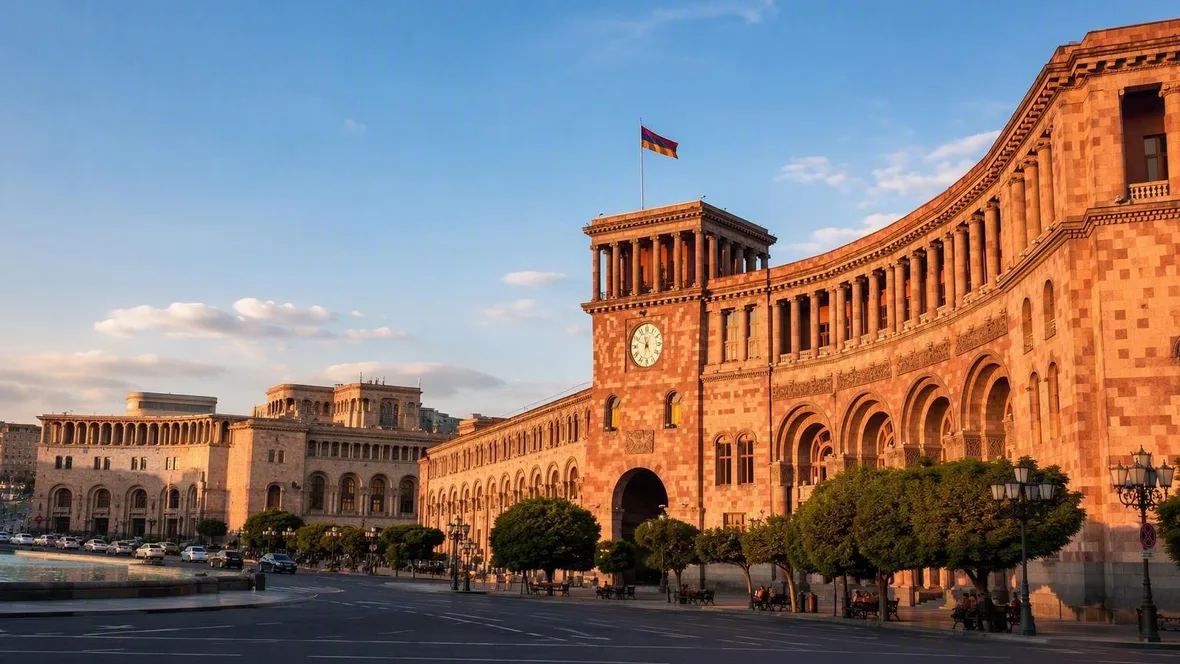
Amiryan Street provides the eastward line into the centre and towards Republic Square. The square appears first as open air after Kond’s compressed lanes. Five large buildings frame its oval ground in pink and yellow-cream tuff, with dark basalt at their bases.
The square can wait for the last light. A turn south makes room for trees and water.
Oaks and water south of the square
English Park, near Italy Street, holds a denser shade beneath tall oaks. A large fountain runs among benches, where people drink coffee, read, walk dogs or sit in hammocks. The water replaces the hard wash of traffic with a steadier sound.
Children’s Park continues with broad paths, mature trees and more benches. Beside it, Vardanyans’ Park lays granite in carpet-like patterns around a pink-quartzite map of Yerevan and its fountains. In summer, families gather around the coloured water jets. Children do not usually cross a fountain plaza in a dignified straight line. The jets make sure of that.
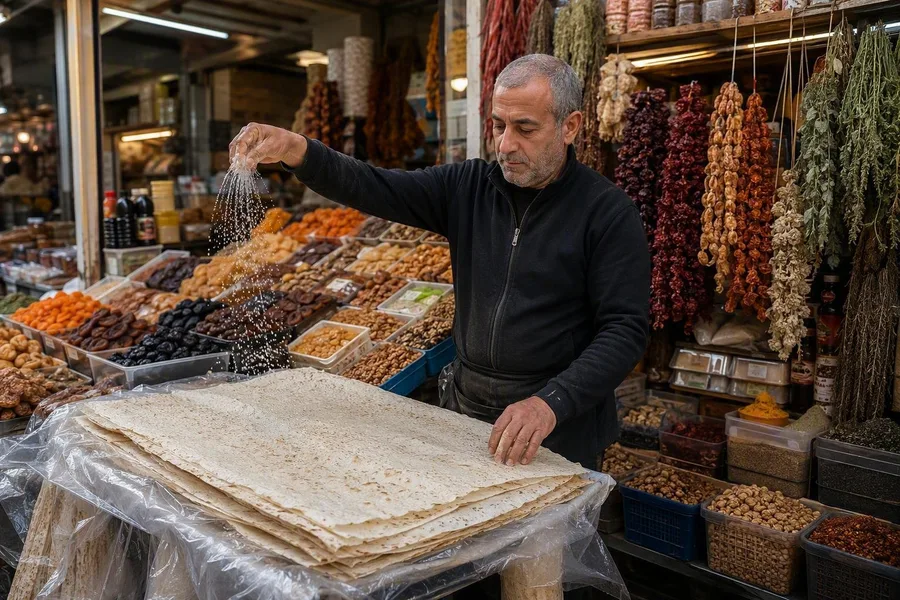 A seller sprinkles water over lavash inside GUM Market on Movses Khorenatsi Street.
Leaves break the remaining sunlight into moving patches across the paths. The shaded benches and wet stone give this part of the centre an everyday scale, even with the broad façades of the square nearby.
A short detour southeast reaches GUM Market on Movses Khorenatsi Street, the reliable stop for food stalls near the centre. Pak Shuka on Mashtots Avenue no longer operates as a produce market; its old market façade now fronts a supermarket.
Inside GUM, front stalls hold dried and candied fruit, nuts, spices and dark strings of walnuts coated in thickened grape or pomegranate juice. Fresh produce, bundled herbs and pickles fill the deeper rows, alongside white piles of sauerkraut. Sellers sprinkle water over thin sheets of lavash to keep the bread pliable. Spices, dried fruit, fresh herbs and damp bread give the hall its distinct smell.
The colours change with the calendar: orange apricots and dark cherries in summer, then peaches, green and purple grapes, and red pomegranates in early autumn. By late afternoon, some traders may already be packing away their goods.
The last colour on Republic Square
Back at Republic Square, the open ground lets the lowering sun run across broad walls. Dark basalt sits beside pink tuff in the patterned paving. Arches, columns and carved friezes repeat the same stone along the surrounding facades.
Pink tuff ranges from pale pastel tones to deeper pink with an orange cast. Low sunlight changes the colour where it strikes. One facade keeps a cool rose shade while another warms. Shadows thicken beneath arches and along the basalt bases.
Then the light drops another notch. The carefully cut blocks turn from pink towards orange, and some surfaces catch an iridescent gleam. Across the square, the last sun rests on the stone in a deep rose-gold band.
Keep exploring