From Hot Griddles to Steel: A Seoul Morning from Gwangjang to Euljiro
At Gwangjang Market, shutters rise at different hours and a bean grinder starts beside a hot pancake pan. South of Cheonggyecheon, Euljiro answers with loaded three-wheelers, forklifted paper and the clipped noise of tools against metal.
Under the market roof
Gwangjang Market does not begin with a single opening bell. Each trader keeps different hours, and metal shutters still break up the covered lanes when the first food stalls start work. The market spreads through packed passages rather than one grand hall. Food counters stand beside clothing stalls and small shops, with silk, hanbok, second-hand clothes and household goods on other rows and upstairs.
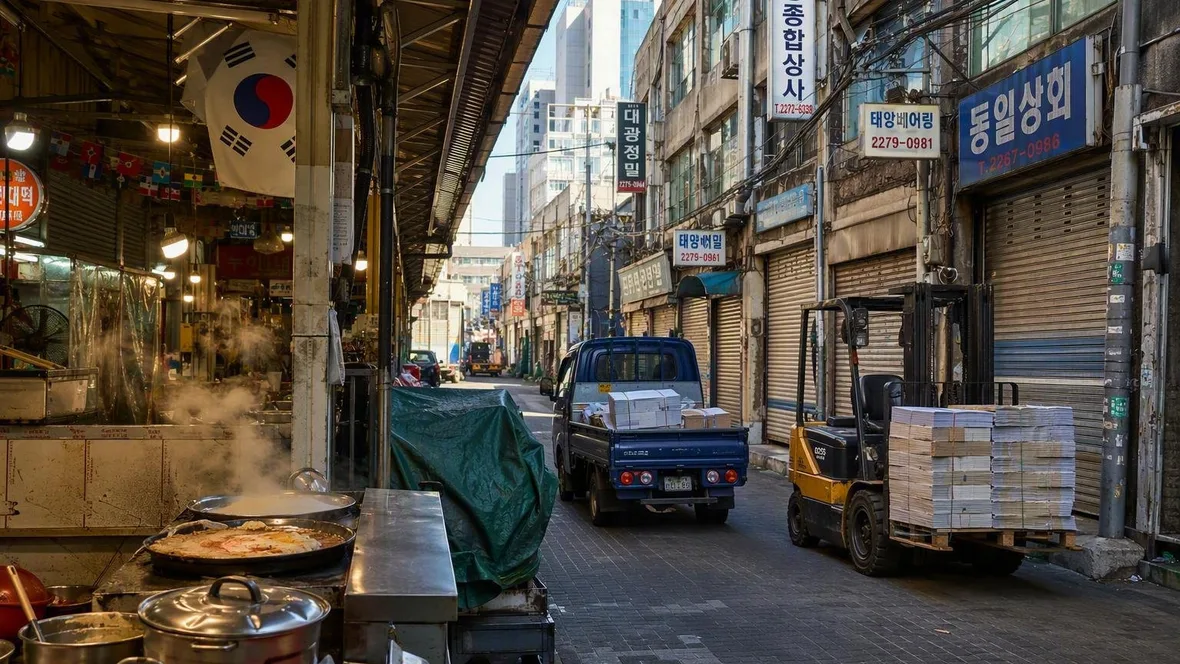
The kitchens provide the first heat. At a mung-bean pancake stall, a grinder turns soaked beans into batter beside a broad pan, where cooks fry pancakes and meat patties in hot oil. The grinder keeps its steady turn. Oil hisses across the plate, and the counter holds the heat of the cooking rather than hiding it behind a kitchen door.
Every task sits close to the next one. A cook works at the pan, a vendor passes food over the counter, and customers eat on plastic stools or at shared tables a few steps away. Steam lifts from hot dishes. Sesame oil hangs in the aisle and brings market workers over from their own early jobs.
Some of the first customers come from the market itself. Others are commuters stopping for small gimbap and hot broth before the rest of the day takes hold. They arrive, take a place at the counter, eat, and move on. Another customer takes the stool.
The food alley fills in patches. One counter already has a warm pan and occupied stools while a neighbouring shutter stays down. The calls of vendors, the crackle of frying batter and the whirr of the mill occupy one stretch of passage; another remains lined with closed shopfronts. This unevenness gives the market its morning shape. It is a place of separate small businesses, each switching on its own part of the day.
Across the stream
Changgyeonggung-ro runs south from the edge of Gwangjang towards Euljiro 4-ga. The route crosses Cheonggyecheon, where the tight market roof gives way briefly to open air, the stream corridor and traffic around the station. Then the streets close in again.
Euljiro first shows a broader commercial road. Its side lanes soon narrow towards Euljiro 3-ga, where lighting suppliers, tile and ceramic dealers, tool shops and printers fill low buildings pressed close together. Scooters and delivery vehicles use the same tight space as pedestrians. Stock sits near doorways, and a loaded vehicle can turn a short stretch of lane into a pause point.
The materials change fast. Gwangjang has batter, steam and cloth. Euljiro has concrete, old metal doors, shelves of fittings and practical goods arranged for work rather than display. Breakfast counters give way to businesses that deal in paper, steel, electrical parts and the small pieces that make a workshop function.
Tools, lamps and metal
Near Euljiro 3-ga, low buildings run together so tightly that their façades and signs can read as a single block. The narrow alleys behind them hold printers, hardware sellers, lighting suppliers and workshops that cut, shape or machine metal.
Hand-painted Korean signs mark some façades. Old metal doors stand under exposed pipes and tangled wiring. Inside, concrete-floored premises hold machines, shelves and stock; outside, boxes and parts may fill a doorway while the next unit remains closed.
The goods explain the district with more force than a signboard can. Screwdrivers, spanners, pliers and hammers hang near drills, grinders and cutting machines. Suppliers keep bearings, chains, belts, motors, bolts and screws in dense ranks. Metal businesses handle sheets of steel, aluminium, stainless steel and copper, along with rods and pipes.
A working tool shop has the blunt order of a useful place. Small hardware fills drawers and trays. Long metal lengths rest along walls. A sheet waits to be cut, welded or machined into a precise component. Descriptions of these lanes include the dry smell of metal dust and tool oil, a hard contrast to the cooking oil back at Gwangjang.
The sound comes in bursts. A grinder or cutting machine throws out a hard mechanical note when work begins; scooters and small delivery vehicles add their engines in the alleys. Silence breaks the pattern. Closed doors and empty rooms sit among active businesses, and redevelopment has already removed part of the former metalworking cluster in Injeong-dong.
No heritage tableau survives here. These businesses take orders, supply parts and shift heavy material through lanes with little spare ground between an open doorway and a passing vehicle. The street remains part of the workshop floor.
Paper on the move
The printing alleys of Inhyeon-dong run between Euljiro 3-ga and Chungmuro. Small print shops produce business cards, posters and banners. Paper moves between them on forklifts, handcarts and converted three-wheeled motorcycles built to carry loads through the bends.
The presses do not create a permanent roar. Recent reporting has found the printing street notably quiet, and the old continuous racket belonged more clearly to busier years. Yet a machine can start behind one open door while a small truck edges down the lane, or a cart rattles over the surface farther along.
Heavy paper stacks rise on forklift forks. Three-wheelers stutter through passages between small businesses, and workers move materials across the threshold as deliveries arrive. The open doors serve machinery, stock and loading. They do not perform for the street.
Lighting shops add another set of materials: glass shades, cable, bulbs, fittings and rows of electrical components. Their displays take on a different role after dark, when neon, cafés and bars appear in parts of Euljiro. In the morning, deliveries and workshop doors hold the attention.
A loaded three-wheeler turns into a printing alley, its engine catching between the low buildings. A forklift lifts a thick stack of paper, carries it across the lane and disappears through an open workshop door.
Keep exploring