From cumin to seawater: walking Marseille to Vallon des Auffes
Start in Noailles, where spices sit in bright heaps and coffee scents drift along La Canebière. The streets widen towards the Vieux-Port, then give way to a sea road, pale rock and a small harbour tucked beneath three stone arches at Vallon des Auffes.
Noailles, close to the ground
The walk starts at Marché des Capucins, where vegetables, fruit, herbs and fish fill the fixed market on rue du Marché des Capucins. The streets run tight around the stalls. Shop awnings, crates and passing bodies narrow the available pavement, while the sound rises with the morning trade.
Rue Longue-des-Capucins keeps that compressed scale. At number 10, Saladin Épices du Monde stacks its wares in coloured heaps and on shelves crowded with jars, sacks, bottles and tins. Cumin and coriander give the air its deep, dry edge. Za’atar, chermoula and Provençal herb blends add their own green and peppery notes; dried fruit softens the smell with sugar, while tea brings a faint floral lift.
The display needs no polishing for effect. A sack has its rough weave, a glass jar catches a sliver of daylight, and a mound of spice holds its colour against the shade of the shop. The market district grows busy quickly, and the narrow street holds voices and footsteps close to the façades.
A short detour through rue Méolan reaches Père Blaize. Its early nineteenth-century wooden frontage can disappear behind the terraces that fill this small street. Inside, dark wooden bins stand beneath handwritten labels. Verbena and lime blossom sit among star anise, fennel, eucalyptus, orange blossom, rosemary, ginger, cinnamon and lavender.
This is a pharmacy-herbalist rather than a place for self-service scoops. Staff draw plants from the wooden bins and make the blends themselves. The room replaces Saladin’s glossy bottles and brilliant powders with dry leaves, paper labels and old timber. Outside again, Noailles still offers only broken pieces of sky between the upper floors. The sea remains out of sight.
Coffee and a longer view
Cours Saint-Louis opens the route. From there, La Canebière runs south to the Vieux-Port, broad enough for trees, cafés, shops and the older buildings that line its length. The street noise changes as well. Market calls thin into the mixed sound of footsteps, tram movement, buses and cars.
At 56 La Canebière, Torréfaction Noailles puts coffee and tea beside chocolate, biscuits, sweets, cups and coffee machines. The window carries a pleasantly unruly abundance: provisions for the table, equipment for the kitchen, and the promise of a dark roast in the middle of the avenue. Coffee can be drunk there or taken away.
La Canebière gives the light more room. The high façades no longer meet overhead in the eye, and the avenue draws a clean line downhill towards the harbour. Near the water, porphyry blocks and paving spread from façade to façade across what was once roadway. Kerbs no longer enforce a hard division between pavement and street. People cross the same level surface in several directions, while the view ahead holds steady.
The route makes a small argument for going slowly, without making a fuss about it. A bus would cover the distance. It would also remove the gradual shift from spice sacks to coffee tins, from close shade to the larger, salt-bright space at the end of the avenue.
The harbour line
At Quai de la Fraternité, the city meets an open basin. Pale granite and older limestone paving run towards the water. Above the quay, the Ombrière hangs as a thin, open-sided roof of polished stainless steel on eight slender columns.
Its underside turns the scene upside down. Hulls, rippled water and people crossing the quay appear in the steel as moving reflections. The roof gives shade, but its open edges leave the harbour fully visible.
In the morning, around ten fish stalls form a short strip of activity beside the canopy. Their displays, the smell of fish and sellers’ voices sharpen the edge of the broad square. Beyond them, moored boats rest in the basin. A small ferry makes repeated crossings between the town hall side and Place aux Huiles.
The Vieux-Port provides the route’s first full view of the Mediterranean. Two forts frame the harbour mouth, and open water begins beyond them. Yet the next stretch does not leave the city with a clean break. The pavement carries the walk onward, past the harbour edge and towards Plage des Catalans, where sand appears between built-up slopes and the water.
Practical note: The walk from the Vieux-Port to Vallon des Auffes is about 3 km, or roughly 36 minutes; bus 83 links the two if the coastal section needs shortening. Check current transport times on the day of travel.
The Corniche takes the high ground
Beyond Catalans, the route reaches Corniche Kennedy. This broad seafront boulevard grew from a narrower coastal path, and its wide pavements now run above the shore. A long stone bench follows the sea-facing side. Rock, road surface and salt-streaked air replace the close grain of the market streets.
The Mediterranean now stays beside the route. Across the roadstead, the Frioul islands and Château d’If sit in the open view. Morning and evening light travel freely over this exposed coast, without Noailles’ walls breaking it into narrow strips. The wind has room here too. It comes across the water and crosses the pavement before meeting the traffic behind it.
The Corniche keeps the walker on higher ground. Below the road, the shore drops through rock and built edges to the water; ahead, the blue field of sea keeps returning between the houses. The sound has changed again. Tram bells and market voices have gone. Tyres pass on the boulevard, while wind and water fill the gaps.
Near Vallon des Auffes, a viaduct appears over a narrow inlet. A pedestrian stair leaves the high road and descends towards the harbour. The difference is immediate: the broad pavement gives way to steps, stone walls and sloping ground. Above, the Corniche stays exposed to sky and traffic. Below, the inlet draws the buildings and boats close together.
Beneath the three arches
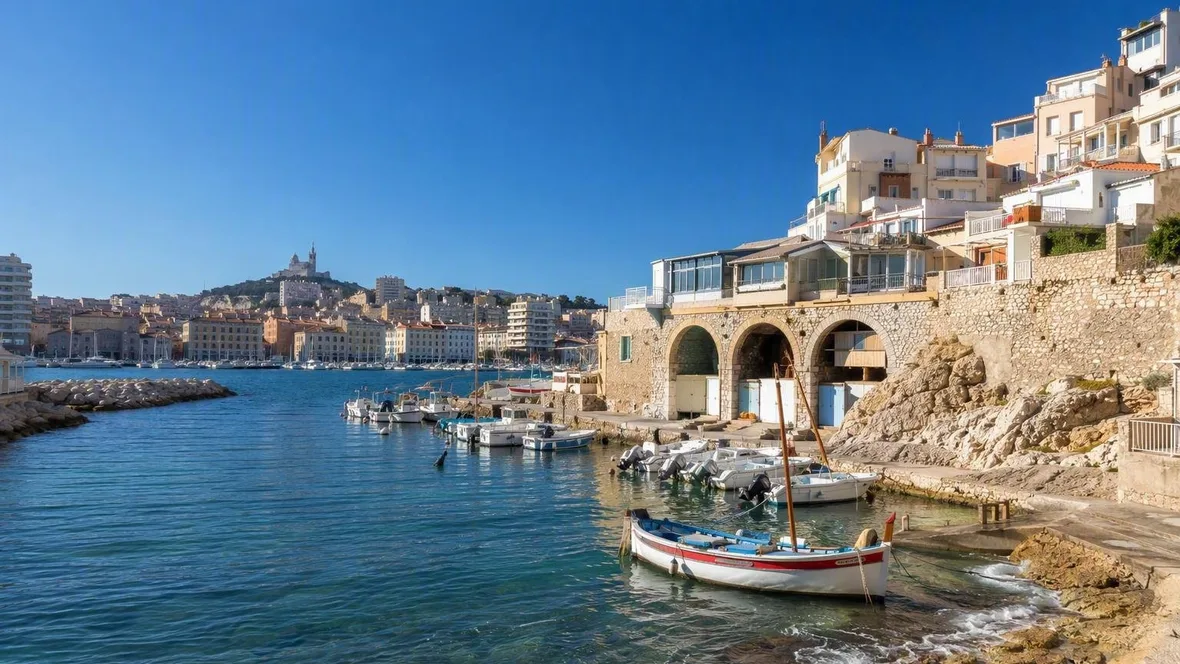
Three round arches of local Cassis stone carry the 60-metre viaduct across Vallon des Auffes. Under them lies a small harbour basin, only 2,000 square metres in area, with a concrete quay on one side and sloping edges leading down towards the water and the low houses.
Coloured façades, cabanons and small fishermen’s houses gather around the inlet. Traditional Provençal pointus lie along the quay in a row, their small hulls matching the basin’s domestic scale. This is no beach resort with a broad sweep of sand. Rocks, ramps, kade walls and a long breakwater define the edge instead.
The breakwater protects the basin from southerly wind and swell. Inside, the boats rise and settle gently against their lines. Beyond its end, the water has a harder, more open movement at the rocky mouth of the inlet.
A rocky seawater spot behind the arches is known locally as the piscine du Vallon. Traffic crosses the viaduct overhead. Below it, a pointu shifts against the concrete quay as a small wave reaches the rocks, flashes in the late light, and folds back into the Mediterranean.
Keep exploring