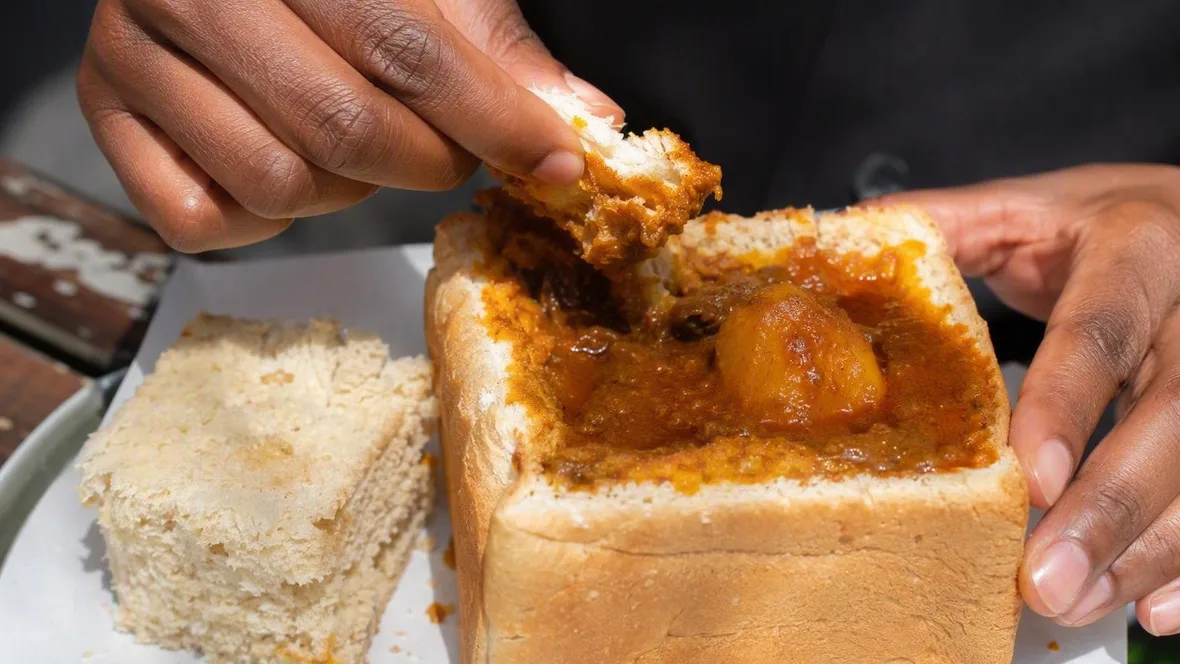
Durban, Served in a Loaf
At Victoria Street Market, turmeric, cumin, coriander, ginger, garlic and chilli sit in sacks, packets and spice blends. Several spice stalls have passed through three or four generations of the same families.
Masala at Victoria Street Market
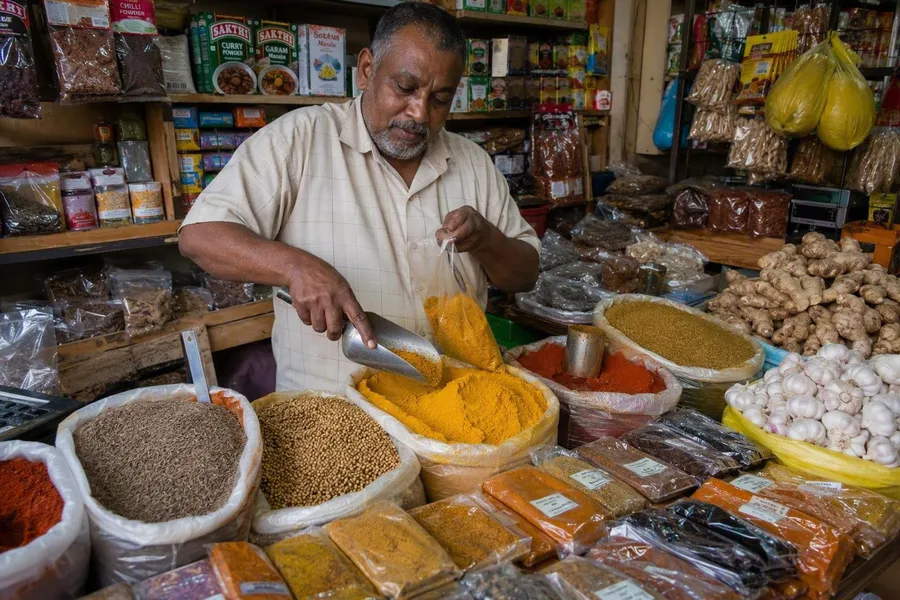 A trader sells spices and masala blends at Durban’s Victoria Street Market.
Durban curry begins in the market as much as in the kitchen. Around Victoria Street Market and Dr Yusuf Dadoo Street, formerly Grey Street, traders sell rice, pulses, fish, meat and masala blends to home cooks and small food businesses. Curry, dhal, roti, samoosas and bunny chow belong to the city’s daily food trade, rather than to a separate ceremonial cuisine.
That trade grew from a difficult history. The Truro arrived in Port Natal from Madras on 16 November 1860 with 342 passengers, and the Belvedere followed from Calcutta ten days later. Between then and 1911, the colonial system brought about 152,184 Indian indentured workers to Natal, chiefly for sugar cultivation, as well as tea and wattle plantations, mines and domestic service.
After their contracts ended, many former workers fished, grew vegetables, or sold fruit and produce in town. Independent migrants, including Gujarati merchants arriving from the mid-1870s, opened shops and built trading networks. Indian market gardeners became prominent food suppliers around Durban, and an indoor market opened on Victoria Street in 1910.
Grey Street became a commercial and community district, with shops, market activity and the Jumuah Musjid, or Grey Street Mosque, founded in 1881 on the corner of Grey and Queen streets. The market and its surrounding streets were never a sealed-off Indian quarter: African meat traders and fruit-and-vegetable sellers also worked nearby, amid sharp disputes over street trading and city regulation.
The food changed with the city. Cooks brought knowledge of spices, seeds and regional Indian techniques, then worked with what Natal supplied and what households could afford. Rice shortages encouraged mealie rice, made from broken maize; amadumbe, green banana, fish and sour milk also entered local cooking, while Gujarati merchants supplied spices and familiar vegetables. Durban curry came from those adaptations, not from one unchanged Indian regional recipe.
A typical curry starts with onion, ginger, garlic and curry leaves in oil. Masala, garam masala and chilli follow, then beans or meat, tomato and potato, cooked down to a thick sauce. The Durban style is generally red, hot and tomato-led, with fresh chilli and curry leaves rather than cream.
A bean bunny on Dr Yusuf Dadoo Street
Patel’s Vegetarian Refreshment Room stands at 202 Dr Yusuf Dadoo Street, in the old Grey Street trading district. The family business traces its history to 1911 and sells vegetarian curries, bhajia, pickles, Indian sweets and bunny chow from a compact city-centre counter.
Its bean bunny puts an older strand of the dish on the table. Early bunnies were often vegetarian, especially bean-filled, while meat versions became common later. A quarter or half unsliced white loaf is hollowed out and packed with curry. The removed piece of bread, called the plug or virgin, rests on top or alongside.
The loaf does three jobs: container, plate and cutlery. The plug takes the first scoop, then strips from the bread wall pull up the gravy. The soft crumb soaks up the sauce while the crust and bottom keep the portion together.
Patel’s preserves a family story that bread replaced bowls when customers took food away and the bowls did not return. It is a useful memory from the district’s food trade, but not proof that the family invented bunny chow.
Who made the first bunny?
No document names an inventor or fixes a birth date for bunny chow. Researchers describe the evidence as sparse and contradictory, and generally place the dish after the Second World War; the much-repeated late-1940s date remains plausible rather than established. The earliest known written mention appeared in a Durban shop window in 1972. That shows the dish and its name were in circulation by then, not where either began.
The most persuasive explanation concerns segregation-era takeaway food. Indian businesses around Grey Street sold curry to Black customers who could not eat inside, and a hollowed loaf gave them a disposable bowl that required no cutlery and did not need to be returned. This explains why the form made sense. It does not identify the first person to cut the bread.
Other stories send the first bunny to sugar-cane workers, golf caddies, Queen’s Tavern, Kapitan’s, or cooks handing leftover curry to hungry people. These are popular local accounts, not claims confirmed by contemporary records.
The name carries its own uncertainty. Bunny almost certainly does not mean rabbit: the Oxford English Dictionary considers an origin in bania, a term associated with Indian traders, plus chow the likeliest explanation. Other folk explanations persist, and the deeper origins of chow itself remain disputed.
Lunch on Umbilo Road
Gounden’s Restaurant & Takeaway sits on Umbilo Road, west of Durban’s freight harbour, among workshops and factories. For roughly four decades, the family restaurant has served mainly workers, alongside some office staff. Its mutton bunny comes in a hollowed quarter or half loaf with potato in the curry and small servings of grated carrot, cucumber and tomato.
The lunchtime queue matters because it keeps the dish in its working-day setting. Gounden’s open kitchen, wipe-clean tables, linoleum floor and handwashing area suit a meal eaten by tearing bread and scooping curry with the hands.
Victory Lounge shows the same food in another part of the city. The business moved from central Durban and operates in Chatsworth and at Park Square in uMhlanga. Before opening, the owner, a descendant of the founders, cuts hundreds of loaves for the day. At the uMhlanga branch, bean bunnies sit beside lentil fritters and burfee, a milk-based Indian sweet.
Fourteen bunnies at Britannia
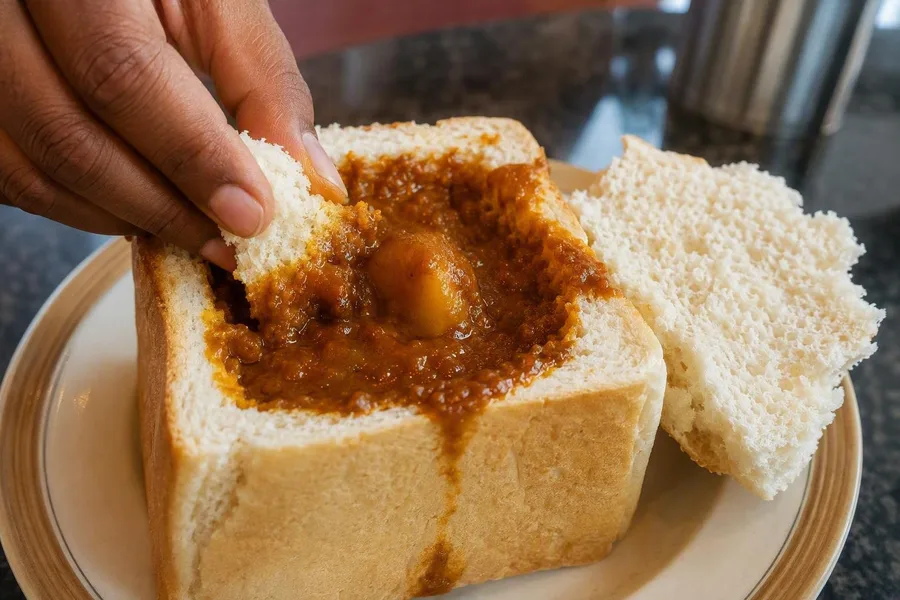 At Britannia Hotel, fingers tear bread into curry-filled bunny chow.
The Moodley family has owned Britannia Hotel, on the south bank of the Umgeni River, since 1983. Its masala blends follow the current owner’s mother’s recipe, and the menu lists fourteen bunny chows. The range includes a chops chutney bunny with bone-in mutton chops, masala, ginger, garlic and extra tomato, as well as a boti bunny that can contain tripe or pig’s trotters with chickpeas and tomato.
This is a fuller, stranger menu than the standard bean or mutton order. Yet each version still depends on the same practical structure: thick curry, a sturdy white loaf and hands rather than a knife and fork.
Practical: Patel’s at 202 Dr Yusuf Dadoo Street opens Monday to Saturday, 06.00–14.00; vegetarian bunnies cost about R30–40, or about R70 for a half loaf. Gounden’s at 520 Umbilo Road, corner of Deodar Avenue, opens Monday to Friday, 09.00–18.00, and Saturday, 09.00–16.30; walk-ins and takeaway orders are standard, with mains around R55. Britannia’s restaurant opens 07.00–20.30 Sunday to Tuesday and until 21.30 Wednesday to Saturday.
At Britannia, the plug lifts away from a square wall of bread. Red-brown curry fills the hollow, oil catches the light on the thick gravy, and potato sits beneath the surface. Fingers tear off the first piece of bread and press it into the sauce.
Keep exploring