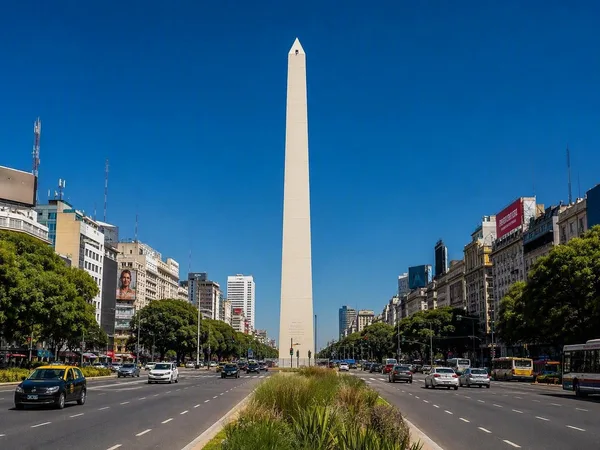
Buenos Aires at the Kiosk Window
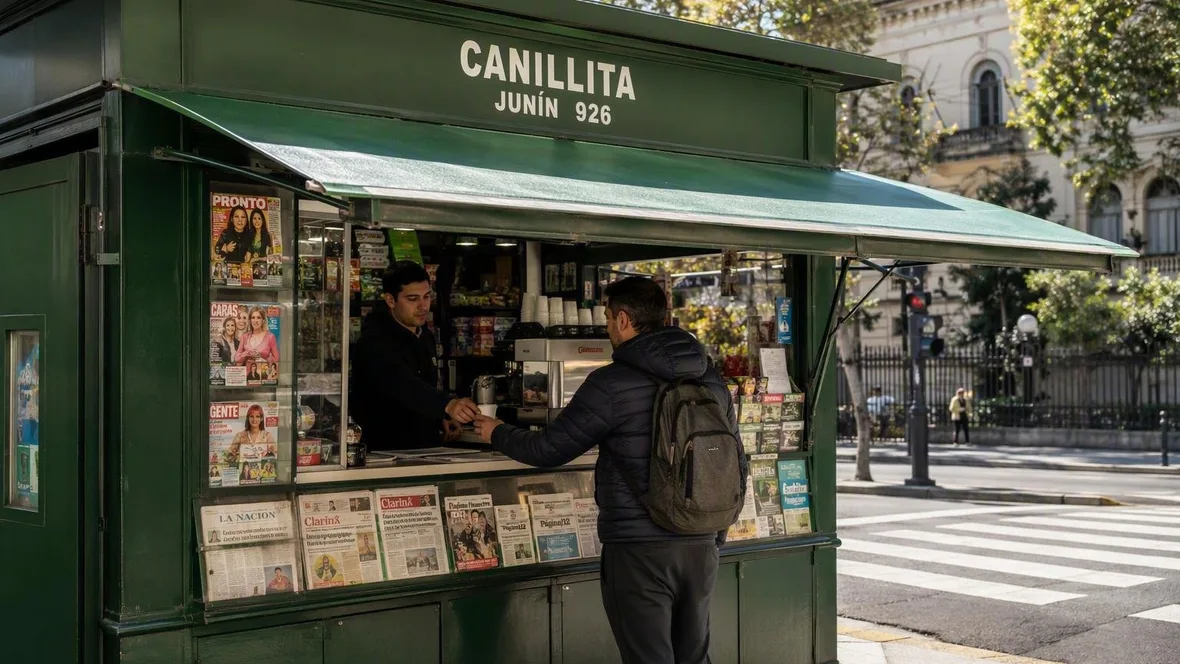
At Junín and Paraguay, coffee crosses the counter of a green newspaper kiosk while magazines still face the pavement. Canillita has broadened its trade without abandoning the compact, street-level exchange that put Buenos Aires kiosks on daily walking routes.
Junín 926, beside the medical faculty
Canillita stands at Junín 926, near Plaza Houssay, the Facultad de Medicina and the Hospital de Clínicas. White lettering cuts across the kiosk’s green exterior. An espresso machine shares its tight interior with newspapers, magazines and collages made from old magazine covers; the counter also sells medialunas, pastries and savoury snacks. Sources record coffee queues among the students and young health professionals who use this stretch of street.
The name carries a practical history. In 1868, La República began selling copies through boys on street corners rather than only through subscriptions. Porteños called these sellers canillitas, after the thin bare lower legs that showed beneath their short trousers. The word later became the usual name for kiosk operators.
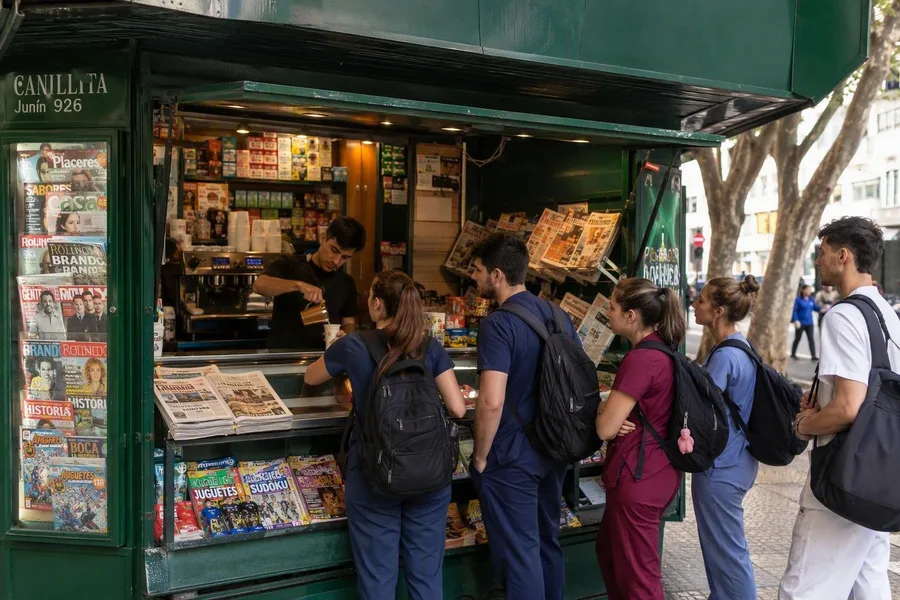 Students queue for coffee at Canillita’s kiosk on Junín 926 beside newspapers and magazines.
By the 1960s, roaming and bicycle newspaper sellers had become scarcer, and fixed kiosks took over more of the trade. They put print directly on routes used by commuters and pedestrians, near stations, corners and institutions. At Canillita, a customer still approaches an open counter rather than entering a shop. The paper has not vanished from view, but coffee now pays for part of the same narrow workplace.
Why the kiosk stays small
Buenos Aires classifies newspaper and magazine kiosks as street furniture. A 2012 law gave them that status, and later concession renewals retained the kiosk as a recognisable, standardised street structure rather than a casual stall.
The official Calle Florida model shows the logic in physical form: a narrow cabinet of metal profiles, aluminium and glass, with a green-painted canopy. Its doors or shutters fold open to expose newspapers and magazines. When closed, the kiosk shrinks back to a compact box. Rules require clearance between its rear and the kerb and set a minimum distance from the next kiosk, keeping each unit within a small patch of pavement.
No operator owns that patch. The permit is personal, non-transferable and revocable; an applicant must submit a site plan and photographs that show the pavement width. Since 2025, provisional permits have lasted three years.
The result is familiar street architecture: green panels, glass, metal and a front that opens directly onto the walking line. Renovated kiosks have added LED lighting and roll-up closures, making their stock clearer after dark without turning them into ordinary shopfronts.
When paper no longer pays alone
Digital information and communication technologies have cut sales of newspapers and magazines, eroded vendors’ income and contributed to closures, according to Argentina’s 2023 national rules for the sector. The old model gave sellers only a percentage of each publication’s cover price, so falling sales left little margin. A university-cited city statistics report put circulation of the leading national newspapers at 20 million copies in 1997 and 2 million in 2024.
That decline changes the counter before it changes the kiosk’s outline. Coffee, non-alcoholic drinks and baked goods now sit beside stationery, school supplies, toys, souvenirs and small household goods; the 2023 national rules explicitly widened the permitted range of merchandise. At Rivadavia and Medrano, beside Las Violetas, one stand shifted mainly to toys after newspaper and magazine sales dropped during and after the pandemic.
Some stands also handle parcels, online purchases and documents. A 2025 rule allows registered newspaper stands, or those working with an authorised postal operator, to process correspondence, packages, bank cards and identity documents. The kiosk can now serve a resident collecting a package as readily as someone buying a magazine.
The city has not allowed print to disappear behind the machine. Its 2026 rules require newspapers and magazines to occupy the front and most visible area, while coffee and other supplementary activity may take no more than half the fixed display. The green kiosk therefore keeps its public face as a press stand, even as its income comes from a wider mix.
Coffee at Córdoba, Santa Fe and Cabildo
Rito, at Avenida Córdoba 2150 opposite the Facultad de Ciencias Económicas, makes that mix plain. Espresso and cortado stand alongside medialunas, chipá and toasted sandwiches; newspapers, magazines and books remain in the assortment. Its low counter faces the avenue and the faculty, not a café dining room.
Atajo Café y Cultura, at Avenida Santa Fe 1940 in Recoleta, puts coffee and newspapers beside vinyl records and cultural interventions in a former press kiosk. Impresso, at Avenida Cabildo 2202 in Belgrano, gives coffee and laminated pastries greater prominence while retaining much of the kiosk’s original structure. These are not a chain of destination cafés. They are small, outward-facing sales points on different pedestrian routes: a university avenue, a busy Recoleta artery and a broad Belgrano thoroughfare.
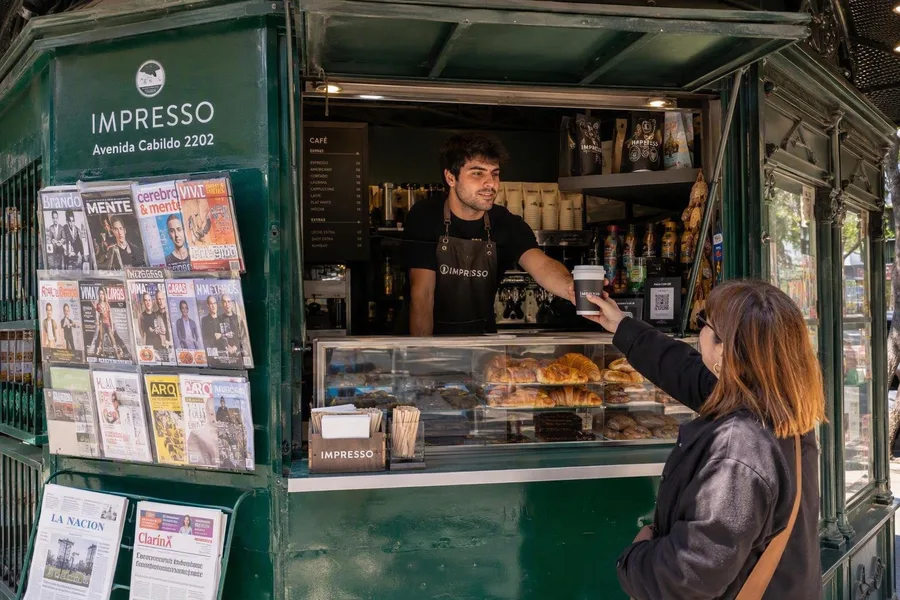 A barista serves coffee and laminated pastries from Impresso’s kiosk on Avenida Cabildo.
The rules keep the distinction visible. Kiosks that add coffee cannot place tables, chairs, parasols or chalkboards on the pavement, and they cannot sell coffee directly opposite an existing hospitality business. A barista works behind a hatch; the pavement remains for people walking past.
Buenos Aires has long held both kinds of public pause. In the early 20th century, Avenida de Mayo combined cafés, hotels and theatres with newspaper offices and handwritten news boards. Café Tortoni opened there in 1858 and had placed tables and chairs on the pavement by 1894. The newer kiosk turns that arrangement inside out: instead of a café sending furniture onto the street, a press stand fits a limited coffee service inside its existing shell.
A short stop on Corrientes
For a compact practical reference: Canillita is at Junín 926; Rito at Avenida Córdoba 2150; Atajo at Avenida Santa Fe 1940; and Impresso at Avenida Cabildo 2202. The city also lists active conventional newspaper kiosks at Avenida Corrientes 1382 and 390, Avenida Cabildo 2319 and 2585, and Avenida Rivadavia 5391.
Not every kiosk has become a coffee bar. Those conventional stands still preserve the baseline: open shutters, print at the front and a brief transaction across a low counter.
At Avenida Corrientes 1282, Capochetta has added a movable bar, a water connection and bold graphics to a converted stand for quick sandwich service. The counter passes food out one order at a time. Beyond the opening, Corrientes keeps moving; the kiosk stays fixed at the pavement’s edge, its small lit worktop framed by green metal and glass.
Keep exploring