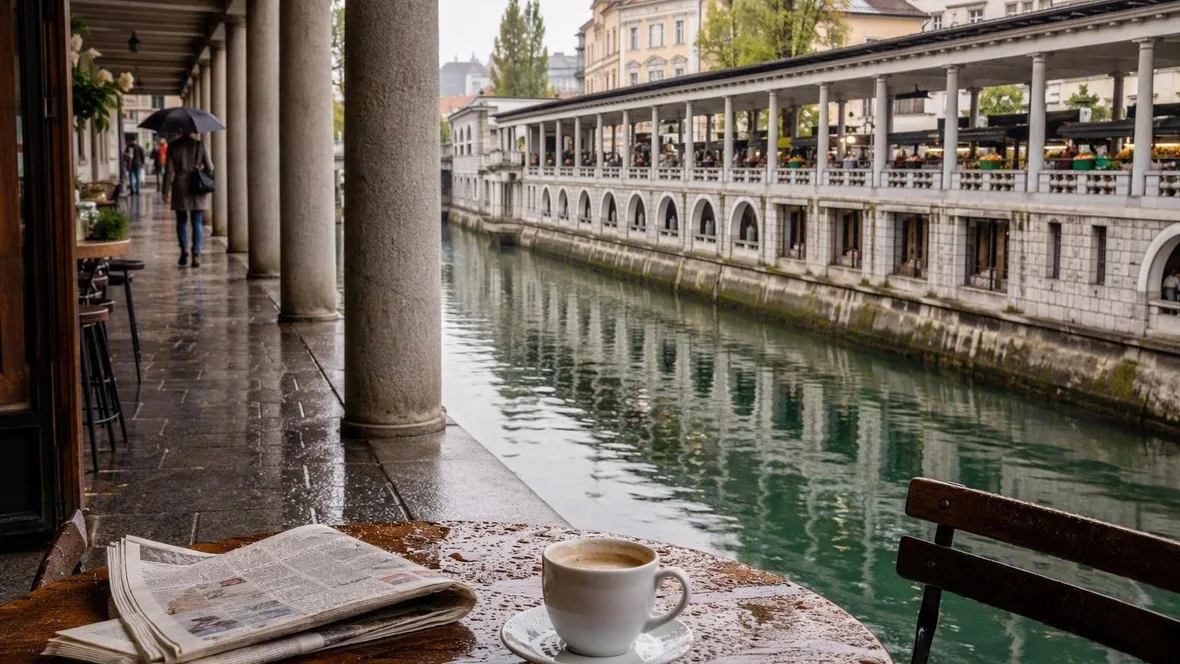
A Rainy Morning Beneath Ljubljana’s Market Arches
Rain sends umbrellas across Ljubljana’s open market squares and under Jože Plečnik’s riverside colonnade. The short walk from vegetables and flowers to coffee by the Ljubljanica follows the working edge of the old town, with the river never far from view.
Umbrellas on Vodnikov trg
Rain draws a clean line across Ljubljana’s Central Market. Umbrellas pass between the stands on Vodnikov trg and neighbouring Pogačarjev trg, where sellers fill tables, carts and display cases with vegetables, fruit, flowers and plants each morning. The paving in the old town can be slippery when wet, so a short walk calls for shoes with grip.
The market is not a single hall. It occupies a strip on the right bank of the Ljubljanica, between the Triple Bridge and the Dragon Bridge, and joins two open squares to a covered market and small food businesses beneath Plečnik’s colonnade. Rain makes that arrangement easy to read. The squares leave the stalls open to the weather; the arcade supplies a covered route beside the river.
The market handles ordinary provisions rather than souvenirs dressed up as local colour. Local growers bring fruit and vegetables, while the covered sections sell bread, cured meats, cheese, nuts and other everyday food. That mix gives the morning its useful purpose. Shopping bags, folded umbrellas and a quick turn towards shelter need no elaborate staging.
Until 1940, trade here took place entirely outdoors. Jože Plečnik’s covered market changed the shape of the riverbank, and the present open squares and covered market in the ground floor of the seminary palace followed after the Second World War. The route still shows those stages in plain order: open stalls first, then columns and a roof, then the water.
From the stalls to the colonnade
From the market squares, the direct line continues through the covered market along Adamič-Lundrovo nabrežje, beneath the market’s arcades and colonnade. The walk does not make a grand detour to reach the Ljubljanica. The quay already belongs to the market.
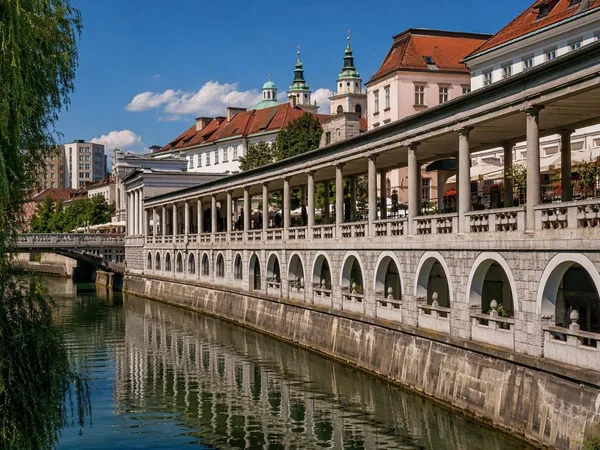
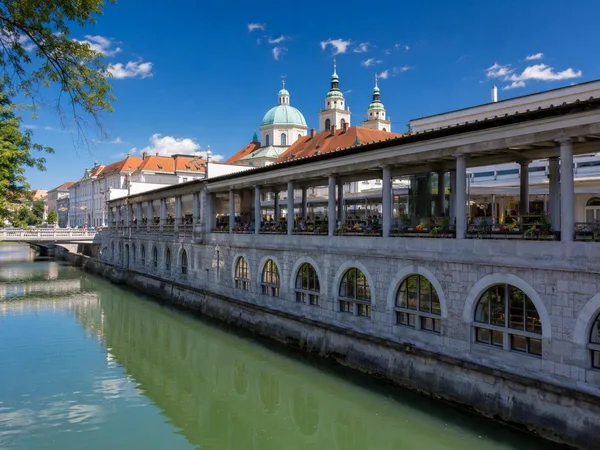
Plečnik built the two-storey market halls along the river’s bend between 1940 and 1944. A curved colonnade runs along the street side beneath a roof of heavy concrete tiles, while a rougher stone base meets the water side. The architecture has a practical effect in rain: pedestrians can continue beside the stalls under cover instead of cutting across the exposed squares.
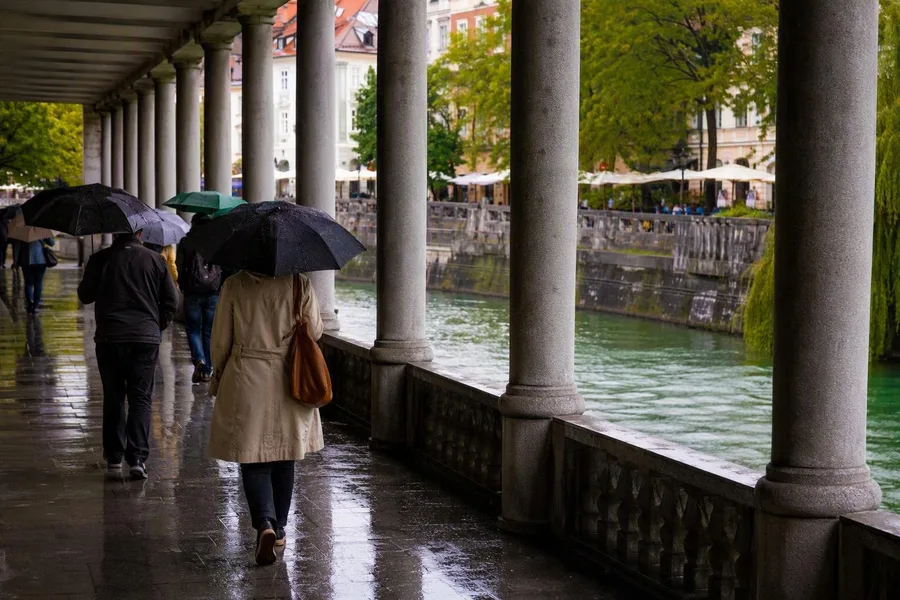 Umbrella-carrying pedestrians pass beneath the market colonnade beside the Ljubljanica.
The building splits its work between levels. Small shops and places to eat occupy the upper floor; the fish market sits below, close to the bank. Doors, windows and two open loggias break the river façade, so the Ljubljanica remains visible from the market building and the quay. A person buying cheese above the water and a person walking towards coffee use the same narrow strip of city.
The colonnade also avoids the usual old-town choice between a covered arcade and a view. Its columns shelter the route without sealing off the river. On a wet morning, that is more useful than picturesque. A few hundred metres of dry pavement can improve anyone’s opinion of urban design.
Adamič-Lundrovo nabrežje
Adamič-Lundrovo nabrežje follows the curve of the Ljubljanica below the market. Rain darkens the paving, umbrellas pass from the open market into the arcade, and the river shows through the openings on the water side. The movement stays close to stalls, stone and water rather than breaking into separate sightseeing stops.
That closeness has a long history. After centuries of flooding, work from the late eighteenth century began to relieve pressure on the Ljubljanica. Early twentieth-century works deepened the riverbed and reinforced the banks, but those measures initially set houses farther from the water. The river became safer to manage, if less present in the street.
From 1930, Plečnik reshaped parts of the embankments with pedestrian spaces, sightlines and riverside structures that returned the water to everyday urban life. Later renewal made the central banks and their connections pedestrian areas and public space. Here that history needs little explanation. The market’s covered passage runs alongside the river instead of turning its back on it.
Cafés with outdoor seating now line much of the old riverside, and promenades carry pedestrians along the water. In rain, the colonnade provides the sensible slower alternative: a route with enough cover to keep walking, and enough openings to keep the river in sight.
Practical note. Start among the stalls on Vodnikov trg and Pogačarjev trg, continue through the covered market, then follow Adamič-Lundrovo nabrežje beneath Plečnik’s colonnade to Plečnikova Južna Café at Adamič-Lundrovo nabrežje 7. Much of the final stretch stays beside the Ljubljanica and under the arcade.
Coffee at Plečnikova Južna
Plečnikova Južna Café sits under the market arches beside a bend in the Ljubljanica. Its terrace lies beneath the arcade and looks towards the river, while coffee and sweet pastries form part of the menu. The café does not interrupt the route. It occupies the same riverside structure that carries the market from open square to covered hall.
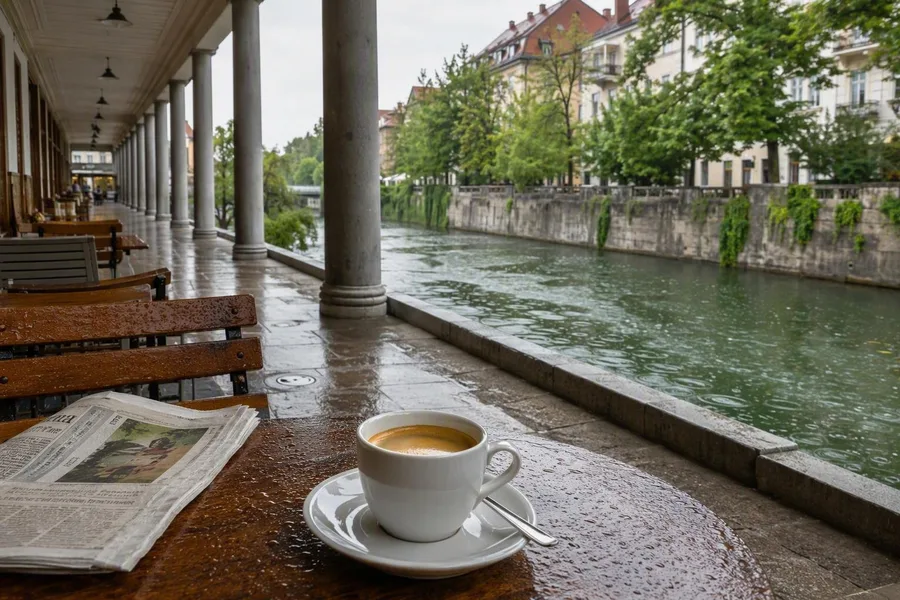 A coffee cup rests beneath the market arches beside the rain-rippled Ljubljanica.
That position explains the modest rhythm of the stop. Above and around the café, the market includes shops and places to eat; below, the fish market occupies the level nearest the water. A coffee cup at the terrace belongs to the daily traffic of this building, not to a staged escape from it.
The riverbank beyond holds other cafés, but this table keeps the market in the frame: roof tiles overhead, columns along the walkway, the Ljubljanica on the far side. Rain breaks the reflected colonnade into wavering pale bands on the water.
Keep exploring