
City · Ukraine
Poltava
Poltava is a regional capital in central Ukraine, spread across the Vorskla River and known for its planned neoclassical centre, literary heritage and halushky dumplings.
Orientation
Poltava stands on both banks of the Vorskla River, with the historic centre on higher ground west of the river. It is the capital of Poltava Oblast. The compact core is built around Round Square (Kruhla Ploshcha); Ivanova Hill, the older hilltop quarter, lies a short walk east along Sobornosti Street.
The city’s character is clear in these two districts: a formal early-19th-century civic plan around Round Square, then a more intimate historic area of cathedral buildings, museums and views over the river valley.
Start at Round Square
Round Square is the practical anchor for a first walk. Early-19th-century administrative buildings form a neoclassical ring around Korpusnyi Garden, with the Monument of Glory at its centre. Eight streets radiate from the square, so it is also the easiest place to get your bearings.
Walk the shaded paths through Korpusnyi Garden, then continue along Sobornosti Street toward Ivanova Hill. The local-history museum, housed in a striking Ukrainian Modernist building, is a worthwhile stop for regional history and ethnography.
Ivanova Hill and the literary city
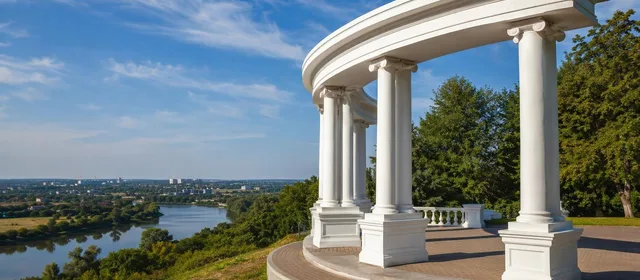
At Ivanova Hill, the White Arbor is a white semicircular colonnade above the Vorskla valley. It is Poltava’s defining viewpoint; the panorama takes in the lower Podil district and the Holy Cross Exaltation Monastery across the valley.
Nearby are the Dormition Cathedral, the estate-museum of Ivan Kotliarevsky and the monument to Poltava halushky. Kotliarevsky’s Eneyida, published in 1798, is a landmark of modern Ukrainian literature. The hill is best approached on foot from the centre; expect an uphill stretch.
The Battle of Poltava
The 1709 Battle of Poltava took place north-west of the centre during the Great Northern War. The battlefield is now a large historical and cultural reserve with the Museum of the History of the Battle of Poltava, memorials, redoubt sites and religious monuments.
This is not part of the central walking circuit. Use local transport or a taxi, and allow time to cover both the museum and the outdoor grounds. Treat the memorial landscape with the restraint appropriate to a place of war and burial.
Food and practical movement
Order Poltava halushky: soft dough dumplings, served in several local styles. They are the city’s best-known dish, not a generic souvenir-food label.
The centre is manageable on foot; buses and trolleybuses connect the larger city and the battlefield area. Railway and local transport schedules can change.
Essential conditions
Ukraine remains under wartime conditions. Air alerts, service interruptions and curfews can affect movement and opening hours. Know the shelter procedure at your accommodation, carry identification, follow local instructions immediately during an alert, and confirm same-day transport and museum access before setting out.
From the magazine
Stories about Poltava
Editorial stories linked directly to Poltava.
No stories about Poltava have been published yet.
Routes from our editors
Travel through Poltava
Editorial routes connecting Poltava with other countries, cities and hotspots.
No routes through Poltava have been published yet.
More in Ukraine
Related hotspots
Other cities, nature areas and places within Ukraine.