
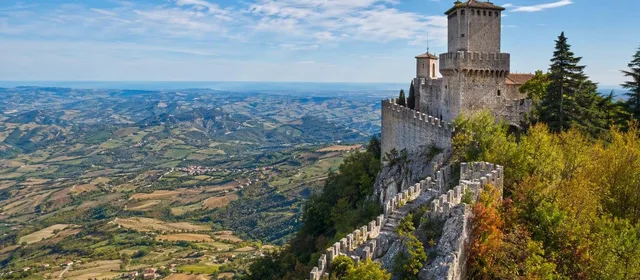
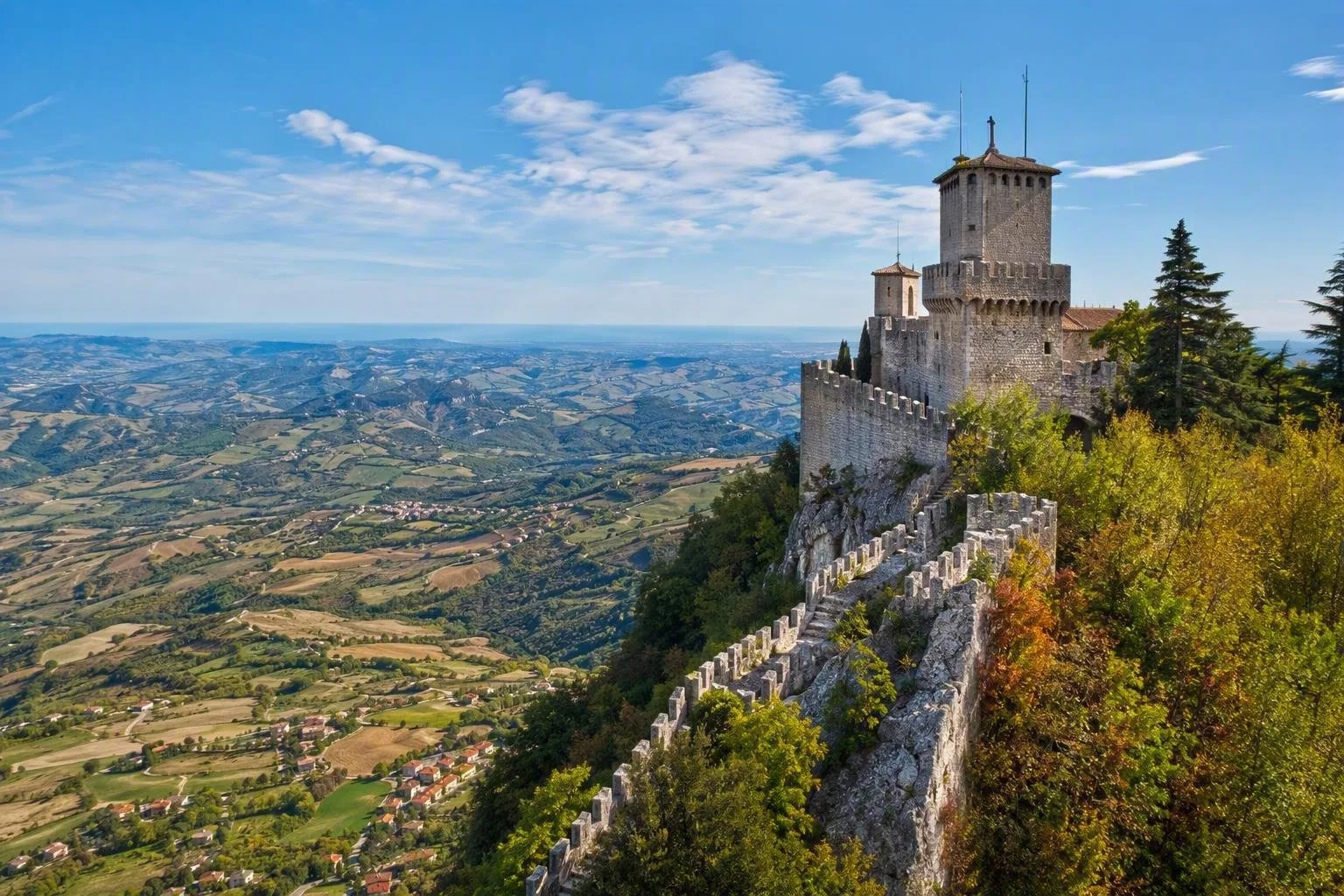
San Marino packs a working republic, a walled hill town and a long mountain ridge into 61 square kilometres. Guaita, Cesta and Montale stand along the crest of Monte Titano, above the Apennine foothills and the Adriatic plain. In the City of San Marino, steep stone lanes run between the Palazzo Pubblico, the Basilica of San Marino and small shops beneath the towers. The Grand and General Council still elects two Captains Regent every six months, following a shared system of office that dates back to the Middle Ages.
Most visitors head straight for the historic centre, but the republic includes nine castelli. Borgo Maggiore sits below the mountain, where market stalls fill the square and a cable car climbs to the capital. Away from the upper lanes, vineyards, fields, woodland and compact villages cover the lower slopes. San Marino’s rulers built and maintained the mountaintop fortifications while larger Italian states surrounded the republic.
Food follows the cooking of nearby Emilia-Romagna and Marche. Trattorias serve piadina and fresh pasta, and local Sangiovese appears on wine lists. Torta Tre Monti stacks thin wafers with chocolate and hazelnut cream, referring to the three towers. Italian is the official language, but San Marino’s public ceremonies, stamps and elected offices set it apart from the towns across the border. Take time to walk the ridge, ride down to Borgo Maggiore and linger over lunch before you leave.


