
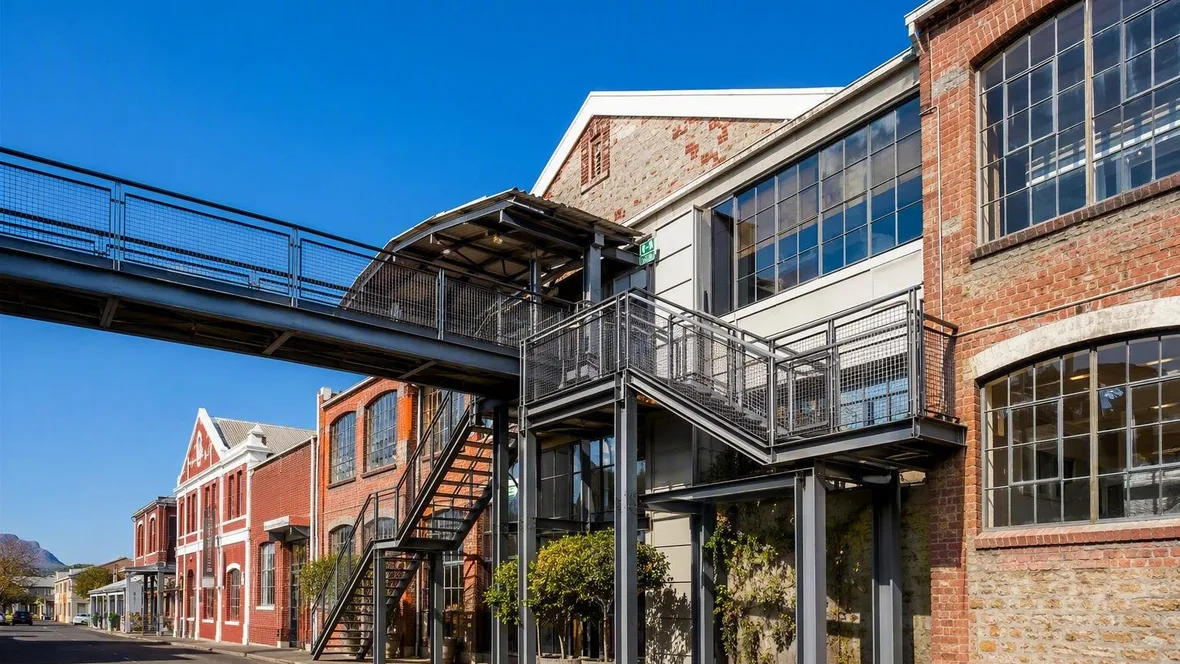
Woodstock, still at work
At the Old Biscuit Mill, steel stairs, bridges and broad steel-framed windows sit alongside the older factory buildings. The conversion retained Pyott’s former biscuit factory and made each newer layer plain to see.
A factory opens to Albert Road
Pyott’s biscuit factory opened on Albert Road early in the 20th century and operated until 1946. Its former production buildings now contain ceramic and art shops, design studios, offices, the Design Academy of Fashion, restaurants, a coffee roaster and the Neighbourgoods Market. On market days, stalls take over the complex’s parking area.
The conversion retained the historic buildings and added steel stairs, walkways and large steel-framed windows. The work also uncovered and restored an old well. The materials show what changed: this is not an intact factory, nor a new building made to look old.
The Old Biscuit Mill is Woodstock’s best-known industrial conversion, but Albert Road does not consist only of restaurants and design shops. Workshops, offices, homes, public transport and older businesses stand close together along this working and commercial street. The mix reflects a much older pattern of transport, housing and employment.
Woodstock began as Papendorp, a settlement on Pieter van Papendorp’s land beside the main road. Papendorp and Salt River formed the independent municipality of Woodstock in 1881, before Cape Town absorbed it in 1913. Rail sped up the change. In 1860, the first locomotive ran from Papendorp towards the Salt River workshops, linking goods, industry and homes across the low ground between the harbour and the slopes.
The railway corridor still marks that productive edge. Albert Road runs beside it, joining former factories and warehouses to shops, apartments and the station area.
Albert Road changes its work
At 66 Albert Road, Woodstock Exchange fills a building once used for clothing production. Textile and garment factories were major Cape Town employers in that period. Artists, designers and makers moved into the property in the early 2000s, when it was called the Woodstock Industrial Centre. After renovation, it reopened as Woodstock Exchange in 2011.
Work did not vanish from the building. Clothing makers, jewellery designers, bakers and fine-art printers now work alongside studios, shops and other small businesses. Their businesses use a different kind of floor space from the garment industry that once occupied the address.
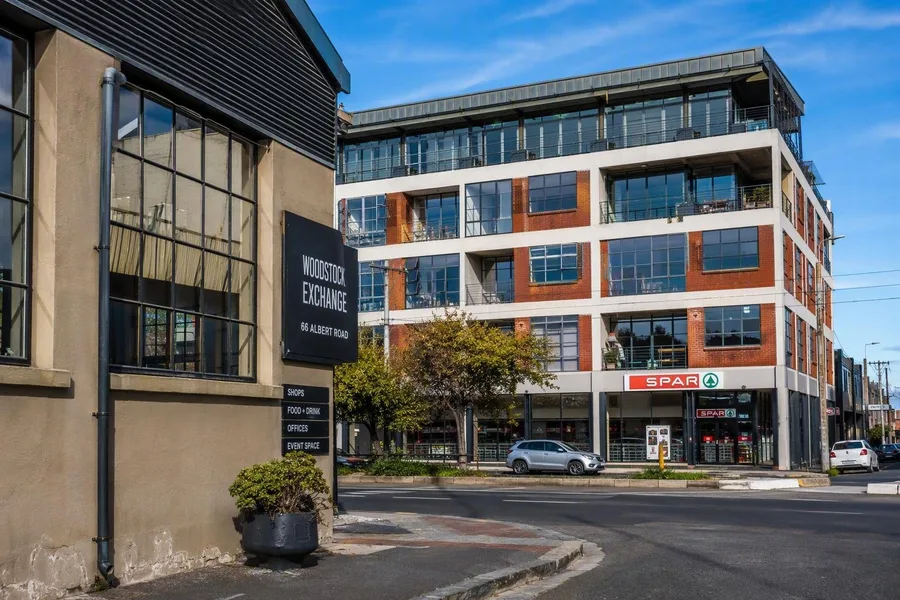 Woodstock Exchange faces WEX1 and its ground-floor SPAR supermarket on Albert Road.
Across the street, WEX1 stacks apartments, shops, restaurants and offices above a ground-floor SPAR supermarket. A former clothing factory, a new mixed-use block and an everyday grocery store now share a short stretch of road.
Farther along, the Woodstock Foundry occupies former cast-metal works at 150 to 170 Albert Road. The industrial buildings now contain studios, shops, small offices and places to eat; tenants include cycle-clothing company Ciovita, The Wheelhouse and Trzebinski Sculpture.
Number 302 provides a different example. This Victorian commercial building from about 1900 to 1905, with industrial structures behind it, was repaired rather than replaced. A jewellery shop and gallery face Albert Road, offices fill the upper floor, and a workshop, restaurant and studio sit around the rear courtyard. The property also accommodates media, photography and film training.
These buildings provide premises for design, food, retail, training and small-scale production. Their renovated space also carries a price and profile that not every established workshop, modest shop or renter can absorb.
Chapel Street and the housing behind the corridor
Chapel Street lies a short distance from Albert Road but has a different physical scale. Like Albert Road, it forms part of a designated heritage area. Compact rows of 19th- and early-20th-century cottages and houses, usually one storey high, stand close to the pavement.
Plastered walls, timber windows, corrugated-iron or tiled roofs, small front gardens and low boundary walls recur along the street. Verandas and stoeps set front doors close to the pavement. In these rows, an added storey or a large extension can change neighbouring light, rooflines and the measured scale of the street.
Woodstock’s residents do not form one fixed group. Long-term black, coloured and working-class residents live alongside middle-income arrivals and lower- and middle-income migrants from elsewhere in Africa; some households share poorly maintained houses. Owners may benefit from rising property values while also meeting higher daily and municipal costs. Renters with informal or weak agreements have less protection when an owner sells, raises rent or clears a building for redevelopment.
The pressure reaches beyond a monthly payment. Residents who remain can lose affordable shops, nearby services and social ties. Established small businesses can lose either their premises or the regular customers that keep them open. New food businesses, shops and workspaces add services and jobs for some people. They do not automatically help a low-paid worker, room renter or small workshop that can no longer afford the address.
Five cottages and an old hospital
Bromwell Street gives that pressure a precise address. In 2013, an owner bought five adjoining cottages occupied by tenants, including families with rental histories stretching over generations, for a development intended to bring in far higher rents. The owner then ended the leases and began eviction proceedings.
In 2024, South Africa’s Constitutional Court ruled that Cape Town could not categorically exclude temporary emergency housing from the inner city. The Bromwell Street tenants could not be evicted until suitable housing became available in, or as close as possible to, Woodstock, Salt River or the inner city. The judgment did not give every tenant a home in a chosen location. It required the effects of moving people away from work, schools and established networks to carry weight.
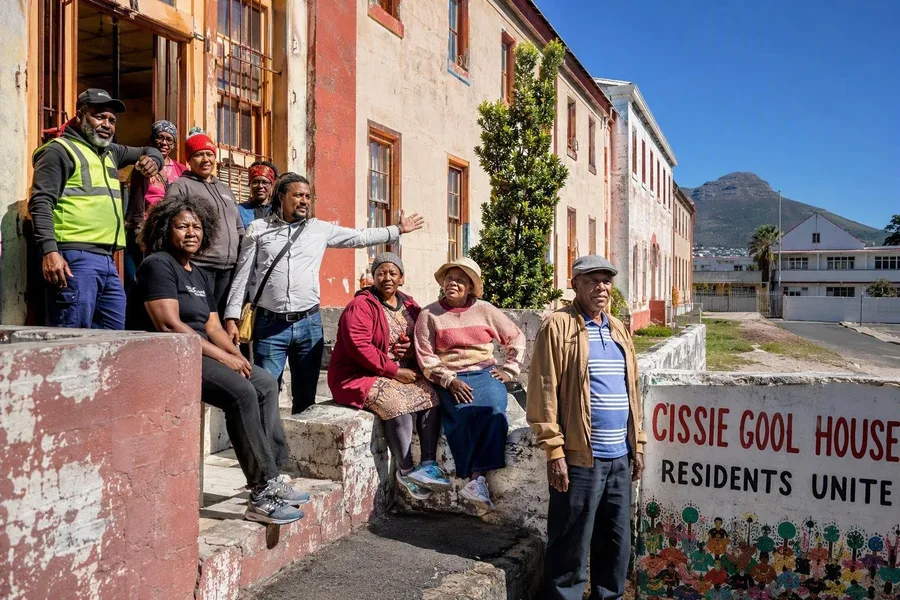 Residents gather at Cissie Gool House, the occupied former Woodstock Hospital.
The former Woodstock Hospital presents another live dispute. More than 800 people have occupied the building since 2017 and call it Cissie Gool House. Residents use monitors and their own leadership structure to manage the property.
Cape Town’s council has approved in principle the site’s sale for a mixed development of 500 homes, including housing aimed at households across a broad income range. Current residents fear eviction before construction and exclusion from the completed homes. Their representatives support redevelopment with secure, genuinely affordable rental housing and a role for residents in design and management.
That position matters because it resists a simple choice between keeping every building untouched and replacing it. In Woodstock, a conversion, a new apartment block or a sale can create work and housing for some people while narrowing the options for renters, low-paid workers and long-running small businesses.
Practical details
MyCiTi service 261 stops near the Old Biscuit Mill. Construction at the Barron and Biscuit Mill stops may reduce road and parking space, though buses continue to run. The Mill’s shops generally open Monday to Friday from 10am to 4pm, Saturday from 9am to 4pm and Sunday from 10am to 2pm; individual tenants may differ. Woodstock Exchange also has tenant-specific opening hours.
Beside Woodstock Station
Woodstock Station stands near the point where work started on the early railway towards Wellington. One block away, Albert Road compresses the neighbourhood into a single view: Baltic Timber, the studios and workshops of Woodstock Exchange, and WEX1, with apartments above shops and a supermarket. The railway lines run beside that dense strip of roofs, workrooms and homes.