Where Wellington’s Native Birds Return
A double gate separates suburban Wellington from a valley where kākā tear at bark, tīeke search the leaf litter and takahē graze beside old reservoirs. Zealandia Te Māra a Tāne has turned a former water catchment into a breeding ground for native wildlife, with birds now moving beyond its fence.
The first striking feature at Zealandia is not a bird. It is the fence.
Its curved cap blocks climbers, buried mesh stops digging animals and a fine grid keeps out all but the smallest young mice. Volunteers inspect the 8.6-kilometre perimeter for rust, damage and possible entry points. Together with the double biosecurity gate, the fence creates an island-like refuge on the mainland.
Inside lie regenerating forest, two reservoirs, streams and walking tracks. More than 40 native bird species have been recorded in the valley, but Zealandia is not a zoo. The animals live freely in the forest, and no sighting is guaranteed.
A reservoir becomes a sanctuary
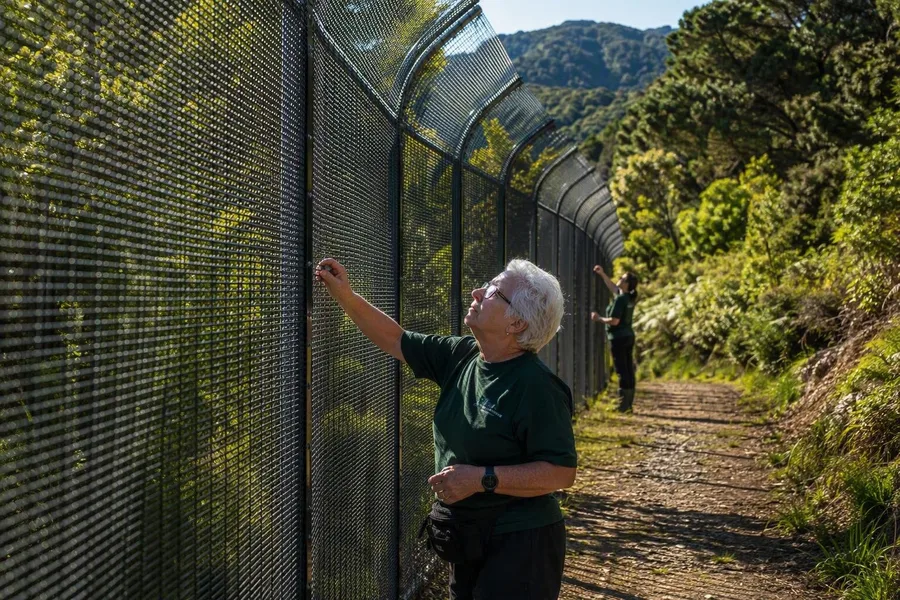 Volunteers inspect Zealandia’s predator-proof fence in the former Wellington water catchment.
The forest has not always looked this way. Māori knew the area as Kaharore, meaning “place of many bird snares”, and used the valley seasonally for food, including kākā and kererū from the forest and fish and kōura from the Kaiwharawhara Stream. European settlers cleared and burned much of the forest from the 1840s. The steepest slopes retained what is now the sanctuary’s oldest regenerating woodland.
Wellington later used the valley to store drinking water. An earth dam went up in 1878 and a concrete dam followed in 1908. After the upper reservoir left service in 1991, Jim and Eve Lynch proposed a sanctuary for native birds in a city where introduced rats, mustelids and possums had reduced birdsong. Zealandia opened in 1999 and covers 225 hectares.
Workers first removed the introduced mammals already inside. Traps, bait stations and monitoring targeted rats, cats, possums, rabbits, hedgehogs and mustelids among other species. Vegetation began to recover once possums no longer stripped leaves from northern rātā, kohekohe and kōtukutuku.
The restoration remains unfinished by design. Introduced pines still form a high canopy in parts of the young forest, where kākā and kārearea use them. Over decades, workers will replace them with native podocarps, while some remaining trunks gain nest cavities for kākā.
Kākā above Lake Road
Lake Road follows Roto Kawau, the lower reservoir, and shows why forest restoration matters to birds. Nest boxes between Tūī Terrace and Beech Track compensate for the shortage of old trees with natural hollows. Display boxes with model eggs explain that work without taking visitors near active nests.
Kākā provide Zealandia’s most visible success. Fourteen young birds were released here in 2002 after the large forest parrots had been absent locally for about a century. Kākā now breed elsewhere in Wellington and regularly appear in central suburbs.
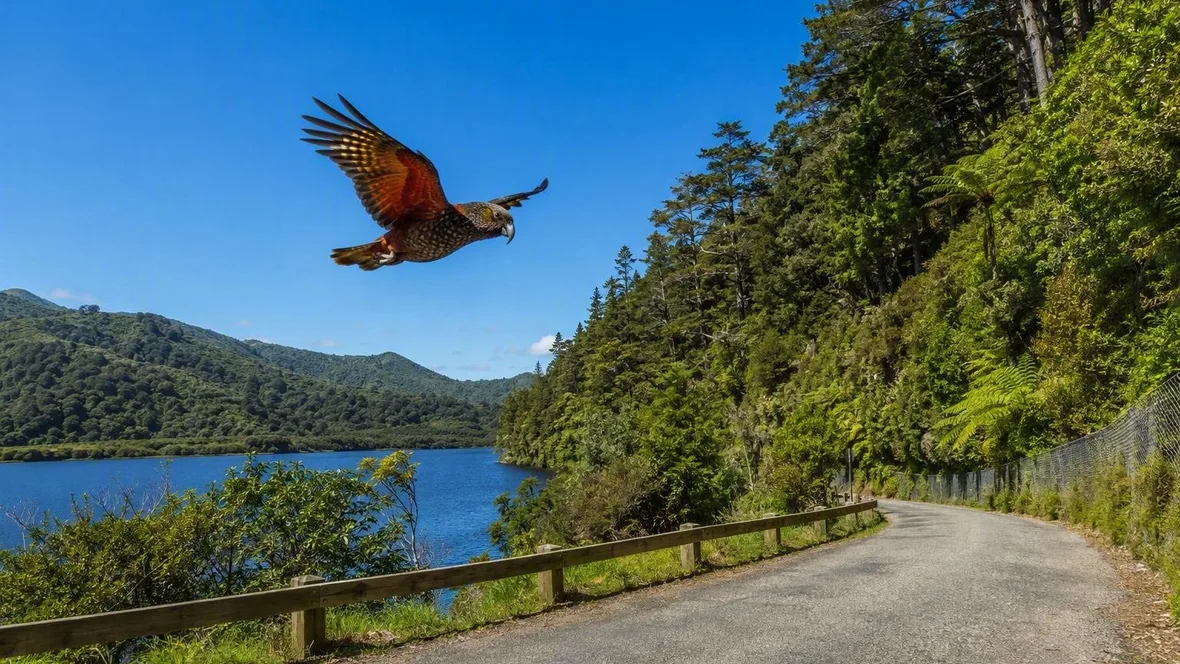
A kākā may announce itself with a harsh call, or with fragments of bark and seed falling as it feeds. Olive-brown plumage conceals a crimson belly and orange-red underwings, which show when the bird crosses Lake Road or moves between pines on the valley’s northern side. Kākā also hang upside down while feeding.
Outside the sanctuary, kākā peel bark to reach sap, especially on large isolated trees, and can damage garden trees or property. People should not feed them. Nuts, fruit and sugar water draw birds together, increase disease risk and can leave kākā ill or malformed; native trees and shrubs provide food and cover without concentrating birds at a feeder.
Tīeke in the leaf litter
Other species need a slower kind of attention. Thirty-nine tīeke, or North Island saddlebacks, arrived from Tiritiri Matangi in 2002, the first transfer of the species to a fenced mainland sanctuary. Their glossy black feathers carry a copper-brown saddle, while orange-red wattles sit beside the bill.
Tīeke forage low down in pairs or family groups. They work through leaf litter, rotting wood and loose bark for invertebrates, sometimes with a pīwakawaka following to catch disturbed insects. Rustling leaves can reveal them before the sharp tee-ke-ke-ke call does.
Stay on marked paths and stop quietly rather than following the sound. Keep distance, and leave feathers, berries, branches and leaves where they lie. Flash photography and drones are prohibited, while temporary closures can protect nesting birds.
Hihi occupy the middle and upper branches. Males have a black head, white ear tufts and a yellow band across the neck and shoulders; females and young birds are grey-brown. Their sharp, electric “stitch” call gave stitchbirds their English name.
Hihi returned to mainland Wellington at Zealandia in 2005 after an absence of more than a century. Nest boxes and sugar-water stations support them while the young forest develops more hollow trees and natural food. The stations on Beech, Discovery, Round the Lake and Turbine tracks give visitors places to wait for a small bird with an upright, flicking tail.
Heavy feet in the Upper Valley
Beyond the lower reservoir, the Round the Lake Track circles Roto Māhanga and crosses small streams in the Upper Valley. A bench near a feeding station gives people a place to watch hihi and korimako without following them, while the path looks back towards the Upper Dam.
Takahē bring very different proportions to this part of Zealandia. These flightless birds have powerful legs, blue-green plumage and a thick red bill that continues over the forehead. The species was once considered extinct, then rediscovered in 1948; Zealandia has housed takahē since 2011.
They often feed on lawns, including the grass near Tūī Terrace, although they range through the Upper Valley and along the perimeter fence. Their call resembles a squeaking swing and may carry farther than a bird grazing behind vegetation.
Wellington beyond the fence
The fence protects a breeding population, but it does not contain birds that can fly. Kākā and kākāriki now appear regularly in parks, reserves and gardens in central Wellington. Tūī and kererū have also increased across the city, while tīeke, toutouwai and pōpokotea remain scarce outside Zealandia and mostly occur in forest reserves close to the valley, where introduced predators still limit them.
Breeding outside Zealandia shows that the change reaches beyond birds passing overhead. A female kākā monitored as a chick in a nest beyond the fence in 2015 was found ten years later raising young in an old hīnau tree at Ōtari-Wilton’s Bush.
Planning a visit
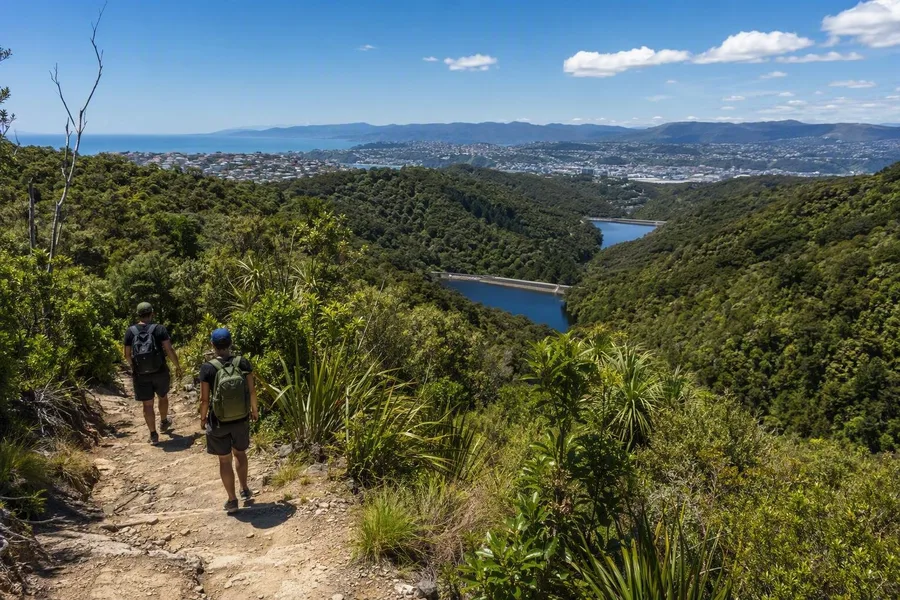 Visitors walk above the Upper Dam, looking across Zealandia’s reservoirs toward Wellington.
Zealandia opens daily from 9am to 5pm, except on Christmas Day, with final entry at 4pm. International admission costs NZ$39 for adults and NZ$18 for visitors aged five to 17; younger children enter free. Day tickets are available at the visitor centre without advance booking and remain valid for two consecutive days. Check bags and pockets for seeds or unwanted animals before passing through the biosecurity gates, and check current track notices after rain.
Past the Upper Dam, tracks climb through regenerating forest. The ground becomes rougher in places. Higher up, the view opens across the enclosed valley and Wellington beyond.
Keep exploring