
Where Faso Dan Fani Takes Shape: Cissin and Koudougou
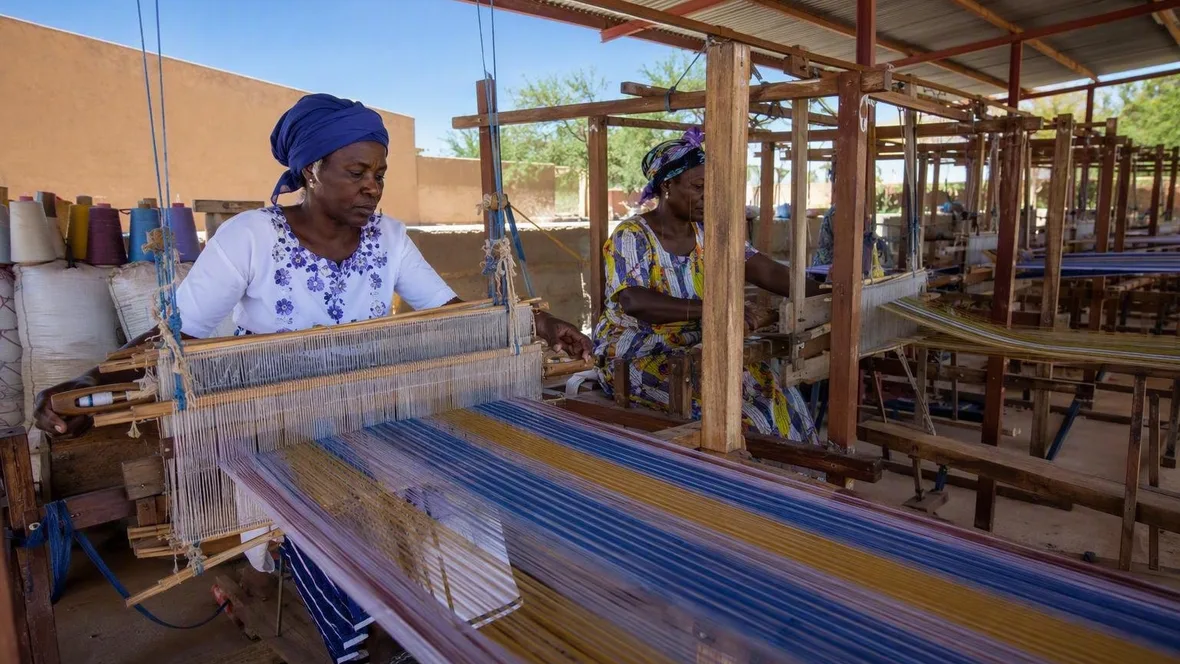
Under a shelter in Cissin, Ouagadougou, weavers press pedals while wooden shuttles pass from left to right. The stripes of Faso Dan Fani begin as counted rows of coloured cotton, not as decoration added later.
Threads counted in Cissin
Long blue, yellow and mauve threads run into the looms at the Association des tisseuses de Kadiogo, known as ATK. White sacks of yarn stand nearby, and women work side by side under a shelter while traffic and motorbikes pass outside. Each press of a metal pedal changes the warp threads. A wooden shuttle carries the weft across them, and the finished band winds onto the front of the loom.
The work starts with counting. One ATK weaver described arranging fifteen blue threads, three yellow ones and three mauve ones for a single field of colour. That sequence fixes the stripe before the shuttle moves. Faso Dan Fani is handwoven cotton, not printed cloth made to imitate woven motifs: colour enters through the yarn, while stripes, checks and more complex designs come from the order of warp and weft.
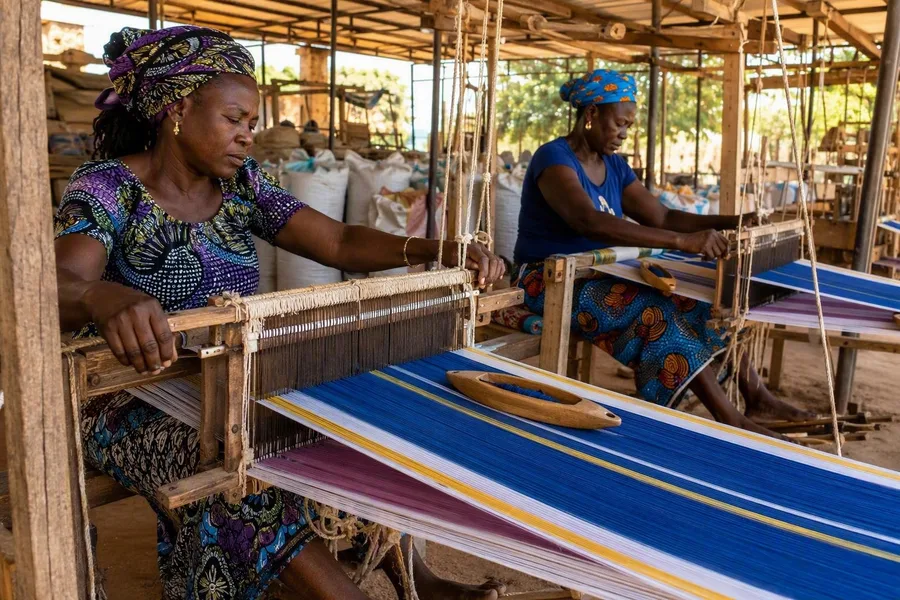 Weavers at ATK in Cissin work coloured yarn on horizontal looms under a shelter.
Many Ouagadougou weavers use horizontal iron looms with pedals, a wooden shuttle and a partly automated reed. These looms produce bands roughly 30 to 40 centimetres wide, broader than those made on older wooden looms traditionally used by men. Weavers sew the finished bands together to make a pagne or a wider length for tailoring.
Faso Dan Fani means “woven cloth of the homeland” in Dioula, but no single motif or colour code covers Burkina Faso. Mossi, Marka, Gourmantché, Dagara and Bobo communities have developed distinct weaving practices and designs. A black-and-white check or red-and-blue stripe may carry a local association, but it does not automatically convey the same message everywhere.
Cotton passes through many hands
Burkinabè cotton farmers supply the fibre. After ginning separates fibre from seed, spinners turn loose cotton into yarn regular enough for weaving; some still roll and twist fibre by hand, while Filature du Sahel in Bobo-Dioulasso also supplies yarn to artisans.
Dyers establish the colours before weaving. Depending on the workshop and the order, they use plant dyes or modern certified dyes. Near ATK, three women preparing white yarn for a mustard colour arranged it in a circle, submerged it, stirred the foaming dye bath and set the yarn out to dry. Dye determines the palette. Counting sets the arrangement, and the loom holds both in cotton.
The division of labour has changed. Historically, women commonly spun and dyed cotton while men wove on horizontal looms. Many present-day weaving groups consist largely of women, and cooperatives connect their work with yarn supplies, training, orders, quality checks and sales.
ATK brings together 32 associations and almost a thousand members. Its organisation handles trade, payment and yarn, and it also operates a mutual credit structure. The work requires more than skill at a loom. Workers need thread, buyers need finished cloth, and someone must coordinate orders and payment.
Handwork also affects the price. ATK says that a single pagne requires at least two or three days of labour, so it cannot be directly compared with cheap imported cloth. Since 2021, an official Faso Dan Fani label has offered verification for recognised handwoven production.
Sankara put woven cotton into government offices
Faso Dan Fani long predates the revolution led by Thomas Sankara, but his government changed its political weight. Between 1983 and 1987, Sankara promoted local production as part of an anti-colonial programme of economic self-reliance. In 1986, a decree required civil servants to wear locally woven cotton rather than Western-style suits.
The rule made government employees visible customers for cotton growers, spinners, dyers, weavers and tailors. Sankara’s support for women’s work also encouraged the growth of female weaving cooperatives. Yet the decree was still an order from a revolutionary government that used coercion more broadly. Faso Dan Fani became both paid work and prescribed public dress, not a simple expression of unanimous national pride.
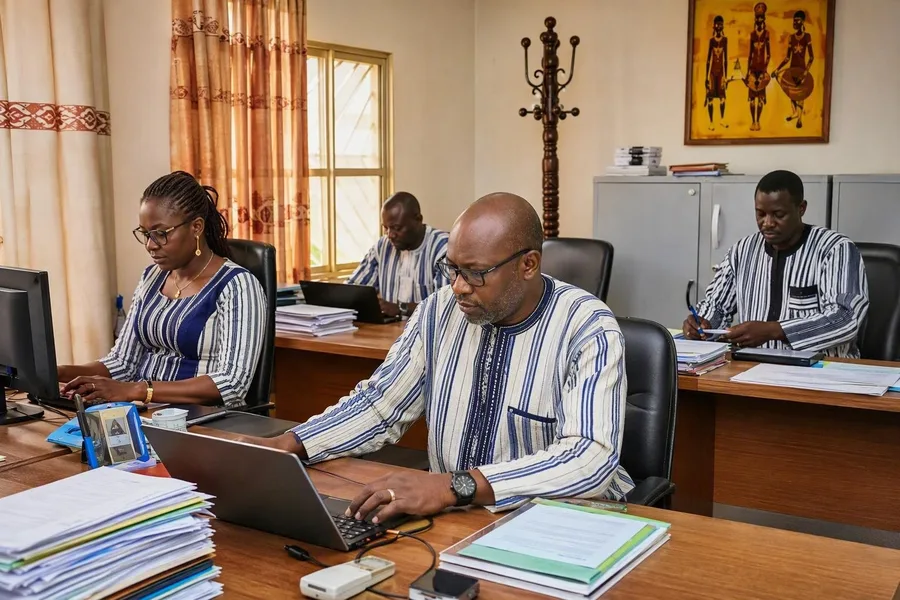 Civil servants wear locally woven Faso Dan Fani in a Burkina Faso government office.
After Sankara’s murder in 1987, makers continued to weave and sell the cloth. Political and official use became prominent again during the 2010s, while designers selected the textile for its construction, colour and suitability for new cuts. A 2023 government edict established handwoven cloth as official state dress and prescribed it for state occasions and school uniforms.
Designer Alida Bazié created Faso Dan Fani academic gowns for Université Joseph Ki-Zerbo in 2023, followed by robes for the judiciary in 2024. The cotton once used chiefly for a wrapped pagne can now form the broad panels and formal sleeves of professional dress.
From woven bands to jackets and shirts in Koudougou
François Yaméogo, who works under the name François 1er, uses traditionally woven, indigo-dyed cotton for modern suits and his characteristic blue jackets. His production unit in Koudougou opened in 2018 and employs more than 80 people, including 70 women. The site brings spinning, weaving, dyeing and garment-making together.
A 2023 report described separate workrooms across the 3,000-square-metre compound. In the handweaving section, some workers spun cotton while others wove; elsewhere, a worker wound yarn, and electric sewing machines turned cloth into clothing. The sequence is plain: dyed yarn is set in order, handwoven fabric leaves the loom, and tailors cut and stitch it into shirts and jackets.
This is not a replacement of cloth by fashion. François 1er uses the same handwoven material for contemporary shapes, while other designers also cut Faso Dan Fani into shirts, tailored jackets and everyday clothing or combine it with other fabrics. Weaving networks have developed designs beyond classic stripes, including checks, ikat, seersucker and houndstooth, and wider looms provide cloth for different garments.
The Koudougou unit displays and sells finished clothes in its own shop. There, the cotton has reached its last visible form: shirts and jackets hang after the work of farmers, spinners, dyers, weavers and tailors.