
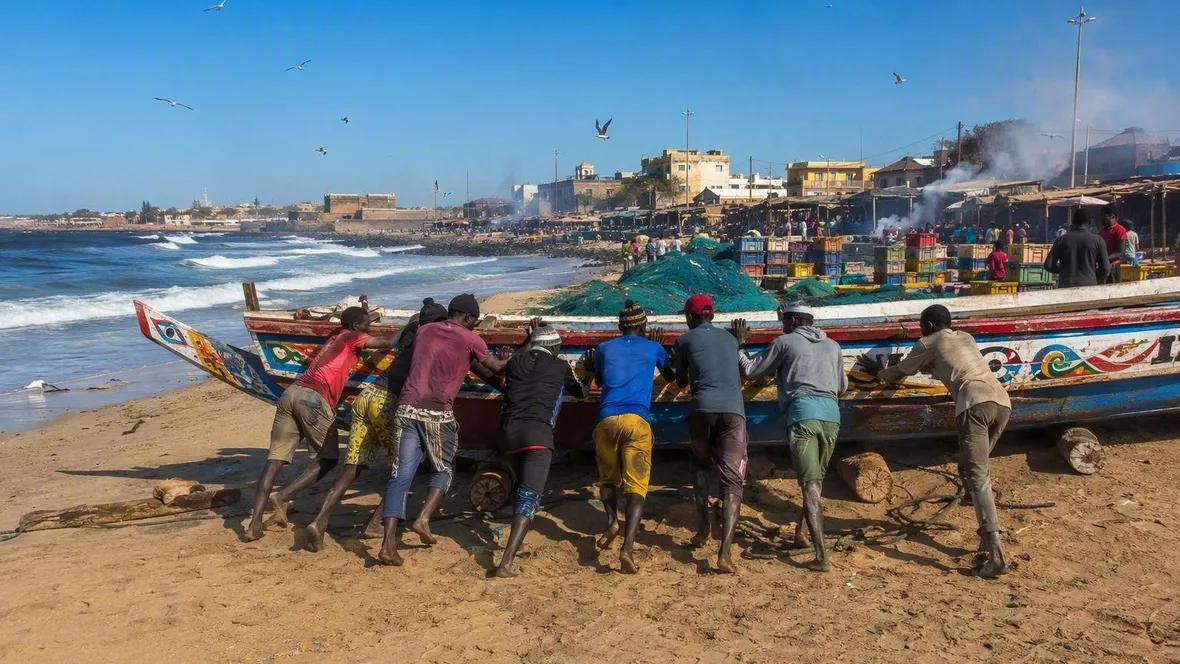
The last push at Soumbédioune
Late in the day, long wooden pirogues return to Soumbédioune, where the beach serves as a landing place, work yard and direct route to the fish market. Once a hull reaches shore, people place rollers beneath it and push the boat across the sand.
A fishing beach inside the capital
Soumbédioune lies on Dakar’s Atlantic coast along the Corniche Ouest. Fishing started here before Dakar expanded around the old Lébou settlement, and it remains the area’s main activity.
The beach and the market share a narrow strip of coast. Pirogues land on sand, fish travels from the boats to stalls a few metres from the quay, and sellers set out wooden tables for the fresh catch. A craft village opened beside the fishing community in 1961, but the shore continued to function as a fishing place.
That layout explains the density of work at the waterline. Rows of pirogues stand on the beach while other boats approach shore or prepare to leave. The sand serves as a landing ground, a place for repairs and a passage between boat and market.
The pirogues are long, narrow wooden boats, carved from hollowed trunks. Long Atlantic waves can lift their hulls from below, while wind and currents shape the approach to shore. Reports from offshore record wind, engines and gulls around a departing pirogue, though they do not document gulls around each landing.
Paint over working timber
Many hulls at Soumbédioune carry green, yellow and red paint, often over a white ground coat. Cracks, patches and other repairs can remain visible between the coloured sections.
Paint protects the wood against water. It also provides the surface for decoration. At Soumbédioune, documented designs include Allah, Wolof blessings, nicknames, a lion, a swordfish and the name of a home port.
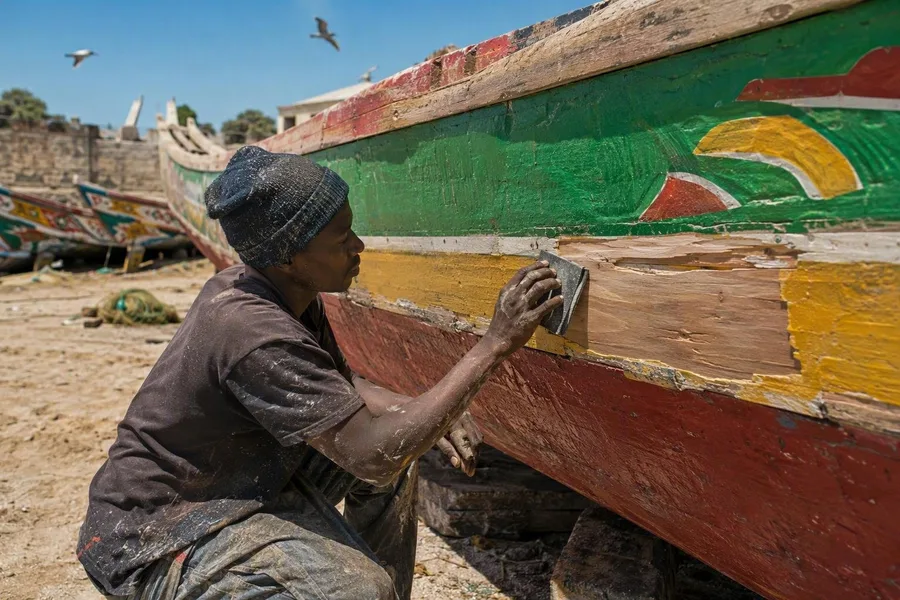 A local painter sands a repaired painted pirogue hull at Soumbédioune.
The colours match those of Senegal’s flag, but the boats do not follow one fixed visual code. Owners personalise their pirogues with religious words, family references, football emblems or other images that matter to them. A painted hull remains a workboat, not a display object.
Local painters sand the timber and add new coats of paint before the boat returns to sea. A bright inscription can sit beside a repaired seam.
Fish moves off the beach
Work continues between the stationary boats. Children have been documented sewing nets and preparing fishing lines among the pirogues, although those repairs are not established as the first task after a particular landing.
Fish from earlier arrivals moves quickly towards the adjoining market. Sellers gather at newly landed boats, and fish crates can appear across the beach within minutes. Women carry crates of fresh fish on their heads to nearby stalls.
At the market, fish is laid on wooden tables and scaled. The 2024 market complex includes covered stalls and storage used by sellers and women who process fish, while selling and preparation still take place close to the coast.
Cooking adds another visible task beside the market. Women grill fresh fish over hot coals. At a documented improvised beach kitchen, fish passes through flour before it goes into hot oil over a fire; smoke blackens walls made from zinc and pieces of pirogue timber. Small food stalls between the beach and the street also give off smoke.
That smoke comes from grills, fires and frying pans. The available reports do not support treating it as smoke from a fish-smoking stage for every catch.
Rollers beneath the hull
In late afternoon, returning pirogues reach the beach. The available accounts do not trace every movement through the surf, but they do record the work that starts once a hull reaches shore.
People put large, hard plastic cylinders under the wooden boat. Other accounts describe tree trunks or empty metal drums used as rollers at Soumbédioune. The accounts therefore show rollers under the hull, rather than a boat dragged directly across dry sand.
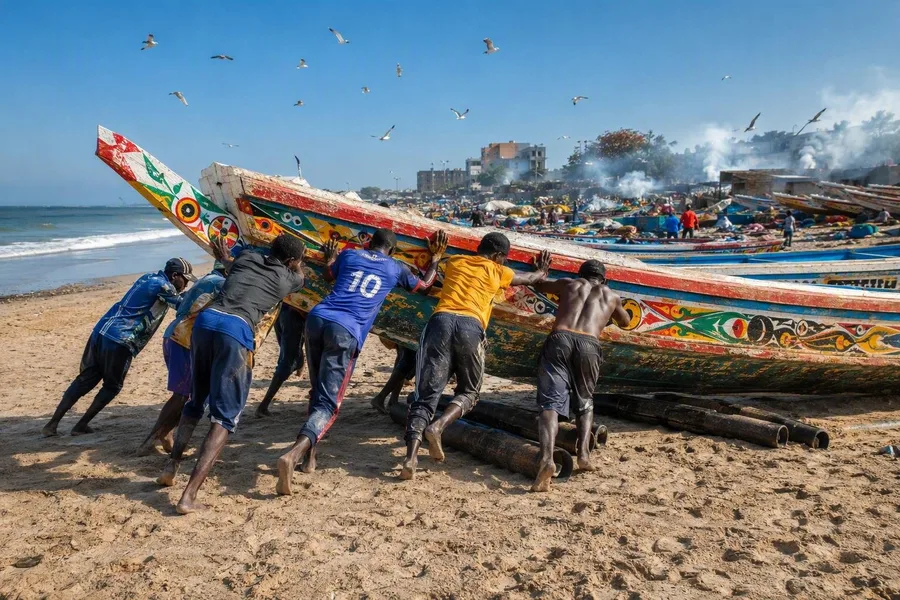 Workers push a painted pirogue over rollers on the sand at Soumbédioune.
A group of up to ten people pushes the pirogue forward. The rollers turn under the hull as the boat moves away from the water and towards the row of beached pirogues. The work depends on hands against timber and on the shifting support beneath the hull.
Some boat movements on the beach take place to singing, music or a djembe. One report also records a fisherman arriving barefoot with a bucket in fresh sand, a small detail that places bare feet at the edge of this work zone.
Nearby, crates remain on the beach. Nets lie among still boats, and smoke rises from the cooking stalls by the market. The arriving hull joins painted timber marked with blessings, home-port names, patches and visible repairs.
People push again.
The pirogue lies still on the sand.