
Temple Doors and Market Bowls in Old Tainan
At Chihkan Tower, seventeenth-century Dutch brickwork sits below Chinese halls for a sea god and the patron of examination success. Old Tainan grew through such changes of use: fortifications became civic and religious ground, while nearby streets kept their shops, food stalls and workshops.
Fort walls beneath temple roofs
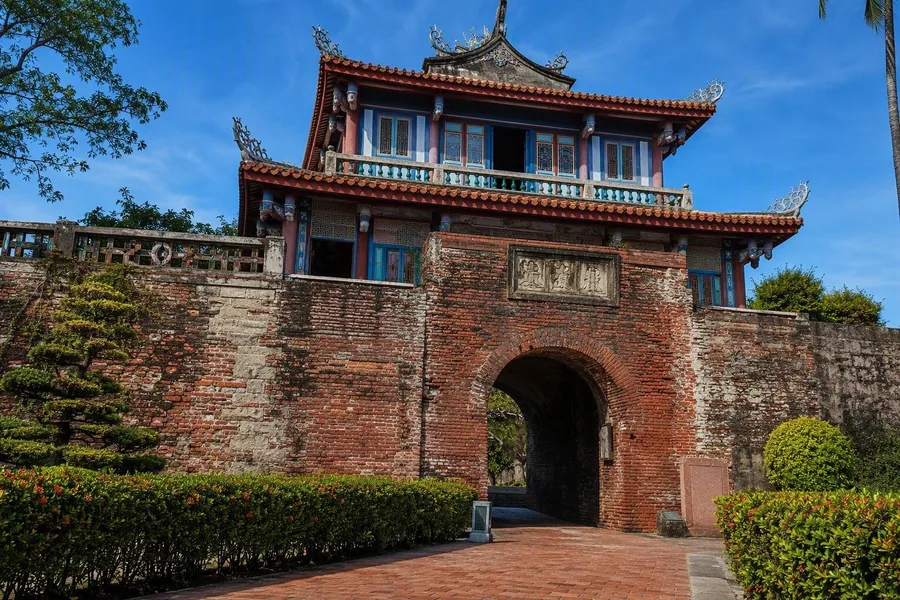 Dutch brickwork at Chihkan Tower sits beneath Minnan-style temple halls in central Tainan.
Tainan developed beside the Taijiang lagoon, where Siraya communities lived before European ships arrived. In 1624, the Dutch East India Company built Fort Zeelandia at present-day Anping. It later built Fort Provintia farther inland as a centre of trade and administration. Chihkan Tower now occupies that second site.
The surviving west gate and a section of the northeastern wall contain Javanese bricks set in mortar made partly with sticky-rice juice, syrup, sand and oyster shells. Minnan-style halls with rising double eaves stand above the former fort. One honours the sea god Haishen. Another contains Kui Xing, who holds a brush and inkpot and represents success in examinations.
Zheng Chenggong, also known as Koxinga, captured the Dutch settlement in 1662 and made Provintia his government seat. Under Qing rule, Tainan became Taiwan’s prefectural capital and remained the island’s political, economic and cultural centre until late in the nineteenth century. The historic centre therefore holds several successive cities rather than one preserved colonial quarter.
The streets around Chihkan put monuments beside ordinary trade. Milkfish soup, duck soup, tea, pastries, incense and metalwork all appear in the same neighbourhood. A stop at a shrine and a quick bowl of soup can belong to the same walk through a few blocks.
Mazu in a prince’s former palace
The Grand Mazu Temple stands close to Chihkan on the site of Ming prince Ningjing’s palace. Qing officials converted the palace in 1684 into Taiwan’s first state-established temple for Mazu, the protector of sailors and fishers. A stone inscription from 1685 records the Qing conquest. Worship and political memory share the building.
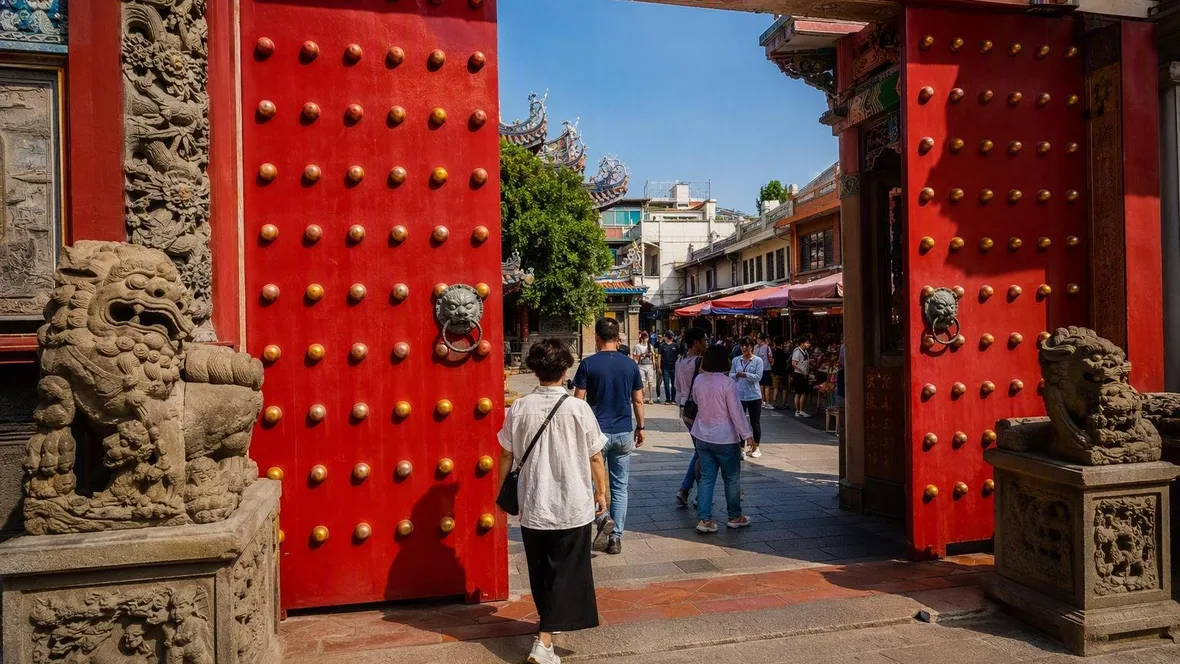
The temple extends behind its forecourt through the Sanchuan Hall, courtyards and a worship hall to its main and rear halls. Its red entrance doors carry 72 metal studs rather than painted door guardians, a feature associated with palaces and official temples. A large gilded Mazu stands inside with Thousand-Mile Eye and Wind-Following Ear.
Unmarried worshippers also pray here to Yue Lao, the marriage god, and ask for the red thread that links future partners. On Mazu’s birthday, the twenty-third day of the third lunar month, the Fucheng Mazu procession brings divine images from different neighbourhoods together. On ordinary days, people pass from the temple forecourt into lanes of errands, meals and offerings.
Nearby, the Official God of War Temple adds a merchant’s concern to this religious map. Guandi represented loyalty, and traders also revered him as a god of commerce and bookkeeping. In a former capital shaped by shipping and administration, moral authority and reliable accounts could share one altar.
Rice bowls along Guohua Street
West of the temples, Guohua Street and Yongle Market gather small counters and food stalls. Shops fill Yongle Market’s ground floor, while homes sit directly above them. Food shopping, cooking and domestic life occupy the same building.
Fushenghao specialises in wanguo, a steamed rice pudding served in its bowl. Cooks soak aged zailai rice, grind it and steam it over lean pork, minced meat and shrimp, then add a sauce thickened with sweet-potato starch. Rice, pork and seafood meet in one compact morning meal.
At Jinde Spring Rolls, a lightly fried wrapper holds cabbage, tofu, egg, pork, shrimp, jack bean, coriander and garlic. Peanut-and-sugar powder adds sweetness, and customers can choose how much goes in. Asong Gua Bao serves steamed buns with pork tongue or lean pork, pickled vegetables and peanut sauce, plus clear broth.
Han’s stall makes oil rice with sticky rice, shiitake mushrooms, black pork, squid and dried shrimp, seasoned with soy sauce, Sichuan pepper and liquorice. The bowl uses dried seafood and spices that suit a port-city market, but it remains everyday food. A few streets away, coffin bread turns a fried, hollowed thick slice of bread into a shell for creamy filling. The snack emerged in the post-war Shakariba and Kangle market district, where baking and cream-sauce techniques became a low-cost street food.
Practicalities: Chihkan Tower, the Grand Mazu Temple, Guohua Street, Yongle Market, Shuixian Market and Shennong Street form a compact walk through the old centre. Small portions make sense here, since the food is spread among individual stalls rather than gathered in one food hall.
The water gods inside the market
Shuixian Temple now stands between Shuixian and Yongle markets, but it once faced Nanshi Harbour in Tainan’s Qing-era network of five canals. Shipping merchants worshipped its five water gods. In 1741, three major trading guilds established their Sanyi Hall office at the temple. Worship, trade and business organisation occupied one address.
The harbour disappeared, but commerce stayed around the temple. Bakers gathered in the district to serve workers and make ritual foods. A bakery beside Shuixian Temple still produces everyday biscuits alongside New Year cakes and offerings for gods and ancestors, including red tortoise cakes and peach-shaped longevity pastries.
Some foods move between altar and shopping bag. Fengpian began as an offering and is now also bought as a market snack. Before Lunar New Year, shoppers come to Shuixian Market for prepared dishes, fresh ingredients, festive food and religious supplies.
Pujidian Temple gives the connection a physical form. The Huang family presses sweet sticky rice into a six-part wooden mould to make mi-gao-zhan, a cake documented as an offering during the Japanese period. During pudu rites for wandering spirits, tall structures of these cakes stand before temples. People sometimes wait through the night until one is opened for eating. The same cake is also sold as a daily snack.
Shennong Street follows the old harbour
Shennong Street was once Beishi Street, the commercial heart of the Five Canals district. After the harbour silted up and a new waterway shifted trade during Japanese rule, many Qing- and Japanese-period buildings remained along the street.
The street measures only four metres across. At number 76, a long former trading house retains brick side walls, Chinese-fir beams, red Minnan roof tiles and roof openings that bring daylight inside. The building later stored joss paper before returning to commercial use. Its fabric records the changing work of the neighbourhood.
Shennong Street runs past former merchant houses, current shops and Jinhuafu, an 1874 temple for Guandi and the kings Ma and Li. The old harbour no longer carries cargo, but small traders still use its narrow plots and street-facing rooms.
Five women at the southern edge
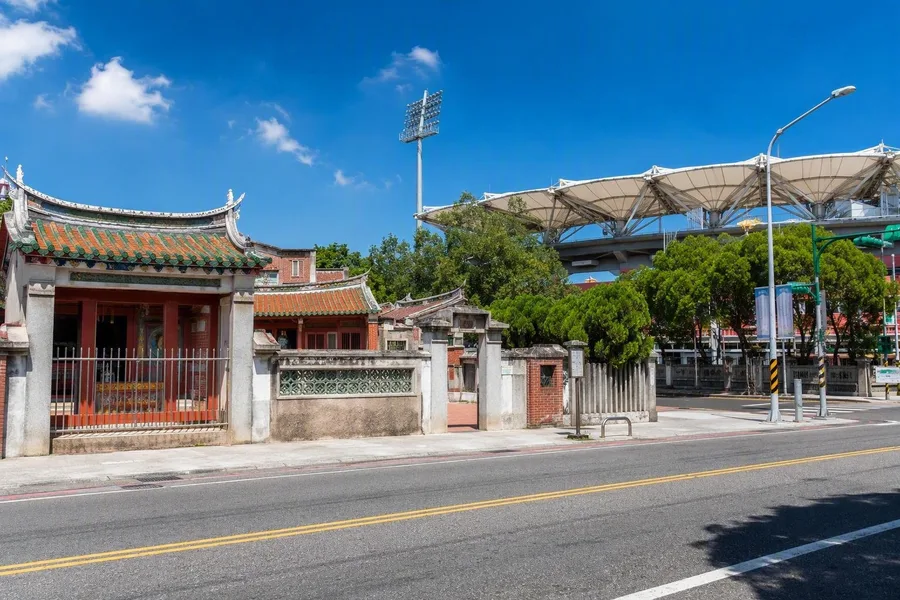 The low Temple of the Five Concubines stands opposite Tainan’s baseball stadium.
South of the busiest food streets, the Temple of the Five Concubines preserves a more intimate account of the Zheng era. Five concubines of Prince Ningjing died in 1683 as Qing power closed in. The prince buried them and then took his own life. The single-courtyard complex became both tomb and temple, with two side wings and a smaller shrine for two servants who also died.
Shops and snack businesses continue nearby, with a baseball stadium opposite. Across the road from the stadium, the low tomb-temple holds five women behind its gate.