
Steam, Soy Milk and the First Open Doors in Dadaocheng
In Dadaocheng, the morning starts with rolled dough, hot oil and soy milk. It then moves a few close-set blocks, through Yongle Market and beneath the arcades of Dihua Street, as shopkeepers bring their counters into use.
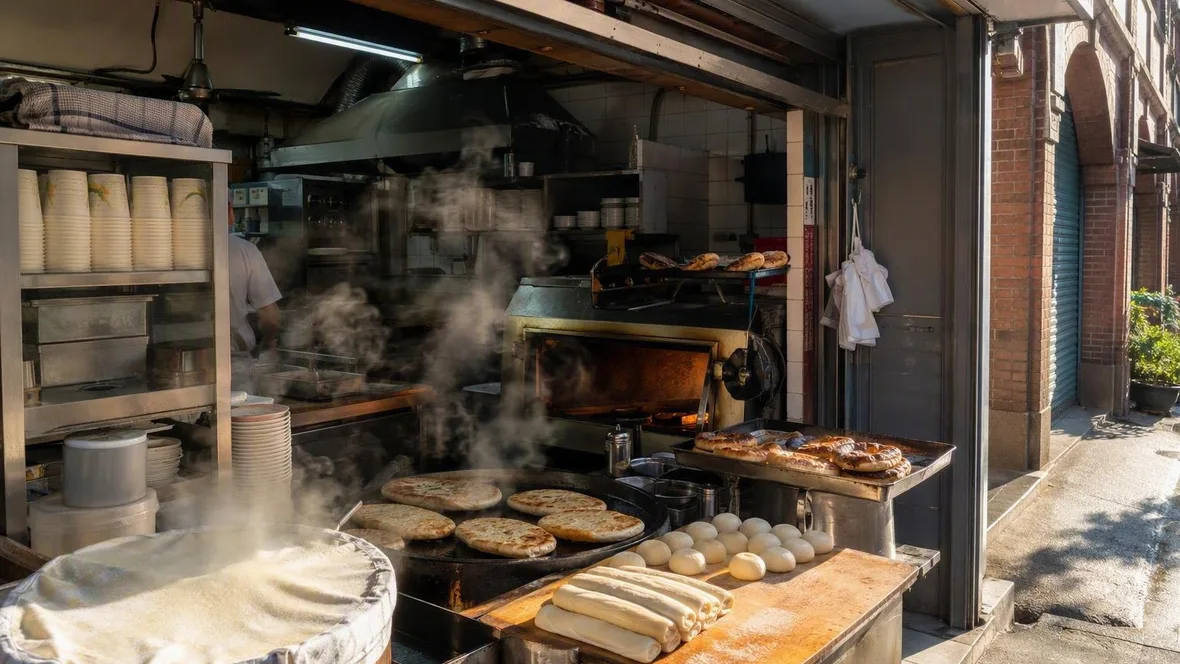
At the corner of Anxi Street and an alley off Dihua Street, Yang Jia Breakfast gives most of its small premises to the kitchen. Soy milk, rice rolls and shaobing are made on site. Fresh shaobing and pepper breads come from the oven.
The first work comes in short, repeated motions. A cook rolls dough by hand. Another length of youtiao drops into hot oil, then comes out crisp and golden. The fried dough slips inside a layered shaobing.
Baked flour, frying oil and warm soy fill this corner of Dadaocheng. The breakfast is plain in the useful sense of the word: hot food, made close to the counter, with nothing extra between the cook and the bowl.
A shaobing holds the youtiao in its flaky layers. Beside it sits soy milk, served sweet or savoury. The savoury version turns the drink into a proper bowl: dried shrimp and pieces of youtiao rest in the hot soy milk, while steam lifts from the pale surface.
Steam marks another breakfast stop near the junction of Dihua Street and Minsheng West Road. Vendors make meat bao with thin dough around a generous meat filling. Freshly steamed buns release visible vapour as they come out, their smooth skins holding in the juices.
These foods give the early streets a practical rhythm. Dough is flattened for the oven. Youtiao is lifted from oil. A steamer opens. The work repeats before the wider market trade has fully begun.
From Anxi Street, Minle Street runs towards Yongle Market. An early fish-noodle shop at Minle 3 stands beside the market, keeping breakfast and the first food stalls within the same small part of Dadaocheng. Dihua Street remains only a turn away, its old shopfronts forming the neighbourhood’s long commercial spine.
Yongle Market, food below and cloth above
Yongle Market shows a red-brick exterior to Dihua Street. The ground floor combines market stalls and places to eat. Fabric merchants fill the floors above.
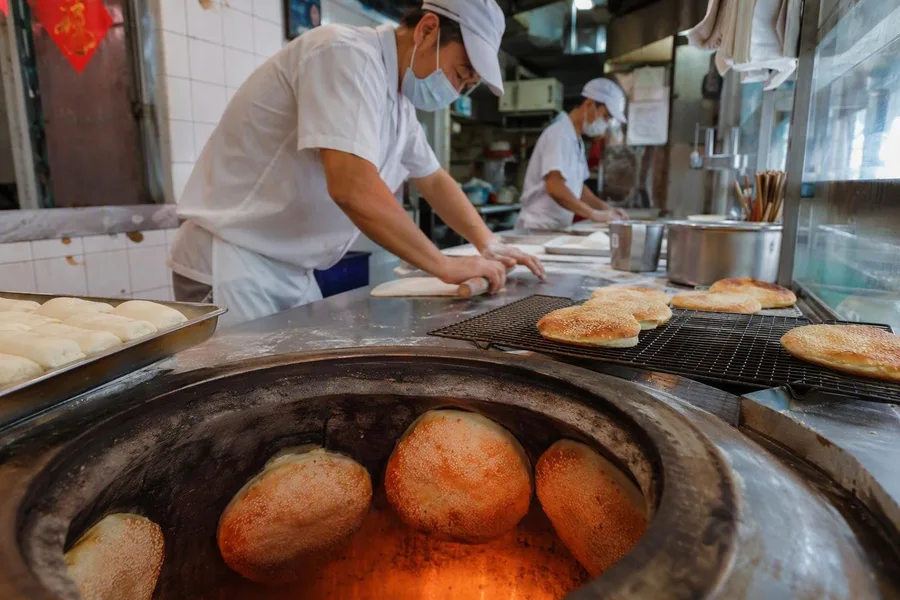 A view of Yongle Market, food below and cloth above.
Downstairs, vegetables, fruit and groceries stand beside prepared food. A vendor weighs sticky rice and usually seals it in a plastic bag. Elsewhere, traders slice raw fish, wrap buns one by one, and make fresh spring rolls with thin handmade wrappers around blanched vegetables, bean sprouts, egg and meat.
A view of Yongle Market, food below and cloth above.
Downstairs, vegetables, fruit and groceries stand beside prepared food. A vendor weighs sticky rice and usually seals it in a plastic bag. Elsewhere, traders slice raw fish, wrap buns one by one, and make fresh spring rolls with thin handmade wrappers around blanched vegetables, bean sprouts, egg and meat.
The counters show work rather than display theatre. A scoop gathers rice. A knife portions fish. Hands fold a wrapper around its filling. Packets pass across the counter in quick, ordinary exchanges.
Bao and mantou are made by hand that day and come out of the oven repeatedly. Stalls often sell them in packs of five, while single buns are wrapped separately. Small carts also operate around the ground-floor food trade early in the day.
The market changes above the stairs. Rolls and bolts of cloth replace produce and cooked rice. Cotton, silk and linen spread across the second and third floors in many colours and patterns. Nearby lanes hold the smaller parts of the same trade: buttons, zips and lace. Tailors on the third floor can turn chosen fabric into curtains or cushions.
The two levels serve different kinds of morning labour. Ground-floor vendors weigh, cut and wrap. Upstairs, merchants measure cloth while tailors prepare to sew.
Practical details: Take Taipei’s green Songshan–Xindian metro line to Beimen Station and use exit 3; the southern end of Dihua Street is a short walk away. Yongle Market’s ground floor normally opens from 08.00 to 16.00 and closes on Mondays. The fabric floors normally open from 09.00 to 18.00 and close on Sundays.
Dihua Street, one counter after another
Outside the market, Dihua Street continues beneath a covered arcade built for rain and sun. Red brick sits beside washed-stone and stucco fronts. Above the shop signs and counters, curved windows, floral reliefs, pilaster-like columns and flat geometric parapets show the different periods in which these buildings went up.
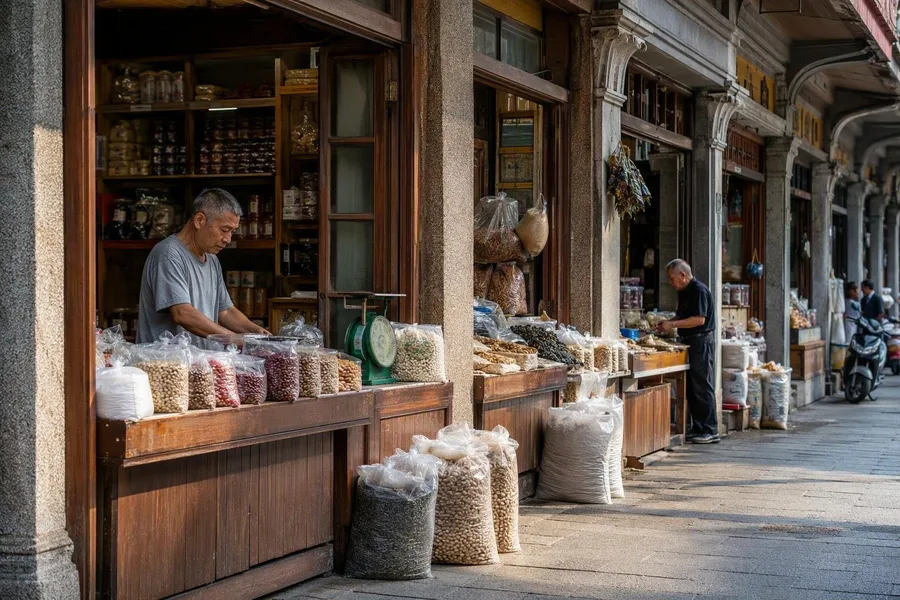 A view of Dihua Street, one counter after another.
The buildings are narrow at the street and deep behind their façades. Shops place their selling space at the front, with workrooms or storage farther inside. Some historic buildings still have wooden pivoting or sliding windows. Older Minnan shopfronts once closed with long interlocking wooden boards: traders removed the boards for business, then fitted them back together at night.
At first daylight, the façades are easier to see than the businesses beneath them. Red brick, arches and carved decoration run along the arcade before every counter has opened. Then the dry-goods trade starts to show itself.
Wholesalers stack jute sacks outside their premises before standard retail hours. Deliveries can begin before seven. Some sacks hold gojiberries. Dried scallops add a dense seafood smell to the dry-goods trade.
Yongle Market has already set food in motion by then. On Dihua Street, dry-goods and herbal businesses open first, followed by textile shops, then cafés, bookshops and design stores. The street does not change all at once. Each open front adds another counter, another rack, another reason for a passer-by to stop.
Under the arcade, the scale stays close. Columns divide the view. Shop counters sit a few steps apart. Above them, red brick and ornamental plaster hold their ground over a working street.
By mid-morning, the ground floor of Yongle Market is weighing rice and wrapping buns. Fabric merchants upstairs pull colour through the building in bolts of cotton, silk and linen. Along Dihua Street, sacks stand by dry-goods shops and open counters line the arcade, while hands carry, cut, weigh, wrap and sell.